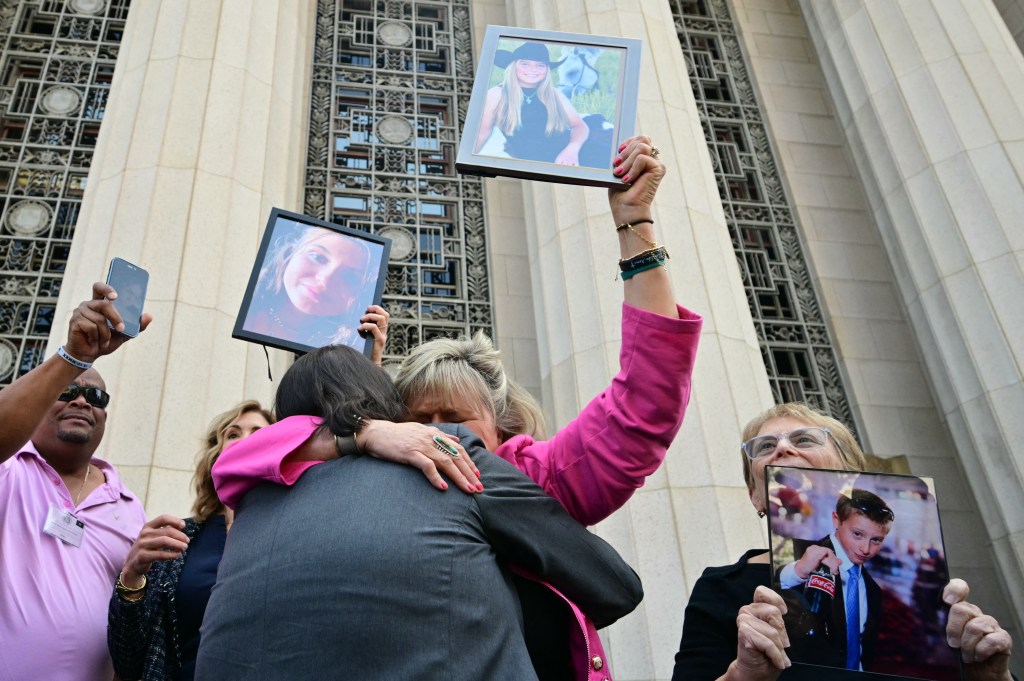
For many psychologists, the evidence that social media harms children’s mental and even physical development is becoming clearer. Mitch Prinstein, a psychologist at the University of North Carolina, Chapel Hill, who studies the effects of social media on youth, told TMD that sustained social media use has tangible effects on brain development and mental health.
In surveys, more than half of children report at least one symptom of dependency on social media, and online communities and aggressive recommendation algorithms don’t just push people to spend too much time scrolling, or toward products they might buy; they also push vulnerable people toward dangerous content and communities—pro-anorexia, self-harm, or worse—that they otherwise would not have encountered.
Setting aside specific content, even the underlying design of social media platforms—receiving quantifiable feedback on how “liked” you and your recent post are—can be harmful. “Kids who are engaging in social comparison or trying to get more likes and feedback, that seems to be worse than just direct messaging,” Prinstein said, noting that active engagement with the mechanisms of liking and commenting was more likely to lead to exposure to harmful content.
Beyond the psychological risks, some research indicates that spending too much time on social media may weaken certain parts of the developing brain. A recent study by scientists at the University of California, San Francisco, imaged the brains of 7,614 adolescents and found that heavy social media use was associated with lower thickness in brain regions, such as the prefrontal cortex, that help regulate attention and impulse control.
This is the largest cross-sectional brain-imaging study on social media specifically, but it’s not the first to identify cortical associations. That said, earlier research linking social media use to brain structural changes has produced inconsistent findings, the effect sizes in this specific study were modest, and it didn’t establish that social media caused the observed differences: Adolescents with thinner cortices could also be more drawn to social media. As Prinstein noted, neuroimaging research on social media and brain development covers only a few years of adolescence; no data yet show that any observed cortical differences persist into adulthood.
There’s little debate that social media platforms can present devastating harms for individual users, but the wider debate over the effect of social media on children—and whether it is the primary driver of a generation-wide mental health crisis—is far from settled.
“With a jury trial, you have individuals who really don’t know the science,” Christopher Ferguson, a psychologist at Stetson University, told TMD. “They’re responding emotionally to the situation. … The juries have heard over and over and over again, in news media and from politicians, just how dangerous social media is. There’s this kind of moral panic going on.”
Ferguson said the link between general social media usage and worse mental health outcomes is not particularly robust. “We actually have difficulty finding clear correlations between time spent on social media and youth mental health,” he said. While some studies show a small overall negative effect of social media on youth mental health, others show no effect, or even minor benefits. “If you add them all together, you get zero,” Ferguson told TMD.
Youth suicide rates and eating-disorder diagnoses have risen substantially since the late 2000s, roughly coinciding with the mass adoption of smartphones and social media. But, as Ferguson found in a time-series study, suicide rates also rose among adults who aren’t heavy social media users, and other factors—family instability, the aftermath of the 2008 recession, income inequality—tracked the same timeline. A cross-national study of high-income countries found no population-level association between increases in social media use and youth suicide between 2013 and 2017, while income inequality was a significant predictor.
Social media may be a symptom, not a cause. “Some people definitely overdo things, and that’s true for social media,” Ferguson argued. In the case of K.G.M., he observed, it seemed that she had pre-existing conditions that made her liable to compulsive, disordered behavior of any kind, such as severe abuse at the hands of her parents and being abandoned by her father.
Jacqueline Nesi, a psychologist at Brown University who studies social media and children, told TMD that both sides of the debate make fair points. “How much of a role is [social media] playing in the development and maintenance of mental health symptoms, in the population of kids,” is an unsettled debate, she noted. “But I do not actually think there is much disagreement on the fact that there are features of these platforms that can be harmful to kids … where individual [people’s] use of social media has been a substantial factor in exacerbating their mental health symptoms.”
That distinction—between harmful platform design and harmful content—became central to the legal strategy in both cases. By focusing on the design of user interfaces rather than the content promoted on different social media platforms, the plaintiffs’ lawyers were able to sidestep federal speech protections. Section 230, enacted with the 1996 Communications Decency Act, exempts social media and internet companies from liability for what their users post.
“We’re not faulting them for having bad stuff on their platform,” Matthew Bergman, a lawyer and the founder of the Social Media Victims Law Center, told TMD. “We’re faulting them for designing an algorithm that foists that on kids when they don’t want to see it, and they’re not looking for it.”
But some observers worry that the current push for limiting children’s access to social media could threaten free speech more broadly. Jenna Leventoff, a senior policy counsel at the American Civil Liberties Union, declined to comment specifically on the recent verdicts, but she told TMD, “You don’t magically obtain First Amendment rights when you turn a certain age; everyone has First Amendment rights, including youth.”
Leventoff argued that laws requiring users to turn over personal information, like age or identity verification, could give the government undue power over what information citizens can access. “If you had to turn over your ID before looking at some embarrassing information,” she said, “knowing that we live in a world of data breaches and leaks, are you going to be deterred from looking at it?” Various online safety restrictions have also proven rather porous. Millions of Australian teens are still using social media platforms through various workarounds.
Even so, critics of social media companies hope the lawsuits will spur constructive reforms—not just through incentives, but also through court orders granting injunctive relief. “There’s some simple ones, like no auto-scrolling, or no infinite scroll, no autoplay videos,” Raskin told TMD.
New Mexico Attorney General Raúl Torrez confirmed last week that his state would ask the judge to order “changes to the design features of the platform itself, real age verification, changes to the algorithm, an independent monitor to oversee those changes, and fundamentally a demand that they do business differently in New Mexico.” This, too, would spark a big legal fight, as companies will argue they have a First Amendment right—among others—to design software features.
Even as scientists debate the extent and nature of social media’s harms, governments appear to be moving full speed ahead with reforms and regulations. But for now, the decision to use social media or not still lies with children and their parents.
“Ultimately, the verdict is important for a number of reasons, but it doesn’t change what we know from the science,” Nesi said. “No facts have changed in this verdict. … As a parent, I don’t think this changes what you do with your child.”