Since Donald Trump launched Operation Epic Fury last week, one thing has been clear: The most MAGA of MAGA media are not behind the president.
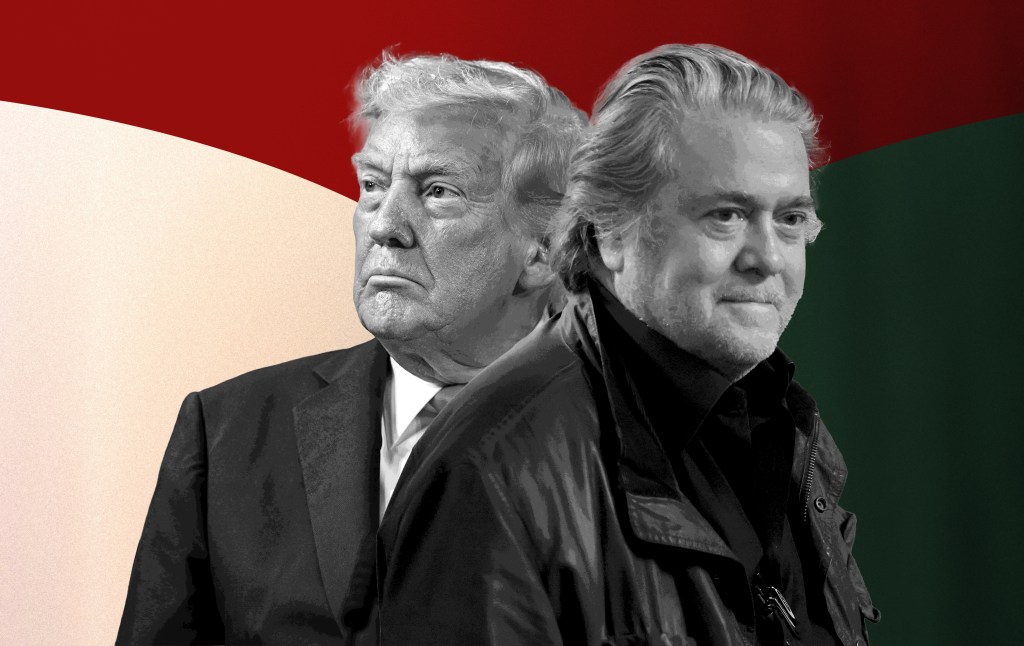
Nowhere else has this been more apparent than on War Room, the live program hosted by Steve Bannon that is part news analysis, part on-air strategy session for the new right. Starting with two days of emergency broadcasts over the weekend, Bannon has been joined by his series of regular guests to provide both neutral military analysis and, increasingly, carefully couched warnings that an extended military operation in Iran would be a terrible mistake.
On March 1 Erik Prince, the founder of military contractor Blackwater and a frequent guest on War Room, shook his head repeatedly while discussing the bombing campaign that had, by that point, decapitated much of the senior leadership of Iran, including Ali Khamenei, the country’s supreme leader for the past 36 years. “I’m not happy about the whole thing,” Prince said. “I don’t think this was in America’s interest. It’s going to uncork a significant can of worms and chaos and destruction in Iran now.”
Bannon, always with an eye toward the MAGA coalition, sounded particularly worried in the same broadcast. “If it’s going to be a hard slog, I mean, that was not pitched in the 2024 campaign. We’re gonna bleed support. We’re just going to bleed support,” he said. Bannon also raised concerns that by “doubling and tripling down with the Persians” and moving military assets out of East Asia, the United States was leaving Taiwan too exposed, and he cautioned that dislodging the current regime in Tehran would not be easy. “This whole apparatus, they’re not Johnny-come-lately. It’s an ancient civilization,” Bannon said. “The folks that run the Islamic Republic are not just bad hombres, they’re tough and smart bad hombres.”
Skepticism to outright opposition has been the dominant view expressed by guests on War Room in the days since the war began. “I’m as MAGA as it gets, we love President Trump, but there’s nothing wrong with wanting more clarity about why we’re standing in a position where—I’m not saying we’ve already put ourselves in a forever war position, but we’re certainly, I think, on the brink,” said the show’s White House correspondent, Natalie Winters, this week. And Brian Glenn, a pro-Trump journalist at Real America’s Voice (the streaming and cable channel that airs War Room) and fiancé of former Rep. Marjorie Taylor Greene, told Bannon he hoped a swift end to the war would allow America to “close the chapter on this whole narrative that we’ve got to stop the Iranian regime from getting a nuclear weapon.”
“Let’s put this to rest, Steve. I’m done with this crap,” Glenn added.
Similar sentiments have been echoed in the past few days by other MAGA media figures such as Megyn Kelly, Tucker Carlson, and Matt Walsh. Criticism from this wing of the pro-Trump movement has focused on everything from a lack of clarity about the mission to the concerns the president is abandoning a core campaign promise to avoid American entanglement in foreign wars. It’s bubbled enough in the online MAGA ecosystem that no less than Karoline Leavitt, the White House press secretary, has responded directly and extensively to some in the coalition who seem to be wavering.
But for the moment, Bannon and his fellow skeptics are hardly representative of conservatives and Trump supporters on the Iran question. Trump appears to have a vast majority of his own voters on his side. A Fox News poll this week found 86 percent of respondents who voted for him in 2024 saying they support the Iran strikes, while an NBC News poll found 77 percent of all Republicans and 90 percent of all self-identified MAGA Republicans saying they support the strikes.
At the more traditional outlets for conservative media, led by Fox News, the coverage and commentary about the war has been largely positive and praiseworthy of the president’s resolve. And for his part, Trump has shot back at some of these critics, specifically Kelly and Carlson. “I think that MAGA is Trump—MAGA’s not the other two,” the president told independent journalist Rachael Bade this week. And in an interview with Jonathan Karl of ABC News on Thursday, Trump put a finer point on it: “Tucker has lost his way…I knew that a long time ago, and he’s not MAGA.”
On any given issue, the most reliable bet on where Republican voters are headed is wherever Trump seems to be going. But there have been notable exceptions, when the opinionmakers of the MAGA-verse have been leading, not lagging, indicators of how Trump’s populist movement was taking matters into its own hands—and leaving the president himself catching up with his own base.
At the end of his first term, for instance, Trump suddenly appeared out of step with his most fervent supporters on the question of vaccines. As Americans began to grapple with a COVID pandemic that went on unabated, the Trump administration launched Operation Warp Speed in May 2020 to join the forces of government and the pharmaceutical industry in order to develop an effective vaccine quickly. By the end of 2020, two of the companies that received grants from the administration, Johnson & Johnson and Moderna, had vaccines in advanced clinical trials.
Before he left the White House, Trump himself took credit for what he called a “monumental national achievement” that “harnessed the full power of government, the genius of American scientists, and the might of American industry to save millions and millions of lives all over the world.” Even afterward, Trump spent significant time encouraging Americans to get vaccinated and reminding them that he backed their development.
But the backlash to vaccines among the most die-hard Trump supporters was seen most acutely within MAGA media coverage, often with Bannon and War Room leading the way by hosting anti-vaccine activists and amplifying unfounded conspiracy theories about them (such as claims that members of the millennial generation were dying at higher numbers than expected thanks to the vaccines). From traditional talk radio to Fox News, suspicion about COVID vaccines became not just commonplace but the default position. It’s no wonder that vaccine hesitancy persisted among Republicans specifically, with Trump looking out of step as he continued to endorse the COVID vaccines.
By the 2024 election, skepticism about vaccines—not just for COVID, but practically every vaccine on the childhood schedule—became a mainstream view within the GOP’s coalition. The country’s most high-profile vaccine critic, Robert F. Kennedy Jr., became a major supporter and coalition partner for Trump’s campaign and now heads Trump’s Department of Health and Human Services. And last year, even Trump seemed to cast doubt on the very COVID vaccines he helped create. The arc of MAGA history is long, but it bends toward conspiracy theories and distrust of institutions.
Could Bannon and others in the MAGA universe be the proverbial canaries in the coal mine warning Trump and his party that the broad support he’s getting for the Iran war from his voters may evaporate quickly? Already, the most natural ally of these anti-interventionist nationalists, Vice President J.D. Vance, is laying down a marker of his initial opposition, laundered in the form of background reporting in New York Times. (“For his part, Mr. Vance, who appeared to personally lean against military attacks, argued that a limited strike was a mistake,” the paper reported this week.) It will be difficult for Trump to dissociate from his own Iran policy if its popularity goes south with the Republican base, but it will be much easier for his heir apparent to take on the true MAGA mantle and announce, more in sorrow than in anger, that a Vance administration will allow true Trumpist foreign policy to flourish.
And so it all depends on so many factors and one chief one: How the actual war goes from here on out. Successful regime change after a week or so of bombing with minimal loss of American life is certainly a possibility, and all the handwringing on War Room and Tucker Carlson’s X feed will be forgotten to history if that’s what transpires.
But a whole range of suboptimal results—a bloody civil war in Iran that leaves the United States in a worse position in the region, say, or a restoration and continuation of the Islamic Republic under new and just-as-recalcitrant leadership, or perhaps a drawn-out military campaign that requires more use of American military personnel, weapons, and materiel than Trump had ever anticipated, or even small-scale terrorist attacks on Americans at home or abroad—risks discrediting Trump on this issue with his party’s base.
If so, the MAGA skeptics won’t look like outliers within their own movement. They’ll just have been ahead of the curve.