It is the lumps and trials
That tell us whether we shall be known
And whether our fate can be exemplary, like a star.
All the rest is waiting
For a letter that never arrives,
Day after day, the exasperation
Until finally you have ripped it open not knowing what it is,
The two envelope halves lying on a plate.
The message was wise, and seemingly
Dictated a long time ago.
Its truth is timeless, but its time has still
Not arrived, telling of danger, and the mostly limited
Steps that can be taken against danger.
John Ashbery
“The One Thing That Can Save America”
1975
A little more than 2,000 years on and Christianity is still trying to scrub off its residual paganism—Presbyterians, to take one example, are usually pretty good on the idolatry front, but open up the Trinity Hymnal and there’s still a lot of sky-god stuff in there, in part reflecting the pre-Christian environment that shaped Christian rhetoric and the Christian literary sensibility but also in part because words such as “sky” and “above” are really useful if you’re writing rhyming verse. (Christian composers are really lucky that the Holy Spirit took the form of a dove rather than a buzzard or an orange.) Go back into the roots of Greek and zeus just means sky (or day or to shine), and if you Italianize the Greek for sky father just a little bit, then you can see how zeus-pater ended up Iuppiter, or Jupiter as we style the sky-father in modern English. The jealous tribal deity of the Hebrews, the sky-father of the ancients, the increasingly abstract divinity of the modern Christo-Aristotelians—God, being outside of time, has no history. But our idea of God has a history, and it begins with looking up to where the light comes from—or where the light seems to come from.
Plato did not have enough biology to understand what he ultimately was describing with his celebrated allegory of the cave: It was the human skull, within which we live, watching shadows and light as transmitted by a vastly complex electrochemical system that enables such vibrant sensory experience that we are able to forget, most of the time, the terrifying fact that each of us is fundamentally alone in the absolutely dark prison of the skull. We are in T.S. Eliot’s solitary confinement:
We think of the key, each in his prison
Thinking of the key, each confirms a prison.
There are those who, wrongly believing that they are engaged in some kind of debunking, point out that Christmas has a great deal in common with such pagan commemorations as the Roman gift-giving festival of Saturnalia (You’re complaining about “re-gifting”? So did Catullus!) or various enduring brumal rites conducted by tree-worshipping Germanic heathens of old, but none of that is news to an educated Christian and would not have been news to an educated Christian of the first millennium, either. They knew what they were doing.
Winter is a time of introspection—and a time of huddling together for warmth—because the exterior darkness exemplifies the interior darkness (“each in his prison”) and that other darkness that we must all give a stray thought to from time to time, when, however fixed we may feel our faith to be at other times, we fear that the darkness may be final. There is a reason the evergreen was adopted as a Christian symbol after a long career as a heathen totem—there is ancient wisdom in the observations of Yuletide, when those poor, cold, huddled masses dwelling up in the same frosty neighborhood where Santa Claus makes his home were desperate to see a little light. We sometimes convince ourselves that we know more about that ancient pagan world than did the people who were living in it—but again, they knew what they were doing.
And perhaps God knew what he was doing, too, with His first recorded words: “Let there be light.”
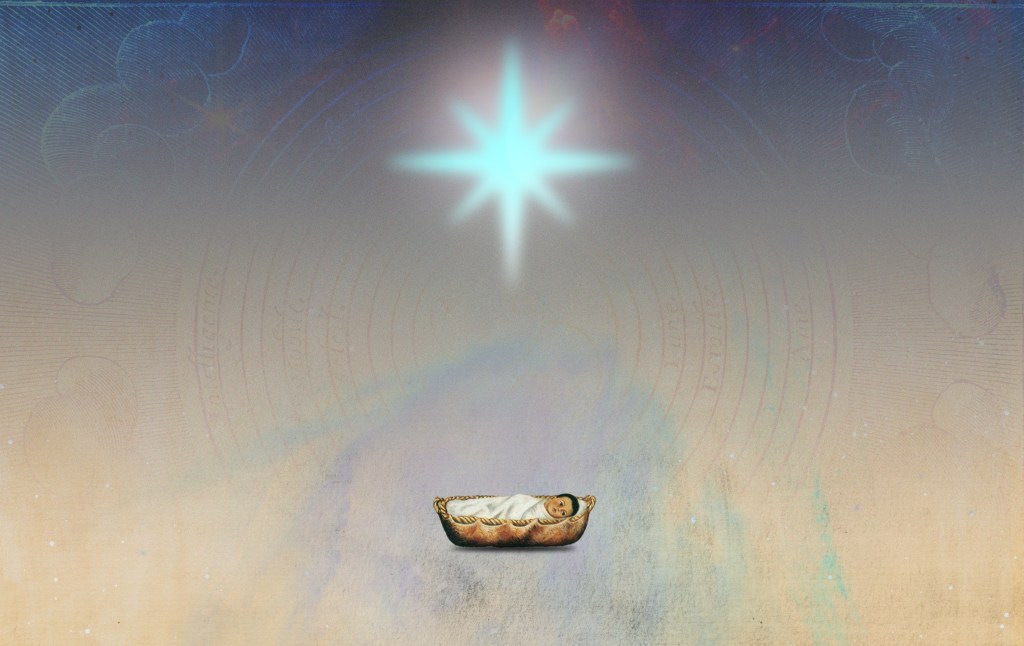
The poet John Ashbery wrote of a “star one is not sure of having seen as darkness resumes.” I like to read the Gospels with the assumption that these things happened and that the people in the stories were not insane, at least not insane beyond what the text concedes. (John the Baptist is one of my favorite characters in all the Bible, and he sure seems more than a little bit nuts to me.) Surely the Magi, the “wise men from the east” we read about in the Gospel according to Matthew, must have been unsure of what they were seeing and of what they had seen, following that “star one is not sure of having seen as darkness resumes.” Herod, full of power and menace, was keen to hear their story and to know about that star.
The star is the perfect symbol (and we must have symbols, being unable to deal directly) of the God of the Theologians—cold and remote, keeping some distance, pointing the way insistently but equally inscrutably. The God of the Theologians is silent. He spoke to others, out there in the darkness, in the deserts and in the mountains and from that burning bush, but, for us, He must be distant and untouchable—that “perfect light” toward which we hope we are being guided. He must be a star—the idea is, of course, much older than Christianity. And, that being the case, in the cosmology of old, an unexpected and unexplained heavenly phenomenon was a serious thing, always a portent of some kind and usually one of danger. Indeed, our wise men still keep track of such things, paying close attention to sundry asteroids and the path of the comet 3I/ATLAS. (Atlas, who holds up the heavens—yet more sky-god stuff.)
But it was not starlight the wise men were after, and the scene they encountered was not sterile or cool. (The night may have been cold—that is not the same thing.) Presumably, the scene at the birth of Our Lord was a lot like the scene of any other birth, one involving a good deal of blood and filth—and pain and fear and danger. They probably arrived some time after the event, but there would have been, one assumes, some evidence—and memory.
What they found in Bethlehem was not a star but the opposite of a star—a newborn child, warm and vulnerable and hungry and needing to be held and cared for. Christianity does not break any new ground there, either: A few thousand miles away from the scene, Krishna had already been worshipped in the form of a divine child for centuries at least, and very probably for more than centuries. But it seems to me that there is a kind of dialectic at work there: star and child, the unreachable and the embraceable, the cold and remote God of the Theologians and Emmanuel, God Who Is with Us.
And perhaps the Magi knew what they were doing, too. The gifts they brought for the newborn Christ suggest that these “three kings,” as the song calls them, knew, somehow, the outlines of His coming career. The first greets Jesus as a king:
Born a King on Bethlehem’s plain,
Gold I bring to crown him again,
King forever, ceasing never,
Over us all to reign.
The second recognizes Jesus in His complicated role as both priest and object of priestly devotion:
Frankincense to offer have I;
Incense owns a Deity nigh;
Prayer and praising, voices raising,
Worshiping God on high.
God on high, yes. But also God right here, Emmanuel, right in front of your eyes, to make sure that you get the message of the Good News.
And the third? The Good News is not always obviously good:
Myrrh is mine; its bitter perfume
breathes a life of gathering gloom;
sorrowing, sighing, bleeding, dying,
sealed in the stone-cold tomb.
Stipulate a real mother, a real father, and a real child. Stipulate that none of these people is insane. Mary and Joseph already have an idea of the divine nature of their son, but here come the Magi with something new to share with them: The first thing they need to know about their child, snuggled up and nursing contentedly and the most beautiful thing they have ever seen in this world, is that He is going to die.
And it is not going to be a quiet, natural death in bed as a happy grandfather. Jesus Himself, as a grown man with some strength and experience, prayed that this would not be true. “If it be possible, let this cup pass from me.”
It is not nothing for a man to give up his life. But I would rather be an ordinary man giving up his life in an ordinary way than to be Mary watching what was done to her son. I would rather be an ordinary man giving up his life in an ordinary way than to be Mary knowing, even in the possibly vague way she knew, what was coming. Joseph, who died before Jesus began His public ministry, had the easier part of it, as fathers so often do. We remember him as Joseph the Worker, who got up in the morning and went to work to labor and provide for his family—an ordinary kind of service and sacrifice that complemented and supplemented and made possible the extraordinary things foretold by the gifts of the Magi. Joseph was the recipient of one great mercy: This isn’t really his story—look at Gerard van Honthorst’s Adoration of the Child (c. 1620) and Joseph is barely there, already fading from the scene. There was no such mercy for Mary, whose part in all this was not mysterious stars and their perfect light but blood and pain: Hers at first and later—and indescribably worse—her son’s.
The story begins in starlight. But there is absolutely darkness waiting, too.
We are talking chimney logistics—again. My older boy is three, and his belief in Santa Claus is unquestioned and unshakeable, and that is how I like it. He knows that the man in the red suit at the mall is not the real deal, but this does not diminish his faith in the jolly old elf. We read “A Visit from St. Nicholas,” and he is curious about why Santa has different names in different contexts.
But he is also curious about why our chimney cannot be seen from outside the house—he has looked for it. We have a gas fireplace. I assure him that Santa is, among other things, the undisputed master of descending through chimneys, and I remind him that Santa has already visited him on previous Christmas missions with no problems. There will be milk and cookies left out, and my little man may put on his chef’s hat and oversee the baking of these cookies as his three little brothers, who are not quite old enough to comprehend Santa just yet, look on with the rapt adoration they reserve for their big brother when they are not actively plotting against him.
As C.S. Lewis describes so beautifully in The Great Divorce, it is all too easy to make an idol of one’s children, and one can easily understand why child-worship was—and remains—a real thing in the world, whether it be formal or unacknowledged or some mix of the two. And what is child worship if not the dark twin of child sacrifice? When I tell my little man the story of Jesus’ birth, he is very concerned about such details as whether Jesus would eventually have a bed of His own. I love that boy for many reasons, and one of them is that he reminds me, from time to time, that there isn’t anything that is truly trivial. I assure him that Jesus, being a carpenter in a family of carpenters, probably had a rather good bed, at least by the standards of the time and place.
It may be the writer’s overestimation of the importance of language, but it seems to me that my older boy, whose command of English is that of a child several years older, is already more like me than like his three little brothers, who have been saying individual words for a while and are just now beginning to put two or three together. They are still more like the child in the manger—by which I do not mean godlike, of course, but if we take seriously the Christian doctrine that Jesus was fully man as well as fully God, then He must have been a lot like these little ones at first.
It is easy to see how people can go so wrong in their relations with their children, especially babies. Whatever the Holy Spirit may be whispering into those little ears, we fathers and mothers (especially mothers) are in effect the gods of their little cosmos, and, because we are not godlike, being god has its ups and downs. The ups are probably the more dangerous of the two: Who does not enjoy being adored the way only a little baby can adore? Who doesn’t want that to last—to be the ordinary, permanent state of affairs?
Of course, it would be unbearable, in much the same way as C.S. Lewis imagines that a marriage would be unbearable if it entailed the intensity of new love for years and decades. But who doesn’t secretly want that, anyway? You look down and see a little face that looks a lot like your face, and that little face is full of love, and right here, inches away from your face—when in life might a man feel less alone?
In truth, we can have that—and do have that, and much more than we can comprehend with our little minds and even smaller hearts: What else is Emmanuel if not that? Emmanuel in truth is neither light nor love, these being only very imperfect approximations that have the convenient quality of being available to human experience, but if we can talk about this in the ordinary way with the ordinary metaphors, then Emmanuel is something like love incomprehensible and something near to perfect light, invisible to us for the same reason we cannot really see sunlight, knowing it only by its effects and its reflection, even as we have spent many thousands of years studying every distant cold remote speck of light in the night sky, seeking portents and meaning in their relations, in their movements, in their waxing and waning. When 3I/ATLAS seemed to move in ways that raised the possibility (never very seriously, as I understand it) that it was something other than a natural object, we turned again to the question: Are we alone in the universe? Plato had an answer for that, the experience of our everyday lives offers another, and Emmanuel offers one more—and all of them are true at the same time in different ways. The compass of reality has more than four cardinal points on it.
There is something we call that “perfect light” because we do not have anything else to call it—or didn’t. But God, in His infinite mercy, sometimes makes things obvious enough even for me, a truth so plain and bloody and awful that it cannot be made tame by my ordinary means of overthinking, by my rationalization, by my abstracting, or by the secret litany of my real secret faith, the one that is always there whatever sincere professions I may make in the way of Christian orthodoxy:
What Precisely
And If and Perhaps and But.
Some people get nervous holding a baby. Some like nothing better. There is a kind of fearful wisdom in both—to hold a baby is to hold an entire world in your arms. The child is a complete creation. The child offers us nothing to interpret, even as we pause by the door before entering the manger, worried that we are intruding on an intimate domestic scene, having followed that peculiar star for our own peculiar reasons. A child: No perfect light. No burning bush. No miracles and resurrections—that is for later. Here, in the little bit of light surrounded by all that darkness: a newborn child. Nothing you have not seen before—and, all the more significant: nothing you have not been before.
In the Good Friday service, the congregation traditionally reads the words of the mob: We mock Him, we denounce Him, we demand His crucifixion. “Give us Barrabas!” It is good and wise that we learn to see ourselves in that crowd. We are made of the same stuff they were. But we are also told to come to the throne as little children—can you see yourself there in the manger, too? Down here in the dirt with the rest of us madcap theologians? “Unto us a Son is given,” and Emmanuel is here, “bringing many sons to glory.” There is your message and your scripture, your prophecy and your theology, your Alpha and your Omega, maybe crying, maybe contented, in His mother’s arms. The star had served its purpose, and so had the wisdom of the wise men. They traveled and traveled and walked right off the map, far beyond the borders of prudence or reasonableness or even wisdom and into the uncharted and dangerous territory of the thing itself, reality beyond symbolism or exegesis or interpretation.
“When they were come into the house, they saw the young child with Mary his mother, and fell down, and worshipped him.” In the presence of that flesh and blood, those wise men forgot all about the star and its possibly metaphorical light—and forgot all about their wisdom, too. Unto us a Son is given. In the city of David, in this place at this time, Emmanuel here and now. Many sons to glory. Not a riddle or a symbol or an omen but a child.
“And this shall be a sign unto you.”