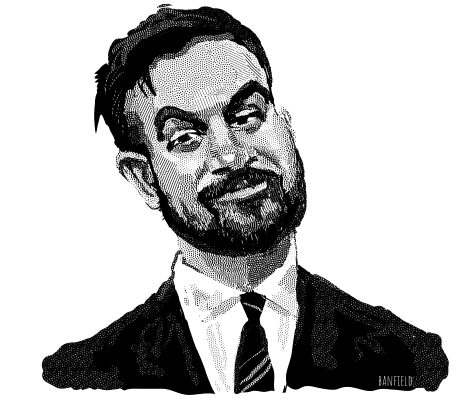
“Ana minkum wa ileikum,” shouted 34-year-old Zohran Mamdani, newly elected mayor of New York, to the heaving crowd in Brooklyn’s Paramount Theater just before midnight on Election Night. I’m one of you!
What did he mean by that? Mamdani, after all, can come off as almost comically foreign. Look at the way he waves as he walks to the podium. He doesn’t swing his arm like a regular American. He doesn’t even wiggle his hand, as the late queen did. He frantically flaps his fingertips against his thumbs, the way kindergarteners do when they are pretending to listen to an imaginary friend. There’s something a bit “off” about Mamdani, like those German spies in old movies who, despite their perfect English, give themselves away by not knowing who won the last World Series. Or like Barack Obama, who proclaimed his affection for the Chicago White Sox and then proved unable to name a single player who’d ever taken the field for them. (Mamdani fends off baseball questions, such as whether he’s a Yankees or a Mets fan, by professing himself a fan of English soccer.)
There is a difference between running for president and running for mayor. In a city that is 36% foreign-born, being foreign is a plus. And like Obama growing up in Hawaii, knowing no black people but struggling, as the age demanded, toward a black identity, Mamdani has actively crafted an outsider image. Born in Uganda, the son of the Columbia professor of postcolonial studies Mahmood Mamdani and the Indian film director Mira Nair (she directed the Disney film Queen of Katwe), Mamdani arrived in the United States at age seven from South Africa, where his father had been teaching for years. Before entering politics, he had a brief career as a rap artist under the name “Young Cardamom.”
But radical politics was always his overriding interest. Mamdani is the product of Bronx Science, an elite public high school where admission requires competitive exams, and Bowdoin, which was among the wokest handful of colleges in the country during his time there. He found his mentors in the street-savvy Democratic Socialists of America (where he was close to Bernie Sanders and New York State Representative Alexandria Ocasio-Cortez) and the city’s Muslim Democratic Club (which pursues its own kind of left-wing politics). He rallied a base of immigrants, Muslims, women, and gays. And armed with a gift for invective, he has ridden out against Donald Trump and his policy of tight borders and swift deportations. “Hear me, President Trump, when I say this,” Mamdani shouted toward the end of his victory speech. “To get to any of us, you will have to get through all of us.” President Trump, perhaps realizing such a confrontation could do him more harm than good, deferred the prospect for a bit by inviting Mamdani to the White House for an affable conversation on the Friday before Thanksgiving.
A Brand-New City
Thus far, Mamdani has had extraordinary good fortune. With the Democratic Party in disarray last winter, former New York governor Andrew Cuomo looked like he could easily take the party’s nomination away from the scandal-tarred incumbent, the black ex-cop and later Trump ally Eric Adams. Cuomo, it’s true, had resigned the governorship under a cloud of sexual-harassment allegations in 2021. But his followers figured such peccadillos would matter less in the big city. What they hadn’t reckoned with was the way the city’s electorate had changed.
Compare it to the situation in 1993, when Republican Rudy Giuliani swept into the mayor’s office. His win was a harbinger of the Republicans’ conquest of Congress the following year. Giuliani was aided by a conservative Catholic (and heavily Italian) bloc of about a fifth of the electorate that today has mostly, in one way or another, departed. More broadly, Giuliani got three-quarters of the white vote in a city that was 43%—and is now just 31%—non-Hispanic white. And that ethnic category now contains different people. The voters that political scientists describe as “progressive new class”—gays, workers in the non-profit sector, people in high tech—have risen from not much more than a tenth of the city to about a quarter. It may now be unwinnable for a Republican.
And in fact, when the dust cleared on the Democratic Party primary on June 24, the city had proved unwinnable even for an old-fashioned Democrat. Under a newly rolled-out “ranked choice” voting system, Mamdani won the nomination outright, with no need for a runoff. He and his advisors were as shocked as anybody: they had not even written a victory speech.
The race was not over, though. Cuomo re-entered as an independent and sought (in vain) to push marginal Republican nominee Curtis Sliwa out of the race. Cuomo had hoped to win with the strategy that the independent billionaire Michael Bloomberg pioneered when he became mayor in the aftermath of September 11, 2001—collaborating with the city’s business elites to finance a mammoth, if mercenary, ground operation. Cuomo had done something similar in his 2018 governor’s race and got all he could out of the strategy this time. In fact, he made an impressive showing: he got 100,000 more votes than Adams had in his winning bid four years ago.
A brand-new electorate was revealed in November. The 350,000 Muslims eligible to vote, whose turnout percentages had barely scraped into the double digits in the past, were galvanized by Mamdani’s frequent attacks on Israel, and went to the polls in droves. The city’s Jews, still a mighty force in Democratic Party politics but no longer a hegemonic vote bank, gave Mamdani only a third of their votes, with Cuomo picking up the other two-thirds. Hakeem Jeffries, the House minority leader, whose Brooklyn congressional district is a Nantucket-shaped patchwork of historically black and historically Jewish districts, pointed out that Mamdani’s support was weakest among older blacks and Latinos living in ungentrified areas. Perhaps Jeffries was seeking a non-Israel-related pretext for withholding his endorsement from a fellow Democrat more in tune with his party’s waxing hostility to the Jewish state. Other top Democrats, including senators Charles Schumer and Kirsten Gillibrand, withheld their endorsements, but Jeffries will likely face a primary next year from a Mamdani-aligned candidate, and in October, he belatedly jumped on the bandwagon. Anyway, Jeffries had a point: it was the transmogrified young population of New York that put Mamdani over the top. Mamdani won 82% of women under 30.
Democratic Socialists of America
Mamdani is a gifted politician. His voice is rich, powerful, and pleasing. He never mumbles. He—or whoever writes for him—has a rhetorician’s feel for what used to be called “periods.” At a mid-October rally, he assailed “a New York where a hard day’s work isn’t enough to buy you a good night’s rest.” And although his attention to syntax is punctilious, his oratory is never dainty. Mamdani is tough, even brutal, in debate. One on one, he never hesitated to raise the sexual harassment charges that had driven Cuomo from the governorship. When Cuomo asked whether Mamdani had the maturity to stand up to life-or-death challenges like a pandemic, Mamdani reacted with a mix of contempt and braggadocio that was almost Trumpian. “Yeah,” he said. “And if we have a health pandemic, then why would New Yorkers turn back to the governor who sent seniors to their deaths in nursing homes?” (He was alluding to a March 2020 Cuomo directive.) “That’s the kind of experience that’s on offer here today. What I don’t have in experience I make up for in integrity, and what you don’t have in integrity, you could never make up for in experience.”
Mamdani also has political common sense. In the Democratic primary debates last spring, the candidates were asked what would be the first foreign country they’d visit as mayor. Three said they’d visit “the Holy Land,” a way of both affirming their support for Israel and baiting a trap for Mamdani, up till then gripped by the delusion that the New York mayor’s office is a foreign-policy position. Rather than blurt out something radical, he left the bait on the table, saying that the problems his predecessors had left would preclude his leaving New York. He is often deft this way. The consonant sequence “md” being practically non-existent in English, Mamdani’s surname is easy for a lot of people to mispronounce. When Cuomo reversed his consonants in a debate, Mamdani flew into a wounded rage. When Letitia James did the same at a rally in Brooklyn, he let it slide.
Talented though he is, Mamdani the politician is unimaginable without the Democratic Socialists of America (DSA), the organization that in a certain sense produced him, and which shows signs of turning into the main political organization of the American Left. It was founded in 1982 by, among others, Michael Harrington, the Catholic activist whose book The Other America: Poverty in the United States (1962) was beloved of 1960s liberals. Harrington had started as a revolutionary but made his peace with the Great Society welfare state. By the time of his death in 1989, DSA members were beginning to tack back in the opposite direction, toward radicalism. The DSA was headquartered in New York, and its chapter there turned into the largest and strongest, with at least 10,000 of its 90,000 members.
The DSA was sometimes confused with, and overshadowed by, the Working Families Party—a group founded in 1998 with the aim of driving the Democratic Party leftward under the leadership of organized labor. But the 2008 financial crisis scrambled things on the left, greatly to the DSA’s benefit. When progressives sought in the autumn of 2011 to make common cause against the finance industry in the Occupy Wall Street protests, the Working Families Party was lukewarm—a lot of their labor supporters felt they had more to gain by collaborating with Wall Street than by fighting it. The DSA became the place to be for committed leftists. And it moved from one organizing success to another: In 2012, Hurricane Sandy hit New York, and tens of thousands of apartment dwellers, many of them aged and immobile, were stranded without food or electricity. It was a DSA-supported effort that sent young people to climb dozens of stories in elevatorless buildings, carrying food and hurricane lamps. They’d return in election season the following year. In 2016, the DSA rallied behind Bernie Sanders when he ran against Hillary Clinton for the Democratic presidential nomination, which he nearly won. (And perhaps actually did.) In 2018, a young DSA member and veteran of the Sanders campaign, the bartender Alexandria Ocasio-Cortez, primaried an old-time Democratic congressman in Queens and beat him. In 2019, a DSA-led campaign against the opening in New York City of a second headquarters for Amazon.com ended with an unprecedented Amazon retreat, to the frustration of then-governor Cuomo. In 2022, Governor Greg Abbott of Texas bused thousands of new migrants northward, and 220,000 from Texas and elsewhere wound up in New York City. It was DSA that connected them to social and housing services—harking back to the 19th-century Tammany Hall practice of meeting new immigrants on the docks. And in 2025, the DSA revived the old 20th-century style of boots-on-the-ground canvassing that had been normal before the internet and before the Bloomberg-Cuomo rent-a-mob system, anchoring a team of at least 50,000 door-knocking and cold-calling volunteers. As Ocasio-Cortez organizer Michael Carter told a blogger for The Nation, “If you gave the Cuomo campaign a list of 50,000 people who said they wanted to volunteer for them, they wouldn’t know what to do with it.” People liked the DSA’s style of politics better. This may be part of the reason 44% of voters under 30 say they have a positive view of socialism.
The DSA has always been an organizer and a motivator. But it is first and foremost an ideology. Candidates who seek its support must pledge their commitment to various socialist policy positions, along with the isolation of Israel. They’re really not joking about this and can be ruthless with candidates who flout them. Even Ocasio-Cortez, whose views on Israel are not as uncompromising as they once were, has lately been mobbed by iPhone-wielding confrontation-stagers. Although there has been press speculation about whether Mamdani is beholden to the DSA or could break with the group if he had to, the question mostly hasn’t come up. The DSA’s views fit him well. Picking up the group’s agenda has even been a boon, allowing him to organize his campaign around a few policy ideas simple enough for anyone to understand.
Mamdani’s platform, in fact, is only slightly more complicated than the one proposed by the glove-sporting single-issue candidate Jimmy McMillan when he ran for governor in 2010 and for mayor in 2013 as the candidate of the The Rent Is Too Damn High Party. Mamdani’s platform had four big issues: 1) rent freezes, 2) free buses, 3) free childcare, 4) city-run grocery stores. These ideas have been politically effective, but that’s not the same thing as saying they’re good ideas, or even that they’re popular.
Take the rent freeze. The plan, if enacted, will apply—can apply—only to rent-stabilized apartments, which the city can regulate. But a significant proportion of landlords are already losing money on the buildings where the apartments are rent-stabilized. The upshot of such a plan would be either to take rental properties off the market or to pass the foregone rent increases on to unregulated renters, which would eventually have the same effect. But 40% of New Yorkers live in the rent-stabilized units, and that’s enough to win an election with.
Or take those free buses. If you think about it, a free, heated space in a city where the wind chill can get below zero in January is more likely than not to become a rolling homeless shelter. Mamdani wants buses to be not only free but also fast. This can be done only with dedicated traffic lanes, which means slowing down New York’s roadways for everyone else. Hence, the odd response to a September New York Times/Siena poll: a majority like free buses “in theory” but 57% say Mamdani should not introduce them. In other words, his platform isn’t sensible, but it shows his heart is in the right place. Mamdani’s most popular issues, the same poll found, are affordable housing and his character.
Defunding the Police and Israel
There had been a fifth item on the Mamdani to-do list—a plan to replace the police for most purposes with a more social-work-focused “Department of Community Safety.” It has its logic: some of the most disturbing crimes in New York’s public spaces are committed by people who ought to be committed themselves. But this position was a disaster for Mamdani. The city has gotten significantly less secure since the George Floyd riots of 2020. Last year, New York governor Kathy Hochul deployed the National Guard to the subways after four people were murdered there in six weeks. The community-safety idea sounded like a call for defunding the police, and for good reason: that’s what Mamdani is on record as wanting.
In June 2020 he tweeted, “We don’t need an investigation to know that the NYPD is racist, anti-queer & a major threat to public safety. What we need is to #DefundTheNYPD.” Shortly before election day he apologized for it. Although questioning the queer-friendliness of policemen sounds like a laugh line from a Lenny Bruce routine, Mamdani is always earnest when he uses words like “queer,” “fascist,” and “Islamophobic” (his favorite description for Andrew Cuomo, who probably couldn’t tell an imam from an iPad). Mamdani has posted a photo of himself extending a middle finger to a statue of Christopher Columbus.
Mamdani is hostile to Israel—and this position probably helped him at the polls. He is the first major American candidate to benefit from what looks like an electoral sea change. New York is still the largest Jewish city on the planet. But according to a September New York Times poll, New Yorkers pretty solidly back the Palestinians in their conflict with Israel, by the comfortable margin of 44% to 25%. The partisan differences are sharp: Republicans back Israel by 57% to 12%. Democrats back the Palestinians by 57% to 18%. So are the differences in age. Senior citizens back Israel by 38% to 28%. People under 30 back the Palestinians by 67% to 13%. When you combine youth and Democratic Party affiliation you get the Mamdani vote. Mamdani voters back the Palestinians by 74% to 5%.
Objection to Israel’s ferocious war in Gaza cannot in itself be considered a radical position—not unless you want to tar the vast majority of Democrats, Europeans, and women as radicals. That’s less easy to say about Mamdani’s hostility. Many Muslims are enraged not just at Israel’s conduct but at its existence. It’s hard to tell whether Mamdani is one of these. His particular connection to Islam has not been much examined. His mother is a Hindu. His father is not conspicuously religious.
Palestine is not, as some have argued, the Vietnam of this generation. On most campuses, it does not rile up many students at all. But it does motivate a network of activists on the left and for many of them it is the primary political commitment. Mamdani appears to belong to the more flammable part of this group. Though he has spoken out against anti-Semitism, he is categorically anti-Zionist—he does not believe Israel has a right to exist as a Jewish state. He has believed since his Bowdoin days that Israel ought to be boycotted and sanctioned. And these commitments are intertwined, albeit confusingly, with his ideas of how to run New York City. In September 2023, he told a panel discussion, “We have to make clear that when the boot of the NYPD is on your neck, it’s been laced by the IDF [Israel Defense Forces].”
Weeks after that, when the Hamas attacks on October 7, 2023 left more than a thousand Israelis dead, the DSA took a firm stand—on the side of Hamas. At 7:09 on the evening of the attacks, the DSA’s International Committee urged its members to “stand with the people of Palestine.” Minutes later, the New York City chapter, Mamdani’s chapter, called a rally to support Palestine the following day. While mourning the loss of life, they also complained in a press release “that some have chosen to focus on a rally while ignoring the root causes of violence in the region, the far-right Netanyahu government’s escalating human rights violations and explicitly genocidal rhetoric, and the dehumanization of the Palestinian people.” Days later, Mamdani himself was arrested at a pro-Palestinian protest outside the house of New York senator Charles Schumer. A month later, two dozen DSA members—mostly older, many Jewish, and many of them members since its 1982 founding—resigned from the organization, on the grounds that the positions it had taken on Gaza “lack basic human empathy and solidarity.”
There was a certain way the world used to run at the high tide of globalization. A pair of portentous events at the start of the century—the Iraq war (2003) and the finance crisis (2008)—set a critical mass of Republicans to thinking that the system was untenable. Democrats kept their faith in the system for a while longer. But now another pair of portentous events—the George Floyd riots (2020) and Israel’s Gaza war (2023-25)—have set them to thinking, too. People have long said that the Democratic Party would have to reinvent itself for a more populist age. What that reinvention will look like is now a bit clearer.