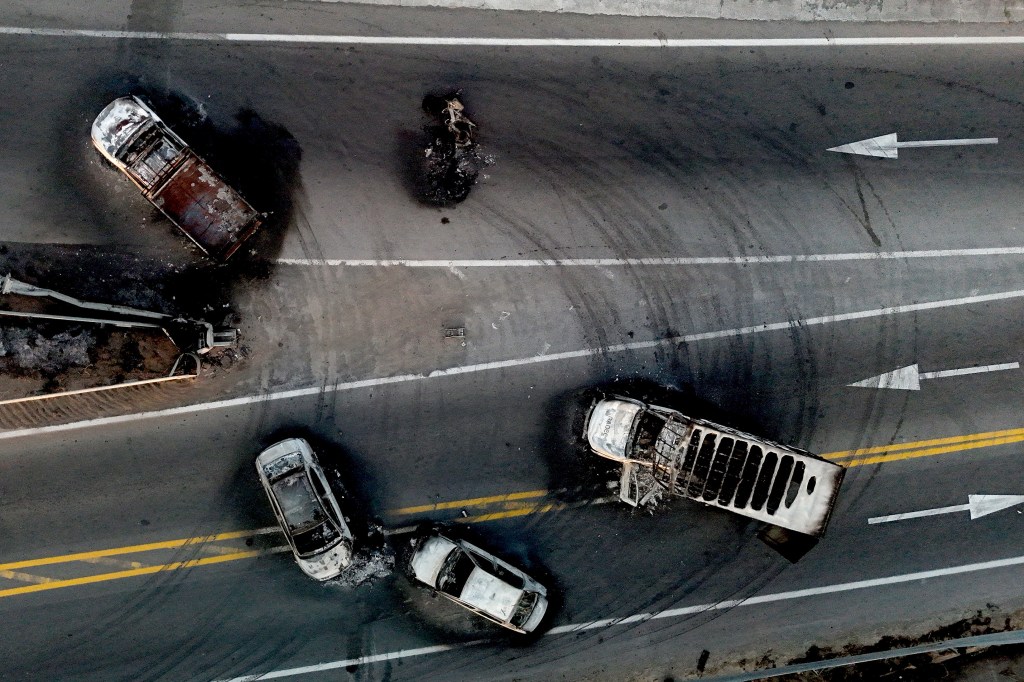
Nemesio Rubén Oseguera Cervantes, popularly known as “El Mencho” and the leader of the Jalisco New Generation Cartel (CJNG), was killed in an operation on Sunday conducted by Mexican security forces. Following the 2016 arrest and eventual extradition to the U.S. of Joaquín “El Chapo” Guzmán, El Mencho was the most wanted drug trafficker still operating freely in Mexico, with a $15 million U.S. bounty on his head. His death is being hailed in Washington and Mexico City as a landmark victory in the war against drug cartels.
While leaders in both countries have reason to celebrate, they also have reasons to fret. In addition to an ongoing wave of violence and disruption unleashed by CJNG in retaliation for El Mencho’s death, the two pillars of Mexico’s cartel duopoly—CJNG and the rival Sinaloa Cartel—are simultaneously leaderless for the first time in the modern drug war, with no clear historical model for what comes next.
Who was El Mencho?
Born in 1966 in the avocado country of Michoacán state’s Tierra Caliente, Oseguera dropped out of school after the fifth grade and illegally migrated to California in his teens. His first known brush with the law came in 1986, when he was arrested for possession of stolen property. After being deported from the U.S. following roughly three years in prison for other criminal charges, he took the unusual step of enrolling as a municipal police officer in rural Jalisco state. A TV Azteca assessment later concluded that he was endeavoring to learn the vulnerabilities of Mexican law enforcement from the inside out, knowledge that played a role in his remarkable success in evading capture once he returned to a life of crime.
Oseguera married into the González Valencia family, whose 15 siblings had been involved in marijuana and opium trafficking since the 1970s, and built CJNG into one of the most operationally versatile cartels Mexico had seen. The CJNG is known for combining organizational structuring with unfathomable barbarity: A raid on a crematorium in Teuchitlán in March 2025 uncovered a CJNG operation that lured recruits with job ads offering $200 to $600 a week and then put them through 30 days of combat and dismemberment training in a room called “La Carnicería,” or “the Butcher Shop.” Only 30 of 200 recruits are reported to have survived.
El Mencho was a central but shadowy presence in the CJNG. Every publicly circulated photograph of him was decades old, and he avoided cultivating the popular legend status of some other cartel figures glorified in narcocorridos, ballads about the exploits of drug smugglers. In past years, rivals scrawled messages claiming he had died of kidney failure; one faction split from CJNG in 2022 on the premise that he was already dead. By the time El Mencho died at the hands of Mexico’s armed forces, CJNG operated across 40 countries and nearly every U.S. state, and through roughly 90 sub-organizations.
Tracking a kingpin.
Four armed helicopters and two twin-engine planes descended on a ranch near Tapalpa at approximately 7:20 a.m. Sunday, where evidence of El Mencho’s presence had steadily grown recently. U.S. agencies had tracked medical equipment shipments to treat his chronic kidney failure into the Jalisco mountains; the presence of one of his girlfriends helped confirm his safehouse’s exact location.
The Mexican army engaged El Mencho’s guards in a firefight that lasted approximately three hours, leaving seven CJNG members, including the kingpin, dead. Two CJNG operatives were arrested, including Audias “El Jardinero” Flores-Silva, the cartel’s most powerful non-family operational leader, who oversaw methamphetamine production, cocaine transport, and weapons procurement. He carried a $5 million bounty from the Drug Enforcement Agency (DEA) and was considered a candidate to succeed El Mencho.
The army’s account of the operation warrants some scrutiny. Mexican and U.S. security sources have told journalists the decision that Mencho not be taken alive was made beforehand, but one of the biggest questions after El Mencho’s death is why Mexico’s government preferred a dead cartel leader to one who might talk.
Charitably, it would be reasonable to assume that the Mexican government determined that keeping him alive would risk a potential CJNG rescue operation or extended reprisals as a way of pressuring the government to release him. In 2020, the Mexican government released El Chapo’s son after determining that the price of keeping him in custody was too high, and Mexican President Claudia Sheinbaum may have been hoping to avoid a similarly embarrassing incident.
Viewed more skeptically, the decision could be seen as an attempt to keep El Mencho from revealing dealings and connections between the CJNG and members of Sheinbaum’s political party, Morena.
Personal reasons may have also come into play. Omar García Harfuch, the security secretary who oversaw the operation, had reasons to prefer finality: In 2020, CJNG deployed 25 to 28 gunmen to assassinate him on a Mexico City boulevard with .50-caliber Barretts and fragmentation grenades, firing over 400 rounds and wounding him three times. In a show of defiance, García Harfuch tweeted from the hospital. Six years later he got the opportunity to return the favor, with more successful results.
Why did Mexico act now?
The El Mencho operation was almost certainly the product of a ratcheting pressure campaign from the U.S., which has been intensifying pressure on Mexico to take more aggressive action against cartel figures.
The opening salvo came on the first day of the second Trump administration. Executive Order 14157 designated cartels as foreign terrorist organizations and declared a national emergency under the International Emergency Economic Powers Act.
These steps were accompanied by a broad institutional reorientation toward fighting drug cartels. The FBI established a Counter Cartel Coordination Center (C4) to integrate its Criminal Investigation and Counterterrorism divisions, while its approximately 200 Joint Terrorism Task Forces took on cartel-related responsibilities alongside their traditional caseload. FISA Section 702 surveillance, which Congress had already expanded to cover counternarcotics in April 2024, became fully applicable to designated cartel networks, meaning any information connected to the designated groups qualified as “foreign intelligence,” even beyond their narcotics activities. The National Counterterrorism Center also pivoted, adding more than 35,000 cartel-linked identities to the classified terrorist database and standing up a new Interagency Fusion Cell to feed intelligence directly to law enforcement in the field.
On February 1, President Trump signed 25 percent tariffs on most Mexican imports. A phone call between Trump and Sheinbaum resulted in a one-month delay on the tariffs and Mexico’s first security concession, in the form of sending 10,000 Mexican National Guard troops to the border. Later that month, Mexican officials transferred 29 cartel figures facing charges in Mexico to U.S. custody in a single day.
The dispute between the U.S. and Mexico over the administration’s desire for action and Mexican concerns over sovereignty reached a peak in early May when Sheinbaum confirmed that Trump had offered to have the U.S. military “take a leading role” in fighting cartels on Mexican soil. She publicly responded by saying, “Sovereignty cannot be sold,” and Trump shot back, telling reporters Sheinbaum was “so afraid of the cartels she can’t walk.”
Sheinbaum’s defiance masked continued concessions. In August, days after the New York Times reported that Trump had secretly signed a Pentagon directive authorizing the use of military force against cartels, Mexico transferred another 26 people to U.S. custody, including Abigael González Valencia, CJNG’s financial architect and El Mencho’s brother-in-law.
The most recent inflection point came on January 3, 2026, when U.S. forces entered Venezuela and captured President Nicolás Maduro, who was then arraigned in a Manhattan courtroom on drug charges. Buoyed by the successful capture of Maduro, Trump began raising the matter of American troop deployments in calls with Sheinbaum. Trump’s desire for unilateral American military action in Mexico grew even clearer—in an interview on Fox News five days later, he warned that “we’ve knocked out 97 percent of the drugs coming in by water, and we are going to start now hitting land.”
On January 15, the Pentagon launched the Joint Interagency Task Force-Counter Cartel in Tucson, Arizona, under Northern Command. The task force fused military intelligence, the FBI, the CIA, the National Security Agency, the DEA, and Immigration and Customs Enforcement into a single targeting operation modeled on the network-mapping methodology used against al-Qaeda and the Islamic State. Five days later, Mexico delivered a third mass transfer of 37 suspects, for a cumulative total of 92. On February 15, 19 members of SEAL Team 2 arrived at a Mexican naval facility in Campeche to help train Mexican counter-drug forces.
One week later, El Mencho was dead.
What does this mean for the cartels?
For most of the last decade and a half, Mexico’s drug trade has been dominated by a duopoly. In addition to El Mencho’s CJNG, Mexico’s cartel landscape has also been heavily influenced by the older and more established Sinaloa Cartel, which was built by figures like El Chapo Guzmán and Ismael “El Mayo” Zambada.
Between them, the two organizations controlled the vast majority of fentanyl, methamphetamine, and cocaine entering the United States. Their competition was brutal, but the duopoly formed two poles around which alliances, disputes, and territorial arrangements organized themselves.
That structure has been shaken by recent law enforcement action targeting the leadership of both cartels. The Sinaloa Cartel was hit first—in July 2024, El Chapo’s son Joaquín Guzmán López lured Ismael “El Mayo” Zambada to a meeting before incapacitating him and flying them both to U.S. custody in New Mexico on a private plane. This triggered a destructive internal war, pitting two Sinaloa Cartel factions against each other and leaving almost 2,000 dead and another 2,000 missing. U.S. courts gave El Mayo life without parole and hit him with $15 billion in forfeiture, one of the largest in DOJ history. As a result of El Mayo’s capture and the internal fighting, the Sinaloa Cartel is thought to have lost 30 of its 42 trafficking routes.
Only a few weeks before the Tapalpa raid, García Harfuch told reporters: “For many years, Mexico and the United States targeted only one drug trafficker. And what changed? Nothing.”
Every prior cartel disruption in modern Mexican history occurred with at least one top-tier organization intact, providing a grim but real anchor of stability. With El Mencho dead, that condition may no longer hold. CJNG’s own succession crisis is acute, but the picture is more complicated than a pending collapse. The retaliation waged by cartel members itself should give pause to anyone predicting a rapid disintegration or fragmentation: Road blockades from the U.S. border to Puebla and Oaxaca, coordinated across at least 15 states within hours, suggest a high degree of centralization and unit loyalty.
What comes next?
In the best-case scenario, the Mexican government will be able to leverage the unprecedented assistance and focus from the U.S. and permanently shatter the power structures of Mexico’s two largest cartels. In the worst-case scenario, the process of trying to accomplish this may result in a CJNG that is fragmented but not crushed, triggering a new wave of mass violence in Mexico as internal CJNG factions vie for control over the organization and dozens of regional criminal groups consolidate and fight among themselves in an attempt to capitalize on the weakness of the CJNG and the Sinaloa Cartel. The violence that comes from this fighting will be less viral than the initial CJNG retaliation—and harder to stop.
This summer’s World Cup will be the first major test of whether Mexico is capable of imposing a monopoly on violence within its borders. Estadio Akron, located in the same Zapopan municipality where cartel forces killed six National Guard troops on Sunday, is scheduled to host four group-stage matches this summer, including Mexico vs. South Korea on June 18. Soccer’s world governing body, FIFA, will undoubtedly be concerned about whether Jalisco remains a viable location for these matches, and the organization holds unilateral authority to relocate games at its discretion.
Before Sunday, CJNG’s monopoly in Jalisco actually simplified things for Mexican security planners, giving them one actor to deal with who was theoretically capable of enforcing a truce and who had economic incentives to keep Jalisco calm during the tournament. That logic died with El Mencho. Instead of needing to negotiate only with the CJNG, Mexican authorities may now face a dozen splinter groups, none of which has an incentive to keep the peace and several of which could be actively fighting each other for control.
For the United States, El Mencho’s death is a short-term political gift to the administration. President Trump enters Tuesday’s State of the Union address with a 39 percent approval rating, stinging from a partial Department of Homeland Security shutdown and a Supreme Court ruling that struck down one of his key tariff authorities. The death of El Mencho represents a win for Trump, and he will likely tout it alongside Mexico’s 92 extraditions, the maritime strikes off Venezuela, and declining fentanyl-related deaths.
Whether the discipline visible in Sunday’s CJNG retaliation translates into a coherent succession or the spectacular end of a chapter in Mexico’s long drug wars remains an open question. Given their competing domestic priorities, Sheinbaum and Trump may be hoping for different answers.