The Venn diagram of K–12 choice and student transportation overlaps in a large way. A 2009 survey of parents in Denver and Washington, DC, found that a little more than one-quarter of respondents reported not enrolling their child in the school they preferred due to transportation difficulties.[REF] A 2024 parental survey found that half of American parents who enrolled their children in district schools, all else being equal, would prefer to enroll their children in other types of schools—charter, home, and (especially) private schools.[REF] In addition to enabling new school options, students require new ways to get to schools and other places of learning.
American taxpayers all pay for district yellow-school-bus systems, but the buses run almost exclusively for the benefit of students attending their zoned district school. In recent years, the number of district yellow bus systems passengers has declined even as the need for transportation in a choice-based K–12 education environment has grown. States such as Ohio and Pennsylvania have expanded their yellow bus service to include students attending private schools. Other possible solutions include updating municipal bus systems to better serve students; including transportation as an allowable use under education savings account (ESA) programs; and encouraging the growth of new schools and education vendors and more robust co-location policies modeled after those in New York and Florida.
Make Walking to School Great Again
The image of the little red schoolhouse, with students pleasantly walking to class, holds an enormous nostalgic power. During the 20th century, however, waves of school district consolidations resulted in an increasing number of students attending larger and more distant schools. The move to larger and more distant schools was likely academically counter-productive, as academic evaluations of small school policies have found higher rates of high school graduation and college readiness associated with small school attendance.[REF] The move also made it increasingly less possible for students to walk or bike to school.
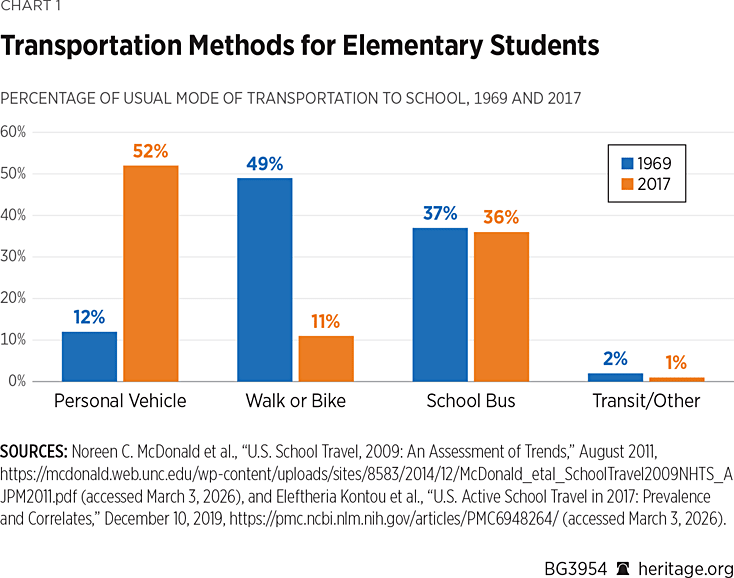
In 1969, 49 percent of elementary students in grades K–8 generally walked or biked to school.[REF] By 2017, the National Household Travel Survey found that only 10.4 percent of students were walking or biking to school.
Data from a 2009 analysis displays the role that distance plays in student transportation methods. Among K–8 students, the overall percentage of students walking or biking to school stood at 13 percent. Among students living within a quarter of a mile of their school, however, 56 percent walked or biked. Among those who lived more than two miles from their school, only 1.7 percent walked or biked.
The country’s first charter school, City Academy in St. Paul, Minnesota, opened its doors in 1992. When it opened, a large number of students, whether the students lived far away or nearby, had the option of attending the school. Some of the students, however, lived close enough to walk or bike to the school. New school creation increases proximate options for families when they open their doors.
Fast forward to 2025 and the United States has 8,150 charter schools.[REF] The conversation around charter school student transportation (understandably) focuses on the exclusion of charter students from district bus systems, despite their status as publicly funded schools. It is also worth noting that every one of the 8,150 charter schools has students living within walking or biking distance. The mere existence of the charter school therefore represents an easy transportation solution for many students.
The United States had an estimated 30,492 private schools—almost four times the number of charter schools.[REF] Cost remains the biggest obstacle to private school attendance, but when choice programs mitigate that concern, private school options open within walking distance of tens of thousands of students.
Microschools represent the latest education innovation that increases education options and geographic proximity. These schools serve an average of 16 students and operate in a variety of spaces, such as homes and places of worship. In a 2017 article in Education Next, Andy Calkins may have made the most prophetic comment of the decade:
It wouldn’t surprise me if, 5 to 10 years from now, everyone looks at this and thinks, “That grew a whole lot faster than I thought it could.” There is a slice of the market that is not being served by public education. They’re saying, “The public schools don’t work, [and] I can’t get into the charter schools.”[REF]
The National Microschooling Center estimates that 95,000 microschools operate in the United States.[REF] From a transportation standpoint, microschools create a great deal of proximity. For some perspective: The United States has approximately 42,000 zip codes.
Other major service providers participating in ESA programs include tutoring centers. Nationwide, the number of tutoring centers tripled between 1997 and 2022 to approximately 10,000—more than triple the number in 1997.[REF] State lawmakers have included colleges and universities as eligible service providers in many ESA programs, and there are nearly 4,000 degree-granting institutions nationwide.[REF]
(Super) Co-Location as a Transportation Solution
One way to accelerate the creation of new schools is to make use of underused district facilities under a more robust version of “co-location” policies.
What Are Co-Location Policies? New York policymakers, due in part to the prohibitively high price of real estate in New York City, pioneered the practice of co-location—in which charter schools operate in underused public school district buildings. The charter school either physically locates in the same building with a district school, or the school district covers the cost of rented space (no physical co-location). From a transportation perspective this represents an appealing policy, as New York City students remain eligible to ride school district buses when attending co-located charter schools.[REF]
In 2017, the Florida legislature created a co-location policy for charter schools known as Schools of Hope, which it has expanded since then.[REF] Florida’s policy focuses on getting highly effective charter schools into areas with low-performing district schools.
The time has come to think more boldly about co-location.
The United States is almost a decade and a half into a baby bust, and underused district space is an abundant resource. The Common Sense Institute in Arizona, for instance, recently estimated that Arizona school districts have sufficient vacant and underused space to accommodate an additional 630,000 students. The mismanagement of district space in Arizona diverts an estimated $1,000,000,000 annual cost from classroom use.[REF]
Moreover, parent surveys reveal very strong demand for private schools and to a lesser extent charter schools, and half of parents surveyed would prefer not to have their children attending a district school.[REF]
Existing co-location policies allow charter schools to sign leases with districts, but theoretically there is no reason a similar statute could not allow private schools or microschools to enter into co-location agreements. Such arrangements would increase the variety of schooling options available to families and could come with a built-in transportation solution (the yellow bus system). Vacant or badly underused district facilities could come back to life by hosting a variety of microschools.
The yellow bus system, however, has serious problems.
The Decline of the Yellow School Bus System
Zip code–based schooling caused huge problems, but it had a silver lining: It simplified student transportation to school. Given the lack of options, a large majority of students attended their zoned district school, and the districts ran bus routes within those districts. The yellow bus system ridership peaked in the 1980s with an estimated 60 percent of public school students transported by bus.[REF]
The ability of districts to perform this straightforward task began to break down over the past decade. In the years before the COVID-19 pandemic, competition for drivers with the license required to drive school buses (a Commercial Driver’s License, CDL) increased with the proliferation of e-commerce and the need for delivery drivers. During the pandemic, demand for these drivers surged.
In September 2021, as schools began to reopen after pandemic shutdowns, the breakdown of the bus system became acute. Students gathered at bus stops only to have no one pick them up. In Massachusetts, the problem became dire enough that Governor Charlie Baker (R) activated the Massachusetts National Guard and began training 250 of its members to transport students.[REF] This deployment represented a wake-up call for a student transportation system with declining ridership and increasing costs.
This problem has persisted past the pandemic era. “The school bus is disappearing. Welcome to the era of the school pickup line” declared The Washington Post in 2024,[REF] noting that most American students now arrived and departed from schools in personal vehicles. Data from the National Transportation Survey, presented in Chart 1, illustrate this conclusion and the decline in ridership carried on past the pandemic. By 2023, only 28 percent of students used the school bus system to get to and from school—down from 36 percent in 2017.[REF]
All taxpayers pay for school district bus systems. Typically, these systems do not serve students who attend any school other than their zoned option—but there are exceptions. Pennsylvania law requires districts to provide transportation to students attending charter and private schools within their boundaries.[REF] Ohio law contains a similar provision, subject to limitations on the additional travel time.
The Ohio and Pennsylvania provisions are just and helpful, and lawmakers should emulate them nationwide, but the struggles of districts to find CDL drivers show no signs of abating. Ninety percent of school districts nationwide reported bus driver shortages in the fall of 2025, and districts employed 7,000 fewer bus drivers than during the pre-pandemic era.[REF] Solutions, discussed below, lie in the expansion of transportation options which do not require drivers with a CDL.
Bellwether Education’s Andrew Rotherham suggested that districts simply exit student transportation entirely, in effect turning the task over to larger authorities like cities and counties:
And it’s not hard to envision a regional solution that integrated transportation to better serve young people (and old people), reduced some inefficiencies, and generally met community needs better. There are some unique aspects of school transportation, especially for little kids and special needs students, but a more comprehensive system could address these, too.[REF]
Education systems that have evolved beyond local monopoly schooling must also evolve beyond district-based monopolies on student transportation. In cities where families routinely cross district lines, cities or counties could coordinate a more rational system of student transportation based on taking smaller groups of students to more destinations.
Removing Federal and State Impediments to Transportation Modernization
Nationwide only 2.2 percent of students used municipal mass transit to get to school in 2017 (latest data available). These students tended to be in large urban centers with extensive transit systems. The Federal Transit Administration regulates public transit systems and has promulgated rules allowing only minimal changes to routes and fares for students and prohibiting routes for transit options exclusively for students and school personnel.[REF]
Congress should repeal these regulations and allow local communities to adjust municipal transit routes to best suit their needs. Repeal could be useful in creating cost-effective solutions for areas with a high amount of school choice. For example, the monthly cost for a 31-day Valley Metro bus-and-light-rail pass in Phoenix, Arizona, for a six-year-old to 18-year-old student was $32 as of this writing.[REF]
Scholars from the University of Minnesota evaluated a Minneapolis program to provide transit passes to high school students, finding reduced truancy, higher grade point averages, and substantial reduction in vehicle miles traveled. In large part this was due to the higher number of bus runs and greater flexibility with the municipal system.[REF]
The Motor Vehicle Safety Act of 1974 prohibits the sale or lease of new 15-passenger vans to local education agencies for student transportation unless they meet all school bus safety standards. The National Highway Traffic Safety Administration (NHTSA) enforces this law by imposing civil penalties of up to $10,000 for a single violation or up to $15,000,000 for a series of violations.[REF]
The kindest way to describe the Motor Vehicle Safety Act of 1974 might be “antiquated.” Currently most students get to and from school in personal vehicles, none of which meet all school bus safety standards. States need more tools in their transportation toolbox than yellow buses to meet the modern challenge. Congress should repeal these provisions to enable states to modernize outdated student transport systems.
In addition, state lawmakers should remove any state-level impediments. In 2022, Arizona’s legislature passed SB 1630, which read in part:
Notwithstanding any other law, a school district or charter school in this state or a privately owned and operated entity that is contracted for compensation with a school district or charter school in this state may use a motor vehicle that is designed to carry at least eleven and not more than fifteen passengers to transport students to or from home or school on a regularly scheduled basis.[REF]
This law exempts passenger vans from counterproductive state regulations, and lawmakers from across the country should emulate it in their states.
Transportation as an Allowable Expense for Education Savings Accounts
While details vary by program, ESA programs in Arizona, Arkansas, Georgia, Indiana, Montana, New Hampshire, North Carolina, South Carolina, Tennessee, Texas, Utah, West Virginia, and Wyoming include student transportation as an allowable expense.[REF]
Alternatively, policymakers could create a stand-alone transportation ESA program available to all students as a keystone of a general modernization of student transport.
Possibly Inevitable, But Not Yet Punctual—Self-Driving Vehicles. Education advocates began writing about the potentially transformative technology of self-driving vehicles over a decade ago.[REF] A decade later this prospect remains tantalizing—especially in a choice-rich environment where smaller numbers of students require transportation to more venues. At the time of this writing, several technological, regulatory, and economic challenges to the widespread adoption of driverless passenger vehicles remain unresolved, although progress is evident. Waymo transports 250,000 passengers weekly in test markets, such as Los Angeles, Phoenix, and San Francisco.
In one of these test markets one of the driverless car companies created a “teen account” for riders ages 14 to 17 to use driverless cars with parental supervision.[REF] At the time of this writing, however, these trips cost more on average than the same trip with a ride-sharing service with a human driver.[REF] Also as of the time of this writing, self-driving vehicles in test markets are just beginning to log highway in addition to surface street miles.
Amara’s law[REF] may apply to self-driving vehicles—people tend to overestimate the short-run impact of technologies while underestimating their long-term impact.[REF] Technologies can simultaneously become less expensive and higher quality, so permissive regulation of the self-driving vehicle industry remains warranted.
The Student Transportation Modernization Menu of Possibilities
State lawmakers should pass robust private choice programs and exempt private schools and microschools from municipal zoning restrictions to encourage new school creation—the more proximity to families the better. These choice programs should be formula funded, should not include any anti-competitive accreditation provisions, and should include transportation as an allowable expense.
State and federal lawmakers should remove impediments to municipal transit systems serving K–12 students and those restricting the use of vans for student transport to and from school. State lawmakers should also explore the possibility of passing co-location statutes to govern the process of leasing vacant and underused district space to charter schools and private schools. Students attending these co-located schools should retain their access to the district bus system.
In states with declining district bus ridership and increased costs, policymakers should consider a full replacement of an antiquated district bus system. In many urban areas, most students attend schools other than their assigned district school. Districts running increasingly underused buses in attendance zones that families increasingly ignore represent a costly anachronism. Policymakers should make the existing school bus systems available to private school and homeschool students, as their parents pay the taxes that support them just like everyone else.
Either municipal or regional authorities could modernize student transportation, if federal authorities removed impediments. Alternatively, state lawmakers could redirect funding from antiquated school bus systems to a statewide student transportation account program that would serve all students.
Matthew Ladner is Senior Advisor for Education Policy Implementation in the Center for Education Policy at The Heritage Foundation.