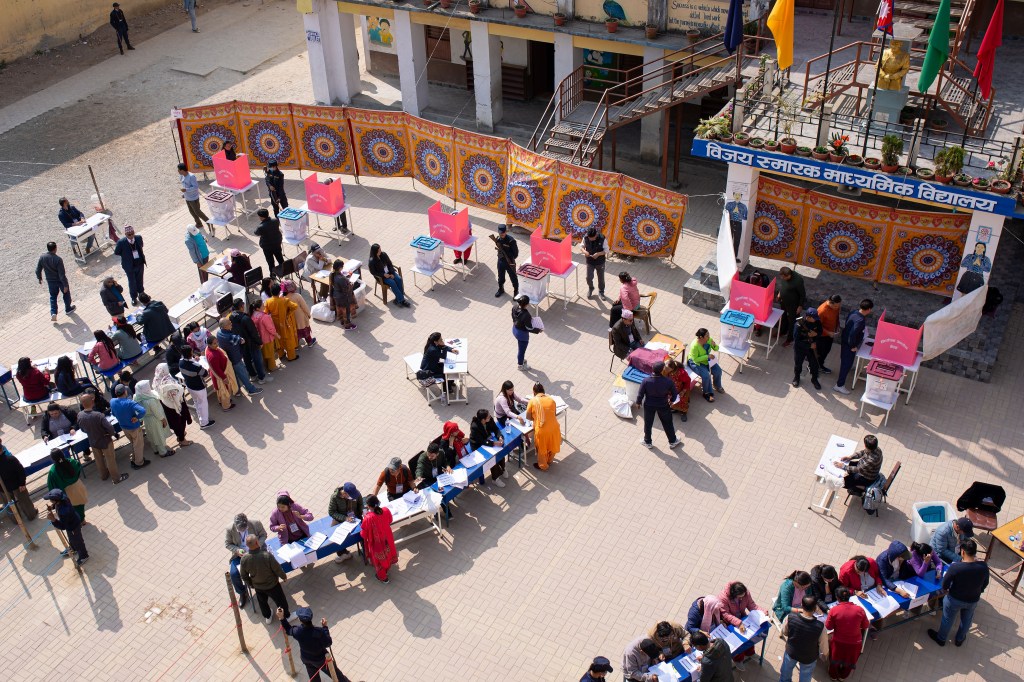
Nepalese officials said that election turnout came in at 58 percent, slightly less than the 61.6 percent turnout of Nepal’s 2022 election. Officials are expecting the final tally to be completed by this evening or Saturday.
Oli’s poor electoral performance shows that, six months after the youth-led protests led him to resign the premiership, voters aren’t craving a return. It was Oli’s government that imposed a rigid social media law, requiring online platforms to register with the government and agree to certain limits. Many companies, including Facebook, YouTube, Instagram, and X, refused and were subsequently banned in the country. Soon, the country had fallen into chaos.
Per Nepali authorities, at least 72 people were killed in the protests, and more than 1,300 have been injured [Note: the injury count was later adjusted up to more than 2,000 and official death count raised to 76]. The government also instituted a curfew, widely ignored, that allowed residents to leave their homes for a few hours a day to buy food and supplies.
…
Along with the parliament building, mobs inflicted damage on the Supreme Court, local police stations, elected leaders’ homes—including those of several former prime ministers—and private businesses. The country’s largest media company, Kantipur Media Group, paused two of its digital publications after fires, set by protesters, destroyed their servers and damaged their offices.
The young Nepalese demonstrators weren’t just lashing out against a government that tried to take away their social media, but also a government that, in their view, condoned corruption and cared only for the elites, the wealthy, and the well-connected. According to data from the World Bank, the country’s real GDP per capita growth was 2.8 percent in 2024, and the lack of economic growth has hit Nepal’s youth particularly hard by constraining the labor market. The unemployment rate for Nepalese workers between 15 and 24 has remained consistently above 20 percent since 2020. Economic discontent spread through social media last year, with many users voicing frustration toward generational wealth, which they saw as perpetuated through government graft, leading to the viralization of nepotism-related posts with the hashtag “#nepokids.”
Nepal’s new government will likely put cleaning up corruption at the top of its priorities, and hopefully last longer in office than most recent Nepalese governments. Even before September’s riots, changes in political leadership were common, with 14 different governments having held ruling power since Nepal’s constitutional monarchy ended in 2008.
Shah, the 35-year-old independent former mayor of Kathmandu and Nepal’s likely next prime minister, had not been affiliated with a political party before this election cycle, and is a relative newcomer to politics. Until 2022—when he was elected mayor of the country’s capital and largest city (his first and only political office)—Shah was a Nepalese rapper, who in 2013 released a song mocking the Nepalese police for harassing youths for having long hair. Shah has always connected with both listeners and voters through social media, and unlike most elected officials, Shah publicly backed the anti-government protests in September, which ultimately took down the national government seated in his city.
In January, he resigned as Kathmandu’s mayor to join the centrist Rastriya Swatantra Party as its prime ministerial candidate. And after polls closed on Thursday, he took to social media to thank the interim government’s leader, Karki. “Under your leadership, democracy has triumphed today,” he wrote in posts shared on platforms including X, Instagram, TikTok, and Facebook.
While mayor, Shah pursued corruption in government, cracked down on tax evaders, and strengthened enforcement of building codes. Shah also went after people he said were illegally taking advantage of public spaces and walkways, including squatters—whom he called “illegal settlers”—and unlicensed street vendors. While his efforts to make sure laws were enforced were broadly popular, human rights advocates have raised alarm about what they identified as rising authoritarian tendencies. In March 2024, human rights advocates wrote an open letter criticizing Shah’s city administration after city police allegedly beat street vendors and destroyed their goods.
On the issue of city-level corruption, Shah “gets the credit for cleaning things up,” David Gellner, professor emeritus at the University of Oxford and former head of its School of Anthropology and Museum Ethnography, told TMD. “The problem about [Shah] is that he’s quite dictatorial. He doesn’t seem to care much about the rule of law,” Gellner explained, noting that he has prioritized enforcement over legal procedure. In August 2022, the city government attempted to demolish an illegally constructed annex built by Norvic International Hospital on public land in Thapathali, only for the Nepalese Supreme Court to intervene, preventing Shah’s administration from dismantling the structures. Shah joked on social media that he wanted to propose a constitutional amendment “to give the Supreme Court all the authority related to approving the building design and taking action against illegal constructions.”
Shah’s active use of social media has not always played well. In November, he posted an expletive-laden screed on Facebook, lashing out at Nepal’s major parties—including the Rastriya Swatantra Party he now leads—and at foreign powers including the U.S., China, and India, concluding: “You Guys all Combined can do nothing.” He deleted it 30 minutes later.
Many of Shah’s supporters support his zeal for weeding out corruption, even if that means cutting some legal corners. “For many youth who are totally frustrated, quite rightly frustrated by bureaucratic stuff and very angry about kind of the ‘nepo babies’ and the flaunting of wealth by these people who’ve got rich through corrupt means, of course, they want quick action,” Gellner said. “They don’t want somebody hide behind procedures all the time.”
Shah and the Rastriya Swatantra Party likely won’t win enough seats to obtain the premiership through an outright parliamentary majority, but appear to be best situated to lead a ruling coalition when the newly elected officials take office. This outcome is hardly uncommon in Nepal, where no single party has won an outright majority since 2008, and coalition governments are the norm.
But this has also contributed to Nepal’s unstable leadership.
Following the 2022 election, Pushpa Kamal Dahal became prime minister through a power-sharing agreement between his Maoist Communist Party, Oli’s Marxist-Leninist Communist Party, the Janamat Party, the Rastriya Prajatantra Party, the Janata Samajbadi Party, the Nagarik Unmukti Party, and the Rastrya Swatantra Party. After 19 months, that government fell apart and Oli succeeded Dahal as prime minister after his party joined forces with the Nepali Congress Party.
Unlike Dahal or Oli, Shah arrives without the baggage of decades in coalition politics—and with what looks like an emphatic popular mandate. RSP’s early lead suggests the party could come close to, or even reach, a parliamentary majority—an outcome with few modern precedents in Nepal. Whether Shah needs coalition partners at all will become clear as final counts come in, but even a near-majority would give him far greater governing leverage than any of his recent predecessors.
“The Gen Z revolutionaries … just want government to work,” Gellner said. “They just want good governance. They want no corruption. They want to be able to get their business done with the government without having to give bribes.”
If Shah forms a government, the question then is whether he can provide the stability and anti-corruption crackdown he’s promised. For the Gen Z protesters who burned down parliament to get here, the answer had better be yes.