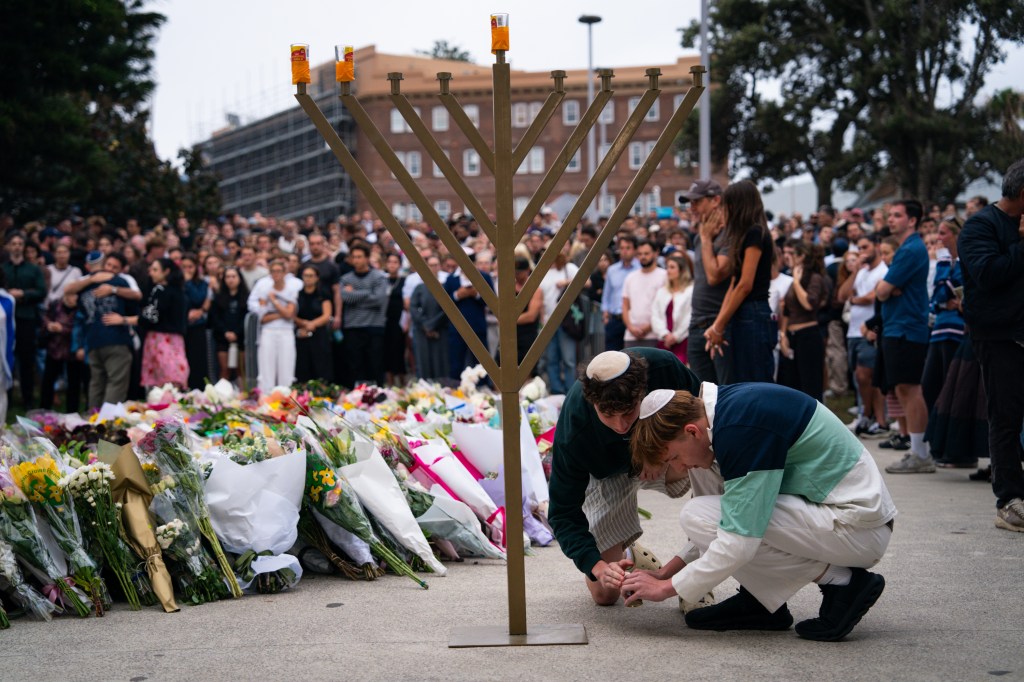
Sixteen people have died as a result of the Bondi Beach attack. No one is surprised by another bout of antisemitic killing, particularly the Jews who have been warning of the dangers of incitement for years. But although we’ve come to expect it, there is still a pervasive lack of understanding regarding the mechanisms of this violence—the “whys” of antisemitism, and the “hows” of its infectious spread.
Australia’s response to the attack will include strengthening laws against hate speech, and that makes sense: Radicalization does not occur in a vacuum. Much of the discourse around the Israeli-Palestinian conflict deliberately operates at the very cusp of antisemitism—close enough to harness its emotional force, yet protected by careful disclaimers. The distinction may matter to those producing or promoting antisemitic content, but it likely does not matter to many of those consuming it. What may in isolation appear as a morally righteous critique is, in practice, circulating in the spaces and trafficking in the tropes of full-blown antisemites, who see it as a validation of their worldview. This ecosystem allows people to enjoy the social rewards of perceived moral purity while their actions stoke the flames of an old and violent hatred.
Indeed, for years, people from all walks of life have thronged the streets and chanted “From the River to the Sea.” It goes without saying that the river is the Jordan and the sea is the Mediterranean, and if all the territory between these two landmarks is “Palestine” then the Jews are, best-case, politically extinguished, and realistically, genocidally driven into the sea. There’s a reason that the October 7 pogrom was known by its perpetrators as “Al-Aqsa Flood,” among other thinly-veiled references to washing my community away.
Still, while many whom I respect disagree with me, I think that criminalizing the River/Sea chant would not be productive. There will always be another phrase to take its place, another way to “globalize the intifada” all the way down to Australia. I don’t feel fear because these offensive and incendiary words are legal—I’m afraid because they’ve gained such widespread acceptance and are seen as proof of a high moral character.
That is the challenge of speaking or writing as a contrarian about the conflict: You’re going up against a prefabricated, just-add-water personal branding tool that has been adopted by millions as a core part of their identity. The symbolism is powerful because it communicates so much. Whether it’s a watermelon emoji, a Palestinian flag or a keffiyeh, you can simultaneously demonstrate your position on domestic politics and foreign affairs, and align yourself with a movement that gives the semblance of seeking change without ever risking being held personally responsible for the actions taken in support of your goals. You can be fully idealistic, rising above gritty local issues with their infuriating trade-offs and needs for compromise, and you can feel the exhilaration of a blindly uncompromising stance. The moral certitude is like a drug. People can’t quit it; when pressed, they double down.
Of course, there are some reputational risks. You could end up like Zohran Mamdani, having to endure answering questions about your views multiple times before being put in charge of one of America’s most populous cities. If you’re a student, you might for the first time face consequences for particularly egregious violations (although these changes have not gone so far as to provide a safe environment for Jewish students).
In general, though, the thing you should be the most afraid of is meeting someone who has studied the history of the conflict. You might be asked about the more than 850,000 Jews expelled from the Arab-controlled regions of the Middle East. You could get tough questions on who would govern a Palestinian state, what civil liberties are protected in areas they control, and why it’s been 20-odd years since anyone in Palestinian politics held an election above the local level. You could even find someone who brings up the extraordinary ethnoreligious diversity of the region and questions why the deeply-entrenched and often violently upheld system of Arab racial supremacy, which has suppressed efforts at self-determination for ethnic minorities (the Kurds being the most persistent and well-justified example) deserves the undying support of Western democratic youth.
Ironically, much of the allure of a pro-Palestinian stance stems from the guilt and shame baked into the modern experience of Western history, and some turn to support for the Palestinian cause as a kind of counterweight to the crimes of colonialism. This is furthered by ahistorical attempts to shoehorn Jewish presence in our own homeland into a colonial narrative, despite the fact that less than half of Israel’s Jews have ancestors who ever lived in Europe, and they certainly didn’t do so as native Europeans. And of course, the demand that Jews move back to Poland, the site of the largest mass extermination we have faced since our expulsion from our own homeland—and more generally, that our safety should continue to be determined by which other nation is in the mood to tolerate our presence—is antisemitic.
But even if one lets the “emigration” of 7.5 million Jews from the Jewish homeland be recast as a feasible or noble cause, well, what’s wrong with being a Jew in America? Land of the free, birthplace of the bagel? Some are still unaware of the vastly disproportionate extent to which American Jews are the victims of hate crimes. Despite making up 2 percent of the population, antisemitic attacks are high, and still rising: Jews are the targeted group in 69 percent of religiously motivated hate crimes and 18 percent of all hate crimes in America.
So what accounts for the recent spike in anti-Jewish acts? If you listen to the voices aligned with the pro-Palestinian camp, they’ll claim no relation to the older stocks of antisemitism and say that if (if!) anyone around them feels a deep and abiding rage toward my community, it’s driven entirely by Jewish or Israeli conduct. Anyone with even a cursory understanding of the history of antisemitism knows that this is not a new angle; such forced naiveté is a blatant attempt to offer ideological cover for antisemites via recycled antisemitic tropes.
As I write this, the death toll ticks up again.
Why doesn’t a place like Sudan, with higher casualties and at least as much colonial responsibility, get the kind of treatment that the Israeli-Palestinian conflict does? One could claim that it’s a case of “no Jews, no news” or that the struggle for control between black Africans and Arabs can’t fit within a colonial narrative built around only white Europeans as colonizers, but the best answer is the smart use of media, technology, and psychology by proponents of the Palestinian national narrative. This mastery of communications also explains why the self-described pro-Palestinian crowd was so silent as Gazans attempted to protest against Hamas.
The first step in this communication strategy is to know your audience: In the Middle East, the message is that Israel is mere months or weeks away from annihilation, that brave fighters will retake the land and reign supreme again, and that the Jews will fall under the weight of their own deceptive, conniving natures. The antisemitism in this local version is much more overt than what Anglophone and European audiences get to see. For the West, the narrative is one of Palestinian innocence, that the Israeli forces are among the gravest human rights offenders of the modern era, and that failure to take action against Israelis (even on an individual level) means complicity in genocide. It’s the jihad narrative for one audience, the victim narrative for another. But if you look closer, you can see where the two start to collide. What else can the Palestinians do to defend themselves, I’ve been asked. When the status quo is so wrong, resistance by any means is justified. Pretty soon, it seems like Osama bin Laden’s manifesto—particularly, its justifications for indiscriminate violence—might have had a point.
Palestinian militant organizations were among the earliest non-state actors to use terrorism as a communication tool, compensating for their weakness in terms of conventional capabilities by forcing the conflict onto the international agenda. From blowing up airplanes to taking (and murdering) hostages at the 1972 Munich Olympics, the attacks were spectacular and brutal, designed for debate and maximum news coverage. Once these had generated a sufficiently high international profile, the Palestinian militias refocused their violence on Israeli and Jewish communities, keeping the compelling nature of the attacks but placing their Western audiences out of harm’s way. These groups have degraded their regional alliances and exhausted the goodwill of the Arab states that once fought alongside them, destroying their chances at a conventional victory. But they have succeeded in exporting the fight to Western societies, and that is a bell which cannot be un-rung.