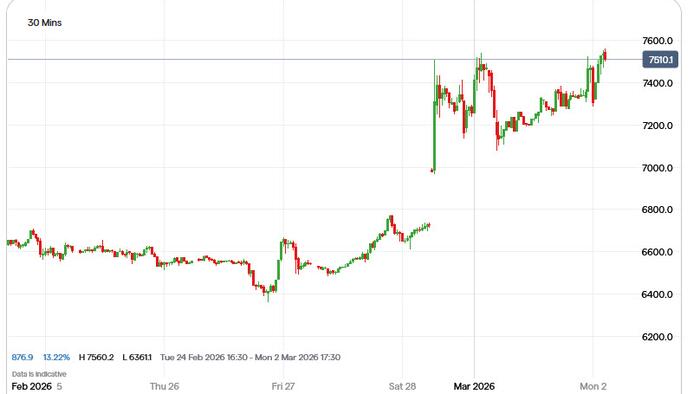
With war in the middle east raging, and the world’s most important oil transit choke point – the Straits of Hormuz which accounts for 20% of daily global oil transit – “effectively” halted after at least three ships were attacked in the vicinity of the waterway – even as Iran’s Foreign Minister Abbas Araghchi told Al Jazeera TV his country has no intention to close the Strait of Hormuz and has kept it open so far, markets have just one question: where does oil open when futures resume trading in a few hours.
Well, we can tell you: according to the IG Weekend Market, an OTC market that reflects prices across over the counter exchanges, oil is set to open more than 10% higher, with spot WTI trading around $75 and Brent set to rise over $80.
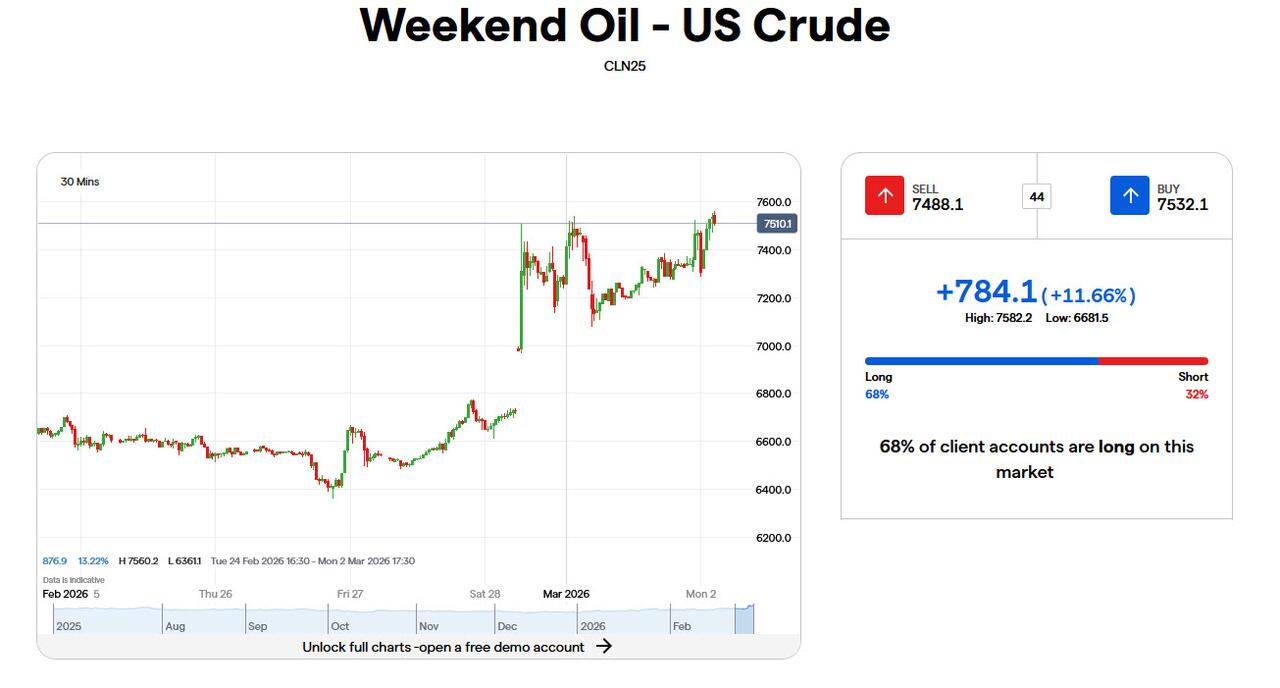
That’s not the question: the question is where does oil trade in a week, a month, a year, and – tied to that – what happens to the oil price curve.
The price spike comes despite OPEC+’s announced modest supply hike. But for such gains will sustain, or extend, investors will need to decide that the conflict is going to drag on. Indeed, this new wave of war is bigger, broader and messier than last June’s fighting. The gap between attacks and retaliation has narrowed: In previous waves it took days, but now it’s hours.
As Bloomberg’s Garfield Reynolds reminds us, during the 2003 invasion of Iraq by US-led forces, crude actually tumbled at the start of hostilities, on speculation the US would achieve a rapid victory. It ended up rebounding from an April trough to enter a long uptrend as it became clearer that there would be no straightforward resolution.
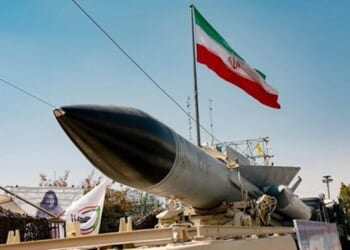
The stakes are higher for oil this time. Iran’s output accounts for more than Iraq’s did in 2003, and Iraq had much less capacity to threaten the Strait of Hormuz. Iran has said it doesn’t plan to close the key shipping channel, but there have already been signs that the conflict is halting tanker traffic.

“Tankers are starting to build by the Strait of Hormuz, but nothing seems to be going through at the moment – tankers are definitely spooked,” said Matt Smith, oil analyst at energy consulting firm Kpler.
That means any lack of clarity on the endgame increases the potential for sustained advances in crude over the coming weeks. Any signs of a prolonged and drawn-out struggle boost the likelihood of crude reaching $80 a barrel and beyond, with Bloomberg Economics outlining a scenario that sees oil spiking above $100 in an extreme disruption scenario.

Sure enough, Middle East leaders have warned Washington that a war on Iran could lead to oil prices jumping to over $100 per barrel, said veteran OPEC analyst Helima Croft from RBC. Analysts from Barclays also said prices could rise to $100.
Other analysts see a more modest jump depending on how the conflict develops. Prices should rise by at least $3 to $5 per barrel when trading starts, said Andy Lipow, president of Lipow Oil Associates.
The worst-case scenario is an attack by Iran on Saudi oil infrastrucure followed by a complete closure of the Strait, Lipow said Sunday. Oil prices would jump by $10 to $20 in this scenario, the analyst said, which he put at a 33% likelihood.
And so, while the world waits to see next steps, it’s buying oil and asking questions later. The attacks already are much wider in scope than last June. Iran’s response already has gone beyond the retaliation it offered in the opening stages of June’s war.
For its part, Bloomberg’s economists thing Iran’s response will continue to escalate. While it can’t match the US’ military superiority, Iran can impose significant costs and seek to bog the US down in the region. Iran’s targets already include US bases in the region and Israel. Tehran could expand to energy infrastructure and regional shipping routes, either directly or through its partners in the region. That includes the Houthis in Yemen, who’ve said they’ll resume their disruption of shipping in regional waters. The possible outcomes are laid out in the chart below.

The price of oil will ultimately be determined by where the war finds its equilibrium point.
In a possible indication that the oil price spike will be brief, Trump said Sunday that Iran wants to talk and he has agreed to do so, leaving open the possibility that there might be a path to de-escalation that avoids a big, prolonged disruption.
“They want to talk, and I have agreed to talk, so I will be talking to them,” Trump told The Atlantic on Sunday. The president told CNBC that U.S. military operations in Iran are “ahead of schedule.”
Loading recommendations…