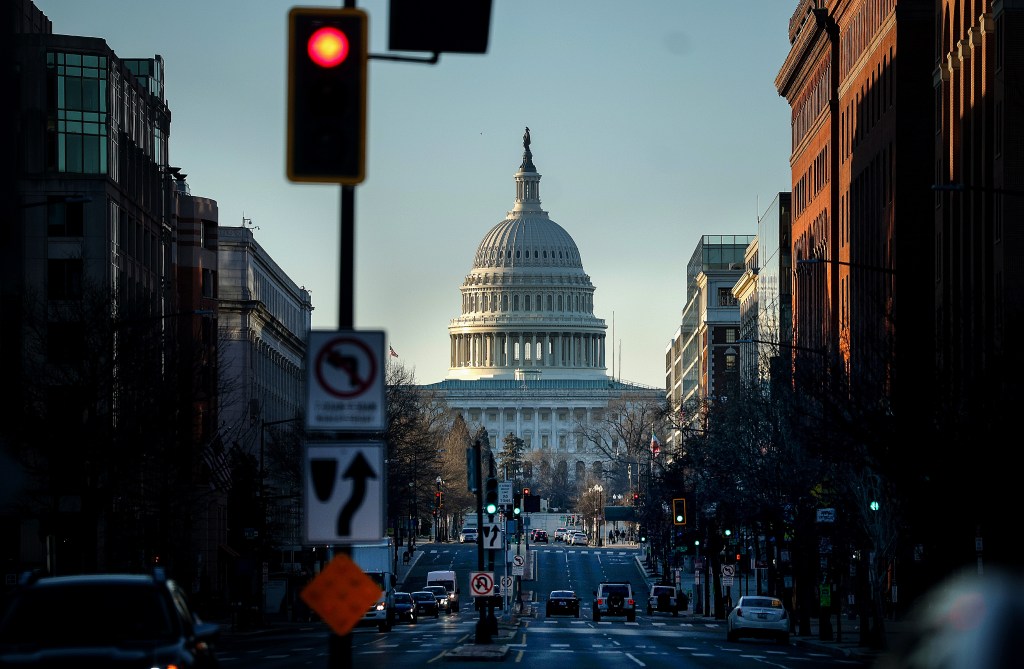
While some DHS employees—including those at the Federal Emergency Management Agency (FEMA)—are furloughed, roughly 120,000 DHS employees are now working without pay, including 61,000 employees of the Transportation Security Administration (TSA), civilian employees at the Coast Guard, and those at the Cybersecurity and Infrastructure Security Agency.
“This is the fourth week I’m working without pay and it’s killing me,” Anthony Riley, a 58-year-old working for TSA, told NBC News on Wednesday. Riley already lost his car during the full government shutdown last year, and said that he currently has no way to drive his wife, who is awaiting a kidney transplant, from Syracuse, New York, to Rochester, should one become available. “Right now, I don’t have any money to move,” he added. “I might be working homeless.”
And yet, with negotiations stalled, it’s still not clear when Congress will pass funding.
By mid-January, it seemed both parties were making progress, and while some Democratic legislators called for limits on immigration enforcement, it didn’t seem headed toward a weekslong DHS shutdown. As TMD reported on January 16:
The thorniest bill for lawmakers has been the one that funds the Department of Homeland Security, including Immigration and Customs Enforcement. The appropriations process—which Congress needs to finish every year and is subject to the Senate’s 60-vote filibuster threshold—is the only place Democrats have real leverage to squeeze concessions out of Republicans, so it is no surprise that they are trying to use that bill to rein in some of the Trump administration’s immigration enforcement practices. The much-covered shooting of Renée Good by an ICE officer in Minneapolis has especially affected those negotiations.
Eight days later, two federal agents shot and killed Pretti, and Democrats concluded they could no longer support DHS funding in the absence of key reforms to immigration enforcement. On January 24, the day Pretti was killed, Democratic Senate Minority Leader Chuck Schumer announced that legislation to fund DHS was “woefully inadequate to rein in the abuses of ICE,” declaring, “I will vote no.”
In the coming weeks, Schumer and House Minority Leader Hakeem Jeffries would detail the specific reforms the Democrats demanded be attached to a funding bill. Their 10-point list included demands that the bill:
- bar federal immigration enforcement operations from conducting “roving patrols”
- restrict how the agency can obtain arrest warrants
- prevent immigration agents from operating in certain “protected areas,” including schools, courts, and medical centers
- bar them from racial profiling (which DHS denies doing)
- require officers to wear body cameras
- and require that they don’t wear face masks.
Congress reached a deal to end the first partial government shutdown on January 29, funding eight departments through the end of the fiscal year—which runs through the end of September—but could not reach an agreement to fund DHS. Instead, Congress passed a bill to temporarily fund DHS for an additional two weeks, though congressional Democrats said at the time that, moving forward, they would only support bills to fund DHS through the end of the fiscal year and include their demands. On February 14, the extension expired, and Congress has been unable to come close to a deal.
Even the removal of Noem as Homeland Security secretary has not broken the impasse. Several Democratic elected officials including Schumer and Jeffries had been calling on President Donald Trump to fire Noem since January. On January 27, Jeffries issued a joint statement with other Democrats saying they would bring impeachment proceedings against Noem if Trump did not remove her from the DHS post.
Trump fired Noem on March 5, announcing she would become special envoy for the newly formed “Shield of Americas,” and that he would nominate Republican Sen. Markwayne Mullin of Oklahoma to replace her.
Republican Senate Majority Leader John Thune suggested at the time that the leadership change could assuage Democrats’ concerns about funding the agency with no new strings attached. “Democrats have been complaining about that forever,” he said on March 5. So this to me is a huge development, I would think, in the funding conversation and hopefully they’ll get more earnest about coming to the table and trying to get a deal.”
But Democrats held fast, with Schumer stating the same day that the problems at DHS extend “beyond any one person,” adding, “The rot there is deep.” Similarly, Jeffries said that Noem’s departure from the agency is “welcome” but “not sufficient,” emphasizing the need for “change in policy.”
It’s not clear when we may see a breakthrough on negotiations or DHS funding. Thomas Kahn, a distinguished faculty fellow at American University’s Center for Congressional and Presidential Studies, noted that the White House’s involvement is further complicating discussions. Kahn worked in Congress for 33 years, including two decades as the House Budget Committee staff director.
“The issue is negotiation with the Trump administration, because it’s the Trump administration that is making the final decision,” Kahn told TMD. “And while I’m sure [Democrats] are interested in the views of congressional Republicans, ultimately, it is the Trump administration that is calling the shots.”
Democrats, “like most Americans, are really offended and shocked by the behavior of ICE, and think there should be some reasonable controls on it,” Khan said. “And I think the Trump administration truly, they are so committed to the concept of mass deportation that they’re moving forward with it.”
At least publicly, negotiations seem to be going nowhere.
“It’s just sort of been stuck in neutral at the moment,” Joshua Huder, a senior fellow at Georgetown University’s Government Affairs Institute, told TMD. “We’re just waiting for the gears to get moving again, at least in public.” But he’s “optimistic that talks may be happening behind the scenes,” noting that both parties are incentivized to hold firm in public, but might quietly be working toward a compromise in the background. “My hope is that they’re kind of sorting this out behind the scenes, where it’s not attracting a lot of political attention or a lot of media attention just yet, but, nonetheless, is kind of moving the parties away from the shutdown so that the agencies that need to be funded get funded.”