Editor’s Note: This is the fourth entry in a new Dispatch series titled “Where I’m From.” Every Saturday, a writer will share a meditation on his or her hometown—a bustling metropolis, distant desert outpost, quiet suburb, or somewhere in between—and what makes it unique. The goal? Highlight voices—and good writing—from every corner of these United States.
The only time I and my fellow trombone players were noticed was during a parade. Because the trombone’s slide extends a good 3 feet beyond the marcher playing it, we marched in the front row to keep from hitting others in the band with our slides. John Philip Sousa’s marches—especially “Washington Post,” “The Thunderer,” and “The Stars and Stripes Forever”—had great trombone parts, and that is what we played every Memorial Day, when the members of the Ossining High School Band put on our heavy uniforms and our white buck shoes and marched and played up and down Main Street and State Street (can you get more Our Town than that?) in the well-attended parade.
It was the late 1950s, a time of peace and unprecedented prosperity. We were perhaps the first teenage generation in the world with our own cars, and to live in a world without serious problems, or so we thought; we had not yet heard of Vietnam. Aside from a general fear of “commies,” politics was relatively benign; even if not every one of our parents liked Ike enough to vote for him, we were mostly fine with our president, and trusted him. We had enough money from various jobs (which were easy to get) to go to the movies, put gas in our cars, hold cigarettes in our mouths, and date. My high school class of 158 kids was half Protestant, 16 percent Italian American Catholic, 15 percent Irish American Catholic, 9 percent Jewish, and 8 percent African American. We understood those distinctions, but they did not seem to play much of a role in our daily experience. There were mean kids and a few bullies, but by and large we pretty much got along. We did not admit, talk about, or perhaps have much awareness of the fact that the black kids lived only in one part of town, down the hill toward the railroad tracks, or that there were rich and poor folks and they too had their own parts of town. The identities that mattered more were whether you were a “jock” or a “brain;” whether you were cute, pretty, or not; and whether you could dance. What animated most of us were sports, music, parties (and the chance to “make out,”), and cars (not a few of the boys could take apart an engine and put it back together during a weekend).
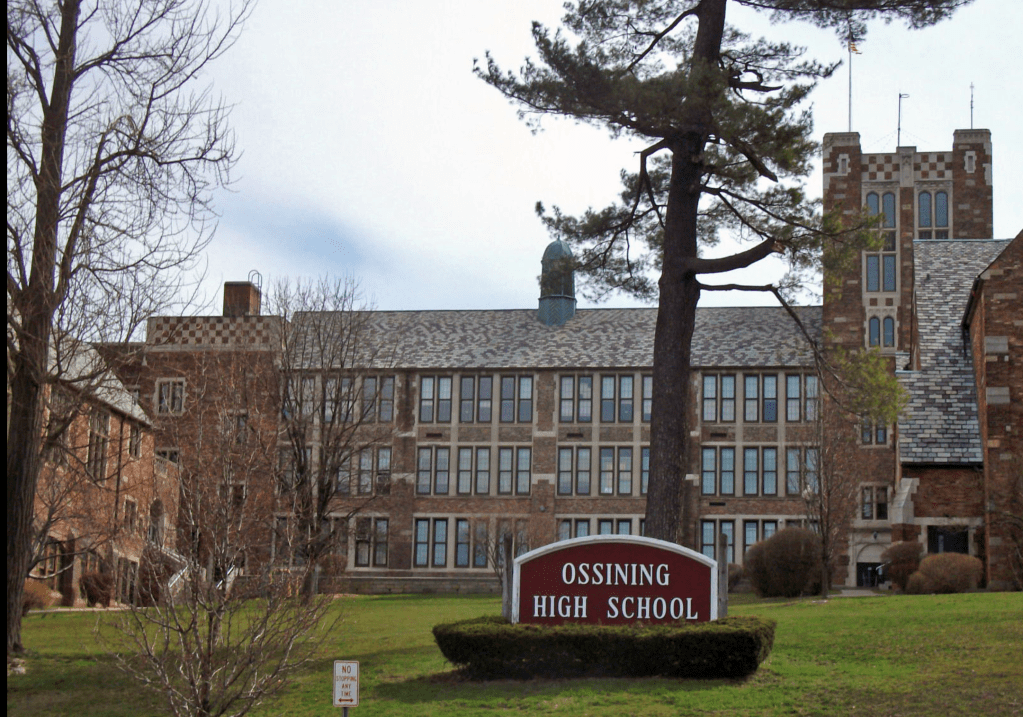
At the same time, we mostly liked going to school and liked the school itself. Perhaps Ossining High School’s Ivy League Gothic style influenced us. Built in 1930, it was designed by James Gamble Rogers, who had designed the Harkness Tower at Yale. Blackboard Jungle was not our world. There were no guns or knives and the closest we got to drugs was an illicit six-pack. While we did not think of the education part as fun, we understood that the purpose was serious and legitimate, to learn history and read books, along with basic skills from typing to how to diagram a sentence, or how to calculate the area of a triangle. There were shop classes for the boys and “home economics” for the girls, where we learned useful things like how to measure a piece of wood, or a quantity of flour in a recipe. Most of us felt teachers were part of a decent and perhaps noble profession—we even had a club, Future Teachers of America, and many in our class became teachers. It was assumed, again perhaps semi-consciously, that some of us were going to go to college, and others were not. But that distinction, too, was not a heavy one—those of us who went to college, I think, did not believe we were “better” than those who did not.
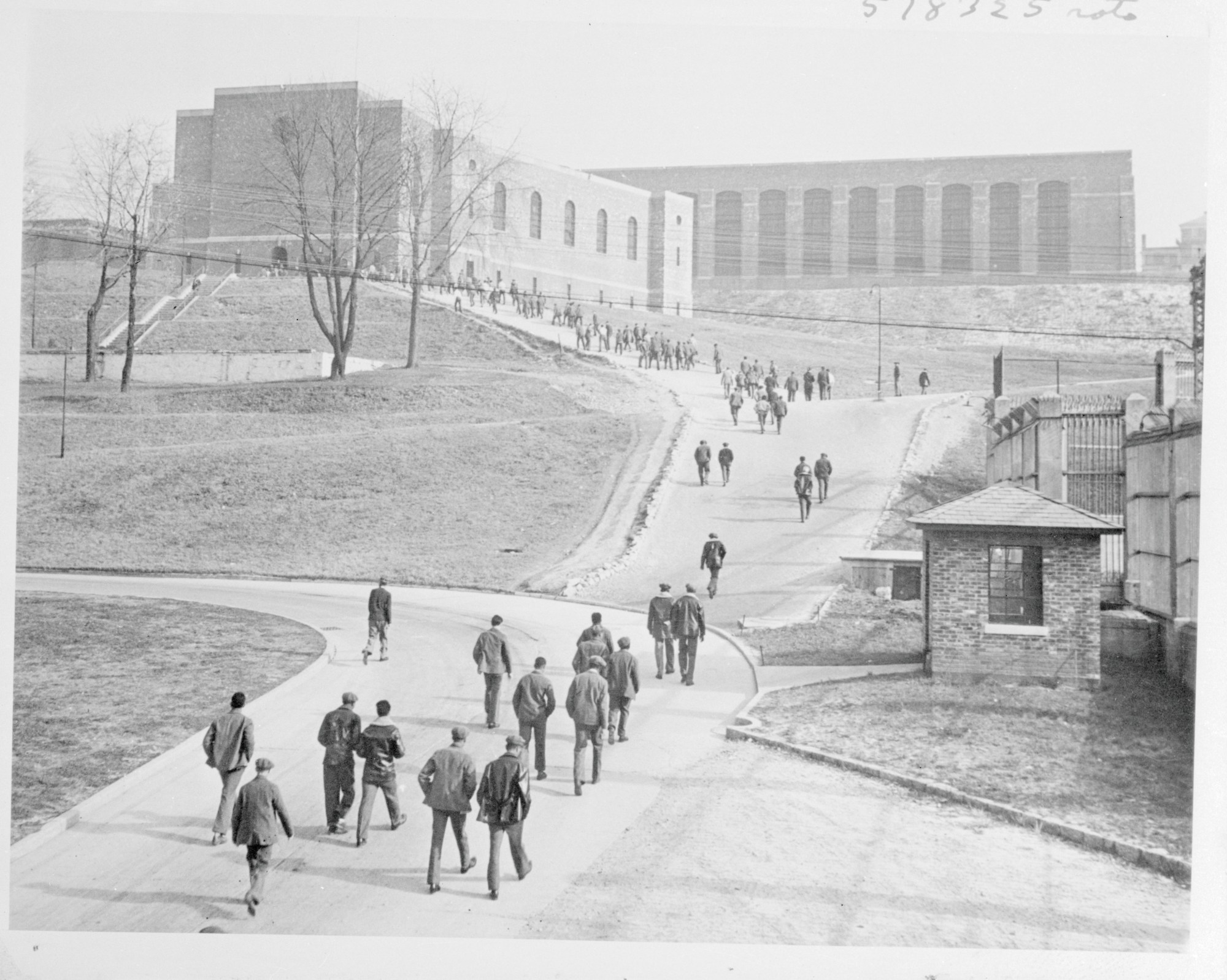
What was striking was how much we all believed (or at least, did not question) our American-ness. Without thinking about it, we seemed to know, however vaguely, that we’d be able to relate to people from other parts of the U.S.; that somehow our town, for all its geographical closeness to New York City (32 miles) was similar to towns in Idaho, Missouri, Maine, or Nebraska. Where did this quiet sense of American-ness come from? Perhaps we knew how typical Ossining was of small towns in the 1950s, despite its one difference: Sing Sing Prison, opened in 1826, and sited right on the mighty Hudson River. In fact the town was named Sing Sing until 1901 when, perhaps slightly embarrassed by its association with the prison, it changed its name to Ossining.
Perched on a series of hills high above the Hudson, Ossining’s 19th century Main Street reflected the self-contained nature of many towns of the time; an imposing bank where Main met the Albany Post Road, clothing stores, a five-and-dime, a movie theater, and Kipp’s Pharmacy with its classic soda fountain. We were also likely influenced by newly available national TV programs (recall there were only three major channels), the movies, our teachers, the textbooks that skipped over the darker parts of the nation’s past, and our parents. Were we conforming to our own peers’ rosy colored groupthink? Our varsity football team of 34 had four black kids; one of the 13 basketballers was black and the senior band of 50 had one black person. Did this mean anything? Did this mean we were “integrated?” The question did not come up.
Clearly, we were filled with un-examined and strong biases, perhaps especially about homosexuality. Looking back at 158 classmates I cannot guess at all which of us might have been gay, though it is hard to believe now that every single one of us was straight. And while many of us held the view that boys and girls had an assigned place in life and were meant to stay in it, at the same time, there were platonic male-female friendships, and on a daily basis we treated each other as equals.
If you had told us that our town embodied structural racism, that Robert E. Lee and Ulysses S. Grant were not both great generals and thus worthy of statues erected to honor them, that banks and corporations were exploitative, that capitalism wasn’t a perfect system, that prisons were an institutionalized (and nefarious) extension of the state’s power to discipline its subjects à la the French thinker Michel Foucault (remember our high school was less than a mile from Sing Sing); that we did not all have access to decent health care, that some of the poor would never catch up, we would have been open-mouthed in our disbelief. “No, not so,” we would have said.
Was everything darker beneath the placid surface that I seem to remember?
Though I can no longer see America through such rose-tinted glasses, I still get a patriotic tingling in my spine when I hear a Sousa march, and remember our band, marching down Main Street on Memorial Day, sweat pouring down our foreheads and landing on our white buck shoes. What was that feeling about? What made it course its way through my teenage body, and those of my fellow band members, including, I’m almost sure, our one black musician? Was it the staccato rumblings that began the “Washington Post” march, trombones prominent? Was it the flags waving, the fire engines? Was it also the self-serving optimism of teenagers, reinforced by a time when our futures seemed (and were in fact) pretty bright?
Memories are almost always filled with holes, and so I cannot be 100 percent sure about any of this. But still, it must be meaningful that I cannot relate to today’s stories (and data) about drug use, teenage angst, social media-induced suicides, widespread ADHD, and the now-universally accepted use of the F word, not to mention the apparent failure of schools and parents to get across basic tools like being able to read a book, compose a sentence, and add up a column of figures.
I think we were different and so were our times. But were we? Was everything darker beneath the placid surface that I seem to remember? Were we in denial? How come I did not hear a negative hint in the title of one of Sousa’s best marches, “King Cotton”? Was I (were we) brainwashed? Maybe, even probably. But still, I can’t quite see it. Unless, again, it was self-inflicted—we brainwashed ourselves; a conformism to an ideal. How is it that I was not afraid, hearing from my parents about the last week of August 1949, when a scheduled appearance by Paul Robeson ignited a riot against blacks, Jews, and “commies,” in nearby Peekskill, which the police did little to quell? How is it that in 1953 when I overheard a few men in a local store gloating about how “those k-kes are going to fry tonight” (Julius and Ethel Rosenberg were executed in Sing Sing Prison on June 19, 1953) that I did not begin to see some dark undercurrents in our world?
Looking back, I see that I must have made a choice. I pushed my fears and doubts away along with my inchoate awareness of prejudice, of unfairness, out of sight, beyond feeling. I chose to see these things—and I admit I did see them—as anomalies and blips in the picture, not patterns. Besides, there was much to look forward to in Ossining in the 1950s. Especially the parades.