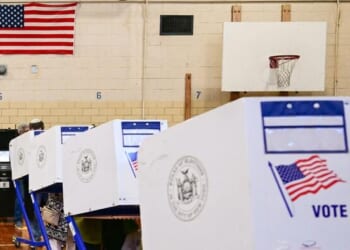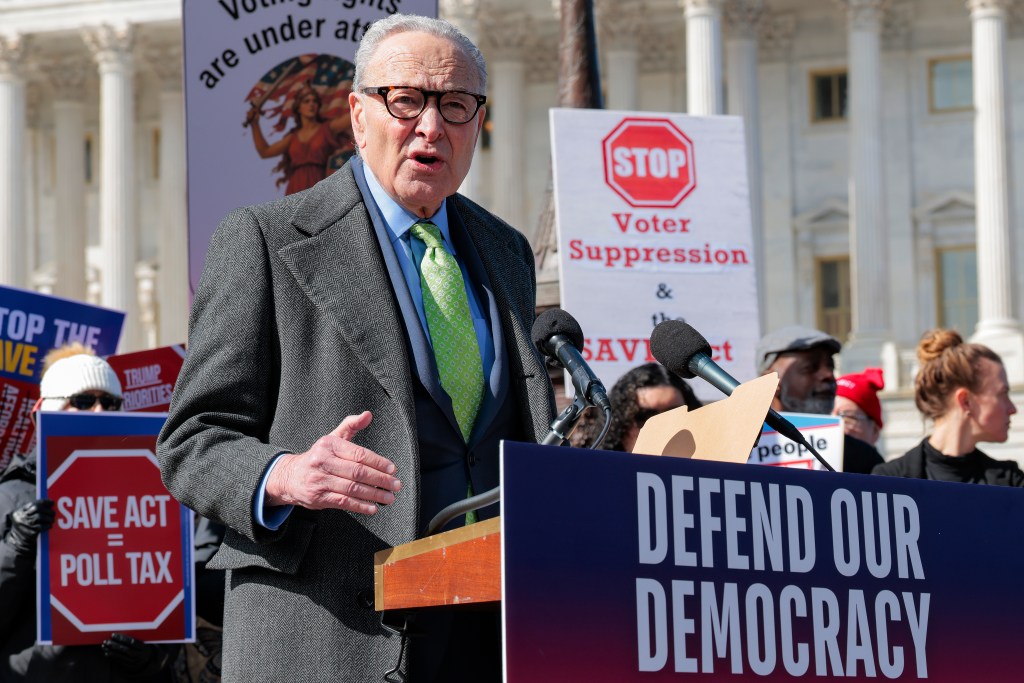
Hello and happy Saturday. Earlier this month, even with the ongoing war in Iran and a partial government shutdown causing headaches at airports across the country, President Donald Trump told lawmakers that passing the SAVE America Act was his “No. 1 priority.” Two versions of it have passed the House but the bill—which would require voters to prove citizenship to register and provide photo ID to vote, among other measures—doesn’t have enough support to pass the Senate without blowing up the filibuster.
While the bill is nominally about election security, the president has been very open about his belief that the SAVE America Act would benefit the GOP in November. “It will guarantee the midterms,” he said when announcing it was his top priority.
Will it, though? Contributing Writer Stephen Richer, the former recorder of Maricopa County, Arizona, isn’t so sure. He points out that married women who’ve changed their name—something more common among Republicans than Democrats—would have to provide additional documentation besides a birth certificate. Plus, the citizenship requirement is mostly easily met with a passport. He writes:
Although more Americans than ever before have a passport, only about half of U.S. citizens have one—namely the affluent and the educated. Most (58 to 64 percent) Americans with a bachelor’s degree have a passport, and 71 percent of Americans with a graduate or professional degree have one. Only 25 percent of those with only a high school diploma have a passport, and 39 percent with some college or an associate’s degree have the document. … This might sound advantageous to the Republican Party of Mitt Romney and Paul Ryan. But that’s not Trump’s GOP. CNN’s exit poll from the 2024 election found that voters in households earning more than $100,000 per year favored Kamala Harris over Trump, 51 to 47 percent.
Kevin D. Williamson also weighed in on the proposed legislation, specifically in regard to election fraud. He makes a potentially unpopular argument by acknowledging that voter fraud is real and may have changed election outcomes—not in presidential elections but in smaller primaries and local elections. But, he writes, the SAVE America Act will not solve the problem. He writes:
The federal government probably should not take on any new duties with regard to the administration of elections at all. While the Constitution does invest the central government with some regulatory authority in voting, Uncle Sam’s footprint at the polling place already is too big, and the states are perfectly capable of managing elections themselves in accordance with the constitutional mandate that “the “Times, Places and Manner of holding Elections for Senators and Representatives, shall be prescribed in each State by the Legislature thereof.”
Pushing for the SAVE America Act is not the only attempt Trump has made to exert influence over the midterms in a way that would benefit Republicans. As we’ve written about a few times, Texas redrew its congressional map to try to secure more Republican seats in the House. That kicked off a response from blue states: California Gov. Gavin Newsom called a special election last November so Californians could vote on a measure that would redraw their maps to give Democrats an advantage. And Virginia is carrying out its own redistricting referendum right now.
Contributor Jeff Mayhugh points out that all this gerrymandering leaves some citizens without proper representation—residents of small rural communities are often drawn into districts where their representative lives hours away and caters to more urban and affluent constituents—and he has a better idea: Expand the House. The Framers envisioned a ratio of one representative for every 30,000 constituents, but the Permanent Apportionment Act of 1929 capped the House at 435 members. Nearly a century later, that means we now have 760,000 constituents for every House member. “Since the capping of the House, our representation has grown distant, access has been denied, and accountability has weakened, resulting in Americans feeling disconnected and powerless in their government,” he writes.
Trump isn’t necessarily wrong to be nervous about the outcome of the midterms, as the president’s party typically fares poorly. What has Michael Warren scratching his head, though, is that many of the headwinds facing the GOP this time around are a direct result of the president’s own policies. Gas prices are up because he unilaterally started a war with Iran, his tariffs have disrupted the economy, and the partial government shutdown is a result of squabbling between Democrats and Republicans over funding the Department of Homeland Security, as Democrats are insisting on immigration-enforcement reforms after the chaos of Minneapolis. Whomever you want to blame for that, there’s an advantage for Democrats in playing hardball but not much upside for the GOP, he notes.
Mike points to past examples of the party in power getting wiped out in the midterms, notably the 2010 midterms that cost Democrats 62 House seats and the 2018 midterms in Trump’s first term, in which Republicans saw a net loss of 41 seats. The difference between those elections and the coming one? The parties at least enjoyed major legislative victories—Obamacare in the former example, and the 2017 Tax Cuts and Jobs Act in the latter. Which creates an obvious question: “What, exactly, has all of this been for? … The answer ought to be depressing for the president’s supporters: not much.”
Elsewhere on the midterm front, David M. Drucker and Charles Hilu wrote this week about how House GOP leadership persuaded Trump to re-endorse incumbent Colorado Rep. Jeff Hurd. And, highlighted below, Steve Hayes has a rollicking in-depth feature on the Republican primary in Florida’s 19th Congressional District, which features several candidates who’ve run for office in other states and a few who’ve been to jail. Thanks for reading and have a great weekend.
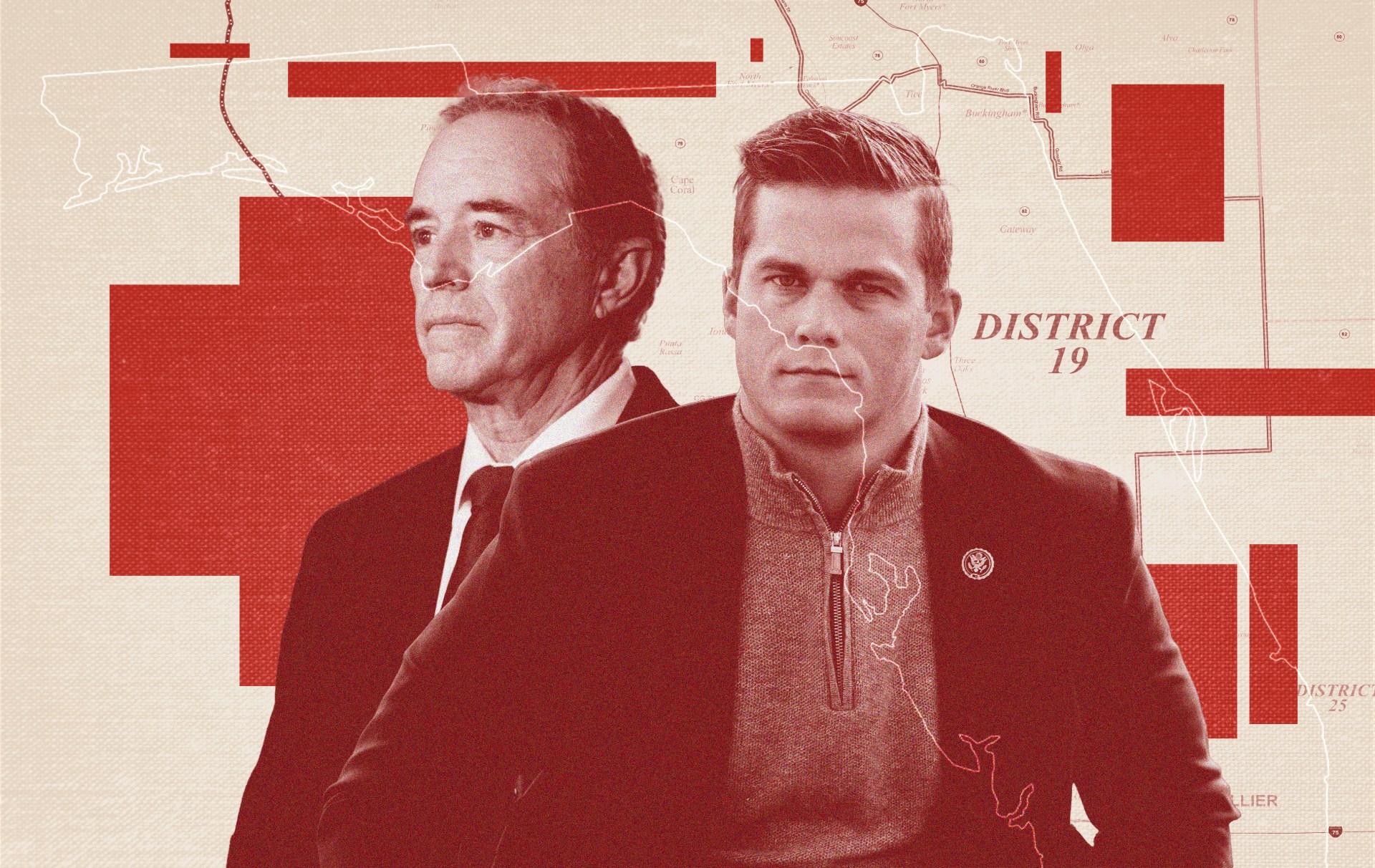
Byron Donalds has long been touted as a Republican rising star and made little secret of his interest in higher office. Would-be replacements have been talking openly about running for at least three years, and the prospect of an open seat here has made the district something of a magnet for MAGA retreads from around the country. Each of the seven candidates onstage during a January candidate forum made a claim that is demonstrably, provably false. Six are not from the district they seek to serve. Five have run for office in another state. Three have been endorsed by Trump in a previous race. At least three have spent time in jail. Two served in Congress and left in disgrace after scandals. Two have gotten Trump pardons. And one will be the next member of Congress from southwest Florida. Former North Carolina Rep. Madison Cawthorn explained to the crowd that he’d moved to Florida in 2022 and fallen in love with voters in southwest Florida after the eye of Hurricane Ian “went right over my house.” “I came down here to get away from politics,” he insisted, “but when I saw the cast of characters that were running to replace Byron Donalds, and after Charlie Kirk was brutally assassinated, I realized I had to get involved.” (In fact, Cawthorn told Punchbowl in November 2024—10 months before Kirk was killed and long before any other candidate had announced—that he was “very much interested” in running if Donalds gave up his seat.)
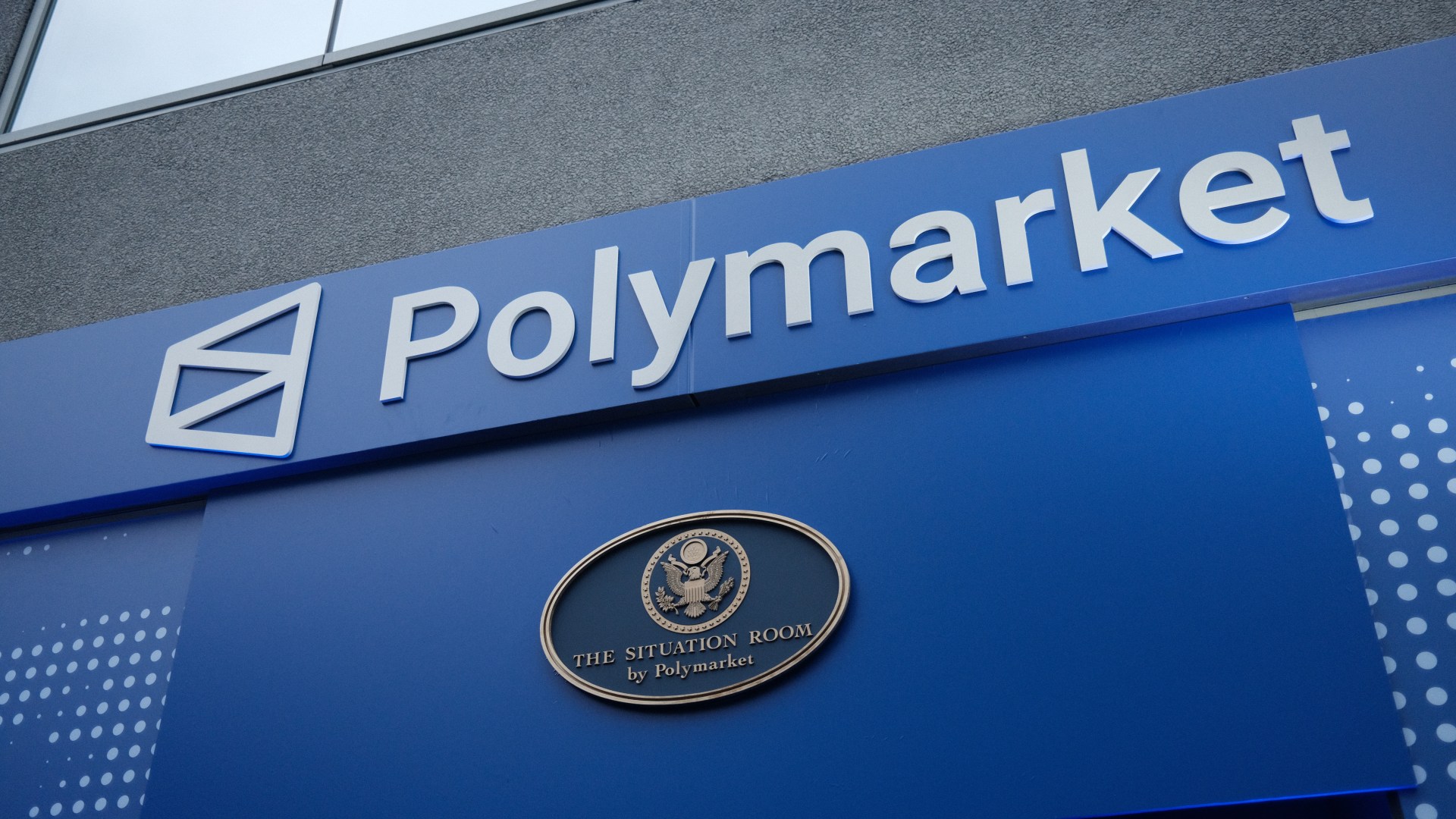
On Friday night, several dozen rain-dampened journalists huddled beneath two pergolas outside Proper 21—a restaurant on D.C.’s K Street known for happy hours and corporate power lunches. Inside, employees of the prediction market behemoth Polymarket were scrambling to salvage what was supposed to be the company’s first viral marketing stunt in the nation’s capital—a pop-up bar called the Situation Room, where the city’s many reporters, lobbyists, and policy nerds could monitor world events with the same gusto and social revelry as sports fans following March Madness or the Super Bowl. But while free beer and wine flowed to the reporters outside, information to monitor did not—reporters waited outside while organizers tried to fix electrical and connectivity issues that rendered the Situation Room nothing more than a room full of black screens. By the time guests were allowed inside, only a few displays were working, and the event had shifted from a marketing gimmick to an unintentional metaphor for the prediction market industry’s stumbling courtship of the Beltway media establishment. But that dynamic could be changing: Even as the event fell flat, the industry’s underlying push to woo Washington is serious, well-funded, and accelerating.

The theory of Plessy v. Ferguson was that segregation was permissible so long as facilities were formally equal. The reality, of course, was that black facilities were systematically underfunded, overcrowded, and stripped of resources. Even “separate but equal” turned out to be a legal fiction that southern states never intended to honor. It fell to civil rights attorneys to expose that fiction—and then to destroy it. The campaign was conceived in the 1930s by Charles Hamilton Houston, then dean of Howard University Law School. Houston traveled through the South with his student, future Supreme Court Justice Thurgood Marshall, documenting in stark detail the inequalities of black educational facilities. From that investigation, Houston and Marshall developed a two-pronged legal strategy. First, they would demonstrate that black schools were not, in fact, equal to white ones, and second, they’d insist on equality, knowing that states could never afford or muster the political willpower to actually duplicate the quality of their facilities.