Unaccountability.
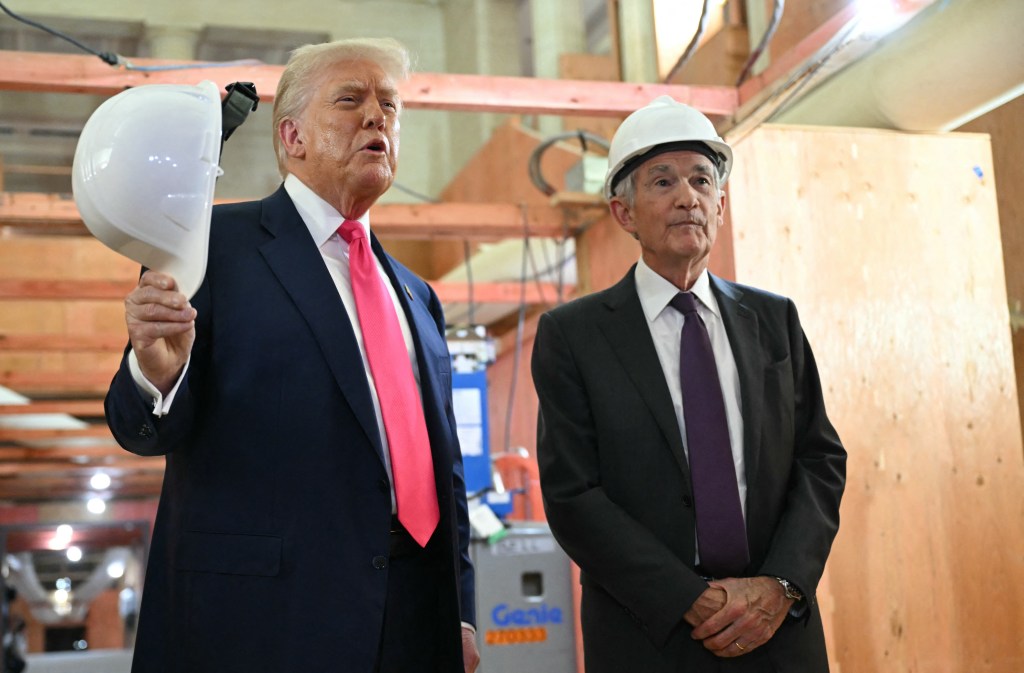
When I say that Powell’s opportunity for candor was unique, what I mean is that hardly anyone who works at the federal level in 2026 can complain about the president’s corruption without fear of serious sanction.
Democratic lawmakers in Congress are an exception, but virtually everyone else has been chilled to the bone. A civil servant who speaks out will be fired; a Republican lawmaker who speaks out will be primaried; a judge who speaks out will be violating their ethical duties to stay out of politics, demonstrating “bias” that Trump will weaponize the next time he loses a case.
Nearly everyone in government has to answer either to the president, to the voters, or to their profession’s code of conduct for the things they say, and so the fact that America is becoming a banana republic before our eyes goes mostly unobserved in official channels. Powell, as the head of the last(?) quasi-independent federal agency, isn’t similarly burdened. He’s not elected, he can be removed only for cause, and he’s not bound by strict judicial ethics that require one to remain publicly neutral about the grand political effort to dismantle the constitutional order.
I know, I know—as a conservative, I’m required to hate the unaccountable administrative state. But in this case, Jerome Powell’s unaccountability is the only thing making it safe-ish for him to call foul on the more sinister unaccountability of Trump’s gangster regime.
The institution that Powell leads has a special role in America’s international preeminence and therefore also arguably a special duty to resist when a Peronist president goes about trying to smash that preeminence on a rock. Divorcing monetary policy from national politics helped make the United States a safe haven for global investors, a place people could park their cash without needing to worry that some dummy in the White House would slash interest rates irresponsibly to goose hiring in an election year. In trying to undo that, Trump is now following in the footsteps of economic basket cases like Argentina, Turkey, Russia, Zimbabwe, and—ta da—Venezuela.
“One of the biggest hurdles for developing nations getting foreign investment is demonstrating they are stable, and their economies aren’t run on rampant, capricious corruption,” former Biden economic adviser Jesse Lee wrote last night after news of the criminal probe of Powell broke. “Trump weaponizing DOJ against the Fed Chair is the loudest possible signal we aren’t a place to invest.” Powell isn’t even the only Federal Reserve director facing trumped-up accusations (pun intended) from the administration, for cripes sake.
That’s what I mean by Maduro-fication. America is celebrating having rid Venezuela of a strutting buffoon running a command economy premised on fatuous nonsense while its own government is under the thumb of … a strutting buffoon running a command economy premised on fatuous nonsense.
Deporting third-worlders, importing their policies.
The Justice Department’s assault on the Fed is the most draconian and dangerous example, but there are numerous other cases lately of Trump following a third-world economic playbook. A few days ago, for instance, the president announced that he’ll be “calling for” a one-year cap on credit-card interest rates at 10 percent. (On Sunday, he implied that simply “calling for” a cap would somehow give that cap the force of law.) You can guess what will happen if that takes effect: Banks will no longer be able to make a buck off of extending credit to high-risk customers, which will lead them to drop those customers, which in turn will force those customers to seek loans from outfits like payday lenders that charge even higher interest rates.
No matter. Reportedly Trump phoned Elizabeth Warren—yes, that Elizabeth Warren—this afternoon to discuss the proposal.
Or take his reaction to the CEO of ExxonMobil declaring Venezuela currently “uninvestable” during a Friday meeting at the White House. ExxonMobil has good reason to be wary of resuming operations there, as its assets in the country were nationalized in the past not once but twice; if the president is serious about redressing the injustice of Caracas “stealing” oil that rightly belonged to U.S. outfits, ExxonMobil should have a standing invitation to join the rebuilding effort. But when Trump was asked on Sunday whether the company will be allowed to drill, he answered, “I’ll probably be inclined to keep Exxon out…. I didn’t like their response. They’re playing too cute.”
That’s what Lee meant by “rampant, capricious corruption.” In Trump’s America, as in Nicolás Maduro’s Venezuela, your financial prospects depend on keeping the president happy. Trump is also following Maduro’s example with respect to Venezuela’s oil revenue, insisting upon controlling the money himself no doubt with plans to direct it eventually to slush funds as yet unknown. According to Energy Secretary Chris Wright, the U.S. government might even take a stake in Venezuelan oil companies.
Remember “socialism without socialism”? We’re getting straight-up socialism now.
Autocracy, patronage, and leftist populist gimmickry that’s dense with unintended consequences are the hallmarks of Maduro-ism. America got a potent dose of it last year when Trump imposed his global tariffs by royal decree, but the White House is getting more aggressive as it grasps for ways before the midterms to show voters that it’s doing something meaningful to address “affordability.” Jonathan Chait identified the irony correctly: For all the administration’s screeching about swarthy immigrants, it ain’t Somalis in Minnesota who are making the federal government run like that of a “sh-thole country.” It’s Trump who’s to blame for that.
Why are we deporting the third world if we’re only going to import their civic culture anyway? Are the underachieving chuds of the postliberal right so insecure about whites’ ability to compete in America that they’d rather dominate a country that sucks than be just another faction in a country that’s thriving?
Two pillars.
It can’t be a coincidence that the two American pillars of post-war stability are teetering at the same time.
If the Fed has been the chief guarantor of global stability in finance, NATO has been the chief guarantor of global stability in international relations. The president is now threatening to topple both, although in neither case directly. His playbook with the Fed, it seems, is to convince Powell to quit as chairman by making his life unbearable.
It’s the same playbook for NATO. Instead of withdrawing from the alliance, the president is conniving to do something so egregious that European members will feel compelled to withdraw themselves. Asked by reporters on Friday about acquiring Greenland, Trump nodded at the possibility of a purchase before adding, “If we don’t do it the easy way, we’re going to do it the hard way.”
The easy way or the hard way is how his GoodFellas administration approaches every problem. It’s why I continue to believe that he’s going to try to fire Powell despite the fact that there are only a few months to go in Powell’s chairmanship. Having first failed to browbeat him into resigning and now having failed to intimidate him into resigning via a DOJ investigation, the president’s impulse to dominate will overwhelm his patience.
Why NATO and the Fed would both be in his sights at the start of the new year is hard to say. Maybe he’s a man in a hurry as he approaches 80: With his health having seen better days, he may have concluded that Maduro-fication needs to accelerate. The Pax Americana is nearly dead and the American experiment is ailing; now’s the time to finish off both, while he has the strength, and live his dream of asserting raw personal power over the economy and the global order.
Maybe he’s grown jaded by his polling and assesses that there’s nothing left to lose by doing whatever he likes, however unpopular it might be. At 42.1 percent approval, the president has settled at about the same level that he spent most of his first term. Absent an economic calamity, that’s likely as low as he’ll go. The mindless devotion of the fanatic Republican base will insulate him from any blowback on Venezuela, ICE, and other failures unrelated to inflation.
In particular, he might be out of ideas on “affordability” apart from the Maduro-esque gimmicks I mentioned earlier and resigned to the fact that his party will lose at least one house of Congress. Pursuing an unpopular agenda of smashing the Fed and NATO risks producing a drubbing, but would it even matter to Trump if his party gets wiped out in November? Republicans are already largely powerless in Congress and he won’t be removed from office regardless of what sort of scandals Democratic-led investigations of the White House might uncover.
Besides, there are other ways to avert electoral losses that don’t require him to do things that voters like. If he’s willing to seize Greenland and sic the DOJ on the chairman of the Federal Reserve, he’s surely willing to seize voting machines if the midterms don’t go his way. Nothing says “Maduro-fication” like nullifying the results of an election you lost.
Whatever the explanation, Trump may have finally shed whatever small degree of accountability to other civic actors he still felt last year. He was popular when he was first sworn in last January and Democrats very much weren’t (and still aren’t), which may have led him to avoid tectonically aggressive postliberal gambits like blowing up NATO. But now that his popularity has faded and the House flipping looks like a fait accompli, why hold back? Why should public opinion matter even a little bit to an elderly term-limited autocrat manque with delusions of imperial grandeur?
Ultimately, I think Jerome Powell is following the strategy I recommended to Denmark last week. Rather than let Trump have what he wants “the easy way” by resigning, Powell is forcing him to take “the hard way” of trying to fire him and reaping the economic and political backlash that would follow. I think he showed remarkable restraint in his video, frankly, by not borrowing a page from the president and offering to fund the Fed’s renovations by shaking down Americans bankers for “private donations” to the project instead. It would have been fun watching Republicans explain why that’s grossly corrupt, which it would be, but Trump’s White House ballroom boondoggle isn’t, although it is.
Hopefully Powell’s example will inspire other non-Democrats in government who find themselves newly unaccountable to the president and his voters to speak out. Here’s one now. Anyone else?