I don’t know that I’m 100 percent ready to agree with Leighton Woodhouse that “the hysterical pussy hats were right,” but I am very much convinced that the anti-federalists were, and that that fact ultimately is more consequential.
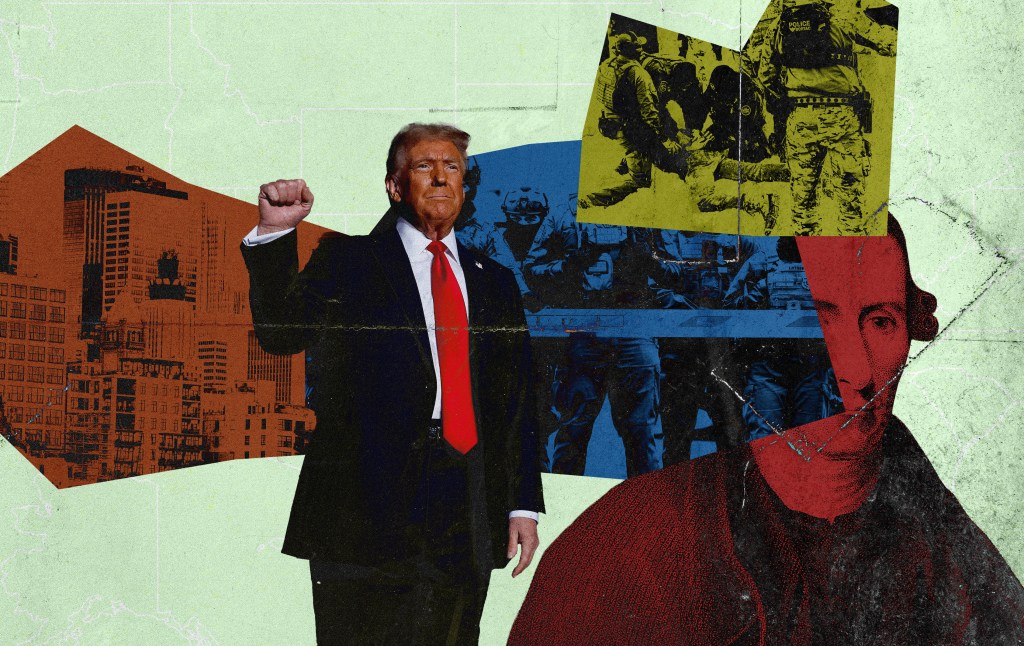
One of the arguments put forward to excuse or minimize the aggression—and the brutality—of ICE’s campaign in Minneapolis is that federal agents cannot rely on the cooperation of state and local authorities when operating in a sanctuary city in a state where the governor was the 2024 Democratic nominee for the vice presidency. So (goes this argument) rather than ask the local police to intervene when, e.g., protesters partly block a street or otherwise inconvenience federal agents, ICE agents really have no choice but to take aggressive action on their own, and that such action is justified by its necessity.
Like so much of what one hears from apologists for Donald Trump and his administration, this is a fundamentally un-American point of view, one that misunderstands the nature of our constitutional order.
The United States has divided powers, checks and balances, federalism, subsidiarity, and all the rest of it by design—the fact that the president cannot simply send men marching into Minneapolis and take over the city without opposition is a strength of our system rather than a shortcoming of it. Forcing the federal government and the states and cities into negotiation with one another is the point.
The federal government that we have today was created by the states to handle certain corporate needs and projects that are of an inherently interstate or national character, prominent among those needs being defense against foreign adversaries, the regulation of interstate commerce, the conduct of international relations, etc. It is Congress and not the president that is entrusted with the premier powers: to declare war, to ratify treaties, to impose federal taxes, etc. But Congress, at the moment, refuses to do its job, its members choking on self-importance even as they abandon self-respect.
While the Constitution has little to say about immigration beyond giving Congress—not the president—the power “to establish a uniform rule of naturalization,” immigration and citizenship have long been classified alongside those other inherently national affairs. As a union of sovereign states, our republic has built into it an unusual and complex—by design!—arrangement when it comes to sovereignty. Federal sovereignty is superimposed on state sovereignty and predominates where federal law conflicts with state law, but, at the same time, the federal government is forbidden to commandeer state governments or those of the municipalities in the states. That is why it is possible to have, among other innovations, “sanctuary” cities and states, where local law-enforcement agencies may decline (or may be forbidden) to cooperate with federal immigration agents.
Support for a policy of genuinely open borders in the United States is negligible. At a very high level of generality, most Americans (including most Democrats and progressives) agree with Trump that it would be better to enforce our immigration laws than to allow them to go generally unenforced, and most of us would prefer a system of immigration that is well-ordered to one that is anarchic; at the level of immediate specificity, many Americans, myself included, believe that the administration’s actions in dispatching thousands of ICE and Border Patrol agents to places such as Minneapolis are an exercise in punitive political theater rather than an exercise in enforcing immigration law. Immigration enforcement is, like many needful things, a matter of “Yes, but.”
Free societies are complicated and require a good deal of negotiation and compromise when it comes to conflicting dynamics of that kind. The American constitutional order is set up for precisely that sort of thing; the emerging presidential autocracy, based on unilateral executive actions that far exceed the powers the Constitution actually invests in the presidency, is entirely alien to that American tradition and—as we can see right in front of our noses, if we are inclined to look—bound to cause trouble.
Some of us cynics might even note that the Republicans’ evident and comfortable sloth when it comes to taking even the most elementary of steps toward reform—such baby steps as mandating the use of E-Verify or some similar system to keep illegal immigrants out of the work force—bespeaks a certain lack of genuine seriousness about the issue. Republicans apparently are happy to dispatch masked gun thugs into the streets of cities with Democratic mayors to punish partisan opponents, but reforming how basic workplace paperwork gets done is, apparently, a project that is going to be decades and decades in the making. We have a lot of show ponies but very few workhorses in our political life.
Congressional dereliction is the demagogue’s fuel.
In the debates over the drafting of the Constitution, the anti-federalists, led by such patriots as Patrick Henry, argued that the framers were laying down a foundation for potential tyranny: a president with too much of the monarch about him, a federal government inadequately constrained, state powers (states have powers, not rights) improperly diminished. And they were, in many respects, correct: While there is much that is great and admirable about our constitutional order, can there really be any question that the political currents in American history have been almost uniformly toward nationalization and centralization—for better and for worse? That federal agents should be acting like an encamped Hessian garrison in Minneapolis is not an inevitable outcome of that nationalizing tendency, but it is the actual outcome, here in the real world. This is the mess we have made.
It is an American problem with an American solution.
President Donald Trump won an election, but so did Gov. Tim Walz and Mayor Jacob Frey. We divide political power for many good reasons, including the swinish characters of men such as Trump together with the servility and self-moronizing passions of those who follow such demagogues. It is evident, from the scene in Minneapolis, that we have not divided that power sufficiently. One morally depraved game show host is all it took to send things off the rails.
It may be that, like me, you do not care very much for the unwise policy of declaring “sanctuary cities.” But you should care for the underlying political superstructure that makes that unwise policy possible—it is fundamental to American liberty.