One of the ironies of the low-trust society—and that is the kind of society we are building, to our detriment—is that its deficit of trust is mirrored by a surplus of gullibility.
What Umberto Eco wrote (describing the view of G.K. Chesterton) about God is true about lesser authorities as well: that when men stop believing, “it isn’t that they then believe in nothing: they believe in everything.”
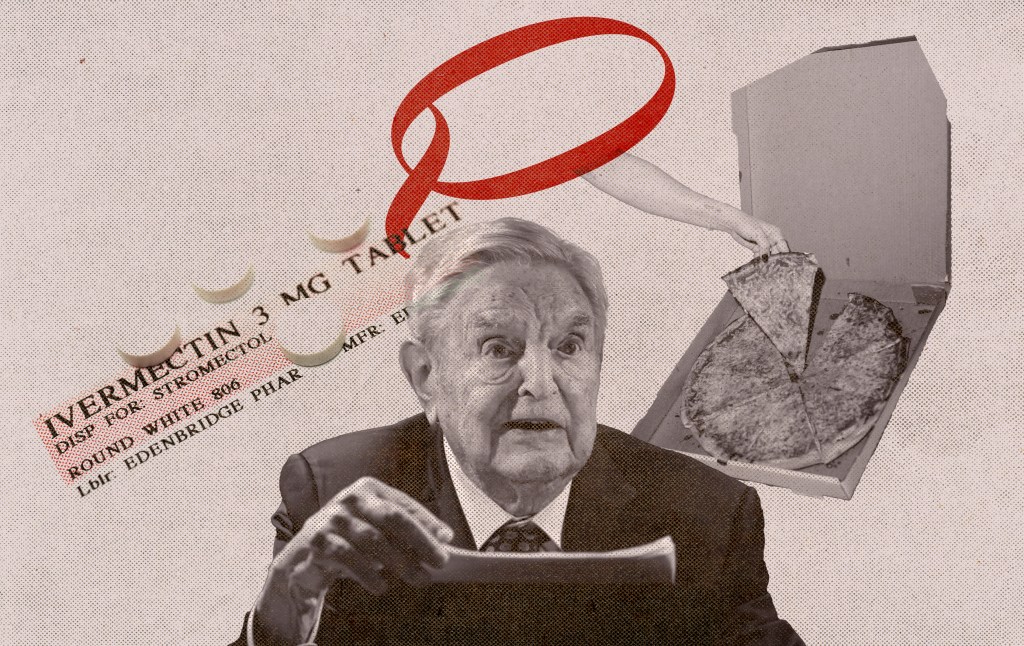
You know what I am talking about: The same people who go on and on (and they do) about how they don’t trust “Big Pharma” are ready to believe anything they see on the internet about ivermectin or raw milk or drinking water with borax dissolved in it. (Please do not drink borax.) Certain people who believe that climate change is a hoax accept at face value wild claims about Satanic pedophile rings operating out of Washington pizzerias, people who reject evolution as a fanciful hypothesis believe that aliens from distant planets secretly walk among us, etc. You can read essays calling for “evidence-based government”
The political world has always attracted its share of conspiracy cranks, from those peddling profoundly silly accounts of international economics (often seasoned with antisemitism, as taste dictates) to “intelligent design” charlatans. Cranky people often develop boutique political interests: There is a reason so many on the American right are at most one degree of separation from the Moonies while the left has thrown up a series of cults over the decades, from the Democratic Workers Party to MOVE. (Many cults crossed the political aisle over the years: The Lyndon LaRouche cult began as a left-wing movement before it was John Birch Society-adjacent, while the Children of God has had both hippie and more traditional fundamentalist aspects in its various iterations.) American celebrity culture exhibits its own cult-y enthusiasms (Scientology, the Esalen Institute, a parade of Hollywood gurus) while many cults and cult-adjacent groups (Synanon, NXIVM) have come out of the great American self-improvement tradition. Wealth and celebrity can produce cultlike devotion (Donald Trump, of course, but also Taylor Swift) or inspire fever dreams of Luciferian conspiracies (George Soros, Charles Koch, Bill Gates) or both at the same time, depending on whether the subject in question comports with one’s own cultural preferences. Cults fill a longstanding demand in the marketplace: They tell people who they are.
In a similar if less dramatic way, quackery is aesthetically conditioned and comes in flavors tied to cultural affiliations and identity markers: The people who believe very deeply in the healing power of crystals or the wisdom of horoscopes are almost never 40-year-old married men with hunting licenses and season tickets for their local college football team; the people who will lecture you about the supposed benefits of an all-meat diet are almost never Jewish grandmothers. Our conspiracy theories, quackery, and other irrational beliefs generally have less to do with considered views about how the world works than they do with implicit assertions about ourselves, about what kind of people we are, and which communities we feel that we belong to—and which communities we reject, compete with, or hate.
Put another way: The problem of social trust is, at a certain level, a problem of diversity.
There is a considerable political science literature on trust and diversity, which you most often will hear cited by conservatives as a reason a Scandinavian-style welfare state could not work in the United States: That kind of thing, the argument goes, works only in small and relatively homogeneous societies, to the extent that it works at all. There is a good deal to that, of course, though it is, as any intelligent person would expect, more complicated than the maxims would imply: Singapore, for example, is small (6 million) but diverse, and it has some features that would please American free-market champions (relatively modest social spending) and some that would confound them (state ownership of 90 percent of the land). Germany is a large country that once exhibited very high levels of social cohesion (not always to the betterment of the world, or of Germany) but more recently has seen its sense of social solidarity decline as it has become more diverse, to such an extent that formerly muted concerns—e.g., that the German welfare state is too expensive—are now part of the ordinary political conversation.
The work of populism is less like what happens in a policy shop and more like what happens in a dress shop: It is a species of fashion, not very much subject to rational evaluation as a series of public policy proposals.
But even if ethnolinguistic homogeneity were the solution to the problem of building or rebuilding social trust, homogeneity is not a practical option for these United States, and it never has been, not even at the beginning. We had 13 different colonies for a reason. Of course there are political principles that can partly mitigate the challenges associated with American scale and diversity—federalism, subsidiarity, etc.—but here the generally unspoken American superstition that all social problems can be solved by passing better laws runs upon the rocks. But if you tell Americans that what is necessary is a change of the national heart and a renewal of the national spirit, they will (go and check the comments section) try to turn that into a simple, simpleminded, and simply beside-the-point question: “Okay, but who should I vote for?”
The relevant concerns here are prior to elections.
Populists—in Europe and the United Kingdom as much as in the United States—have contributed to building the destructive, low-trust political environment through the ordinary means of natural bumptiousness and weaponizing (or monetizing, in the case of Fox News and right-wing influencers) class resentment and social anxiety; elites, in turn, have done their part by abusing the privilege of their position to pursue narrowly self-interested policies (as though the working poor were crying out in the night for solar panel subsidies, college loan relief, and a more generously compensated support staff for the associate dean of students) and to structure the political discourse in such a way as to try to exclude nonconforming views associated with despised social groups, for example by pretending that the disputes involving climate and transgender issues are scientific questions, subject only to expert advice, rather than democratic political disagreements about tradeoffs and priorities and the distribution of burdens.
The electoral success of populists, autocrats, and demagogues from Donald Trump in the United States to Alternative für Deutschland is the result of collapsing trust, not the cause of it. The work of populism is less like what happens in a policy shop and more like what happens in a dress shop: It is a species of fashion, not very much subject to rational evaluation as a series of public policy proposals. Donald Trump has been on every conceivable side of almost every possible issue—whatever it is his devotees see in him, it did not come out of a white paper.
None of this is exactly new. It is an old thing that is getting worse and more common, like comedy podcasts or antibiotic-resistant gonorrhea. Hannah Arendt considered the problem in the context of totalitarianism:
The result of a consistent and total substitution of lies for factual truth is not that the lies will now be accepted as truth, and that the truth be defamed as lies, but that the sense by which we take our bearings in the real world—and the category of truth vs. falsehood is among the mental means to this end—is being destroyed.
Our situation is still more antinomian than totalitarian—more chaotic than coherent—but it is easy to see how the former clears the way for the latter. The destruction of the idea of truth and that truth-affirming sense that Arendt wrote about creates a kind of epistemic vacuum—an opportunity for the talented political entrepreneur with grander and darker ambitions than the merely grasping, lowbrow caudillo politics of Donald Trump and his gang. Crankery and quackery are not mere organic craziness arising naturally from the ferment of our affluence—they are instruments for creating identities and for mobilizing them.
What is important to understand here is that there is a reason socially entangled phenomena such as conspiracy theories, diet fads, and medical quackery tend to spread in ways that are largely (though by no means exclusively) congruent with the lines of political allegiance. Ivermectin is not about health care policy, and raw milk is not about casein. “We could pay for all the good things if only the billionaires would pay their fair share” is not about balancing the federal books. These are attempts, however desultory or incompetent, at mythography—morally charged stories intended to provide a sense of social orientation to people who feel lost and disconnected and who cannot identify any obviously trustworthy and authoritative party to whom they can turn for guidance or judgment.
The great institutions—the churches, the government, the press, the universities, the professional communities and organizations at the commanding heights of business and culture—have given many people substantial reasons to doubt them, and the great demagogues—in the churches, the government, the press, the universities, etc.—have encouraged that doubt, often inflaming it beyond what is reasonable, in the pursuit of their own interests. Social capital accumulated over decades and centuries is not easily replenished once depleted to the critical level, and trust squandered is not easily reestablished.
If you think this problem is going to resolve itself by some mysterious self-actuating means at noon on January 20, 2029, then you are going to be disappointed.