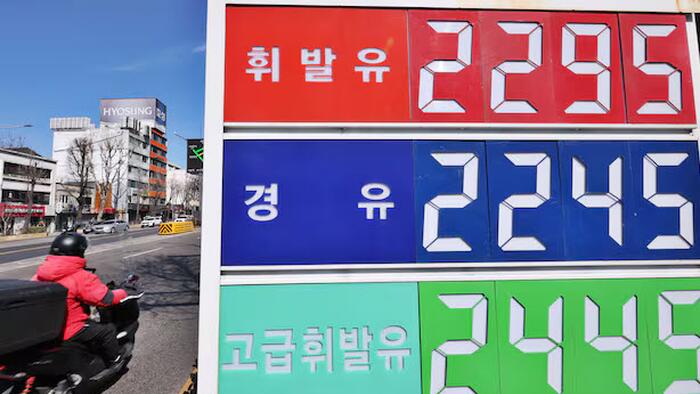
South Korean President Lee Jae Myung said on Monday that authorities would cap domestic fuel prices for the first time in nearly 30 years to contain a spike in prices after the conflict in the Middle East sent global crude prices sharply higher.
Speaking at an emergency cabinet meeting, Lee said in the government would “swifly implement and boldly impement” a maximum price system on petroleum products.
The current crisis “is a significant burden on our economy, which is highly dependent on global trade and energy imports from the Middle East,” Lee said in opening remarks.
He added that South Korea will also look for sources of energy beyond supplies shipped via the Strait of Hormuz.

Having emerged as the most cartoonish “market” in the world – whether it is stocks, crypto, or oil, and where even the smallest downtick has to be stabilized by the government or else watch the momentum-chasing lemmings run over the cliff – Lee said a 100 trillion won market stabilization programme should be expanded if needed, and called on the government and the central bank to prepare additional measures to respond to the volatility of the financial and foreign exchange markets.
South Korean shares slumped 8% on Monday to activate circuit breakers for a second time this month on the escalating Middle East conflict, while the won dropped more than 1% to trade near a key psychological barrier of 1,500 per dollar. The Kospi plunged 12% last Wednesday before surging by 12% on Thursday.

Sure enough, shortly after Korea’s announcement, the Commercial Times reported that Taiwan would set a weekly cap on oil-price increases as it seeks to cushion the economy from the impact of the Middle East war.
The Taipei-based newspaper reported the limit on Monday, citing Premier Cho Jung-tai and unidentified officials. Cho had previously told reporters on Sunday that the government had activated a price-stabilization mechanism to absorb oil price increases. That came after the Ministry of Economic Affairs said the day before that domestic fuel prices would only rise about 5% this week.
On liquefied natural gas, Taiwan’s Economy Minister Kung Ming-hsin told reporters the island only needs to find two more cargoes for March and April. “We won’t have a power shortage, and no additional coal-fired generation will be needed in March and April,” he said on Monday. “We can proceed as planned and safely navigate the period.”
Taiwan’s unleaded gasoline prices rose by as much as 5.5% after the government activated stabilization measures, the ministry said in the statement. Under the floating oil-price adjustment mechanism, prices should have climbed by as much as 19.7% this week, it said, with the government absorbing costs to reduce the impact on households and businesses and maintain domestic price stability.
How long can Taiwan keep prices artificially low, thus ensuring that the snapback will be especially brutal? According to officials cited in the Commercial Times repor, there are currently no concerns that Taiwan will run out of crude oil or natural gas, which simply means that nobody has done the math. The government plans to increase oil and gas purchases from outside the Middle East, and coordinate with Asian countries such as Japan and South Korea to swap LNG cargoes to ensure stable supply, the newspaper reported.
While one can debate the prudence of such price controls until one is blue in the face, the reality is that unless oil stabilizes and reverses, expect similar price caps all across the world coupled with strategic petroleum reserve releases, because a 25% one-day surge in the price of oil – if sustained – not only guarantees a global recession, but it also ensures social unrest, as well as a comprehensive sacking of every incumbent politician.
Loading recommendations…