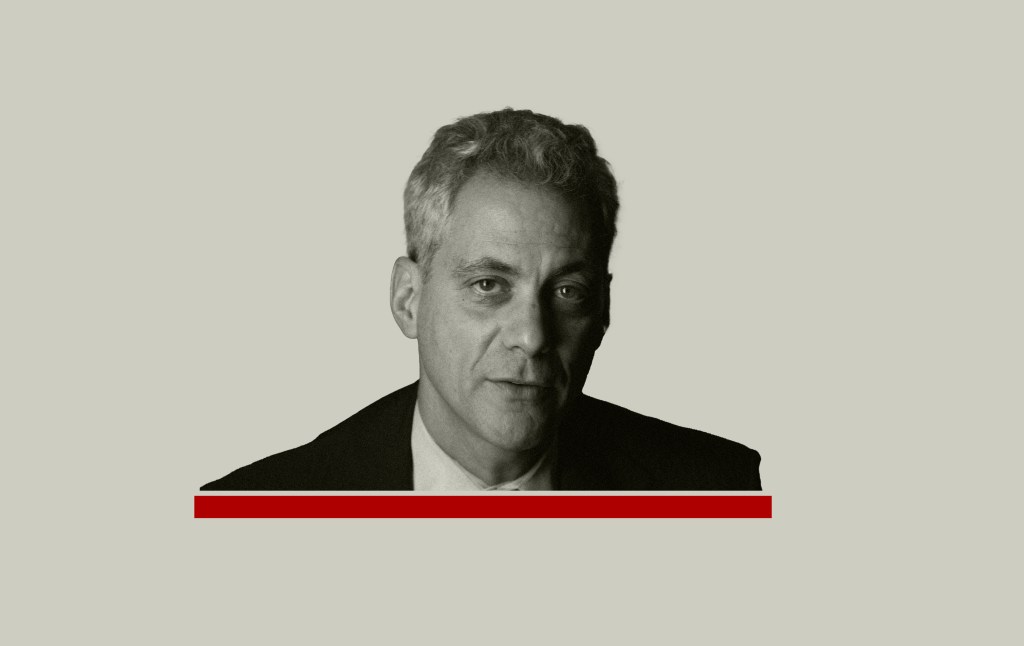
LAS VEGAS—Rahm Emanuel is a politician.
That’s a blindingly obvious descriptor for a prominent, 66-year-old Democrat who has made politics his profession—obsession, some might say. Emanuel was senior aide to Presidents Bill Clinton and Barack Obama, an Illinois congressman, Chicago mayor, U.S. ambassador to Japan, and coming in 2028, almost assuredly, a White House hopeful. But unlike most politicians in an era that frowns on politics and exalts outsiders, Emanuel bear-hugs the label, proudly. He believes many of the problems Americans have with Washington can be solved with more politics, not less.
Emanuel said as much, more than once and to an array of audiences, during two days of meetings in Las Vegas in late December that had all the hallmarks of a presidential campaign swing.
“I like politics. I don’t think you can govern without liking politics. I like meeting people. I like hearing what they have to say,” Emanuel told The Dispatch during a wide-ranging interview in the middle of busy Sadelle’s restaurant inside the Bellagio Hotel and Casino, Part 1 of our one-on-one conversation as I trailed the potential White House contender to visits with labor leaders, educators, and students and Nevada Democratic Party activists, donors, and officials. “I’m pretty partisan, pretty political, up front about winning, but I don’t do it at the expense of trust.”
To voters, “politics” often sounds like a dirty word—just the kind of word Emanuel has been known to sprinkle into discussions, public and private, for years.
“When it came to kids’ health care and the insurance companies were f–king [them,] just—f–k you, and you’re going to get all Rahm. And it ain’t going to be pretty. I may not win, but you are definitely going to lose,” Emanuel said, underscoring his approach to health care policy. In situations where Emanuel apparently concluded profanity was inappropriate, he turned to self-deprecating humor. “So, I’m mayor, and every month, in the city council chamber, we would swear in as citizens, 15 new people,” Emanuel said while headlining a Nevada Democratic Party gathering in Henderson. “I know you were emphasizing that I would do the swearing in, with the emphasis on the word ‘swearing.’”
But to Emanuel, “politics” is just a word for considering what voters want or are willing to tolerate when crafting public policy, and proceeding accordingly.
Pushing ahead with legislation without earning voters’ support or even slow-walking a bill that is broadly acceptable, which Emanuel framed as allowing “policy people” to function “with no political oversight,” can stymie legislation and cost an administration or a political party the legitimacy and power it needs to govern. That’s a big lesson Emanuel said he learned as White House chief of staff during the political struggle to push the Affordable Care Act, Obama’s signature legislation, through Congress.
Responding to a question from a high school student about what that experience taught him, Emanuel recalled urging the 44th president to tackle financial reform before Obamacare to satiate voters’ desire for accountability in the wake of an economic meltdown that spawned multiple taxpayer bailouts of big business, even as many Americans lost their homes and saw retirement savings evaporate. Had Obama followed his recommendation, Emanuel indicated, Democrats might not have suffered a shellacking in the 2010 midterm elections that saw losses of nearly 800 seats nationwide in contests for federal, state, and local office.
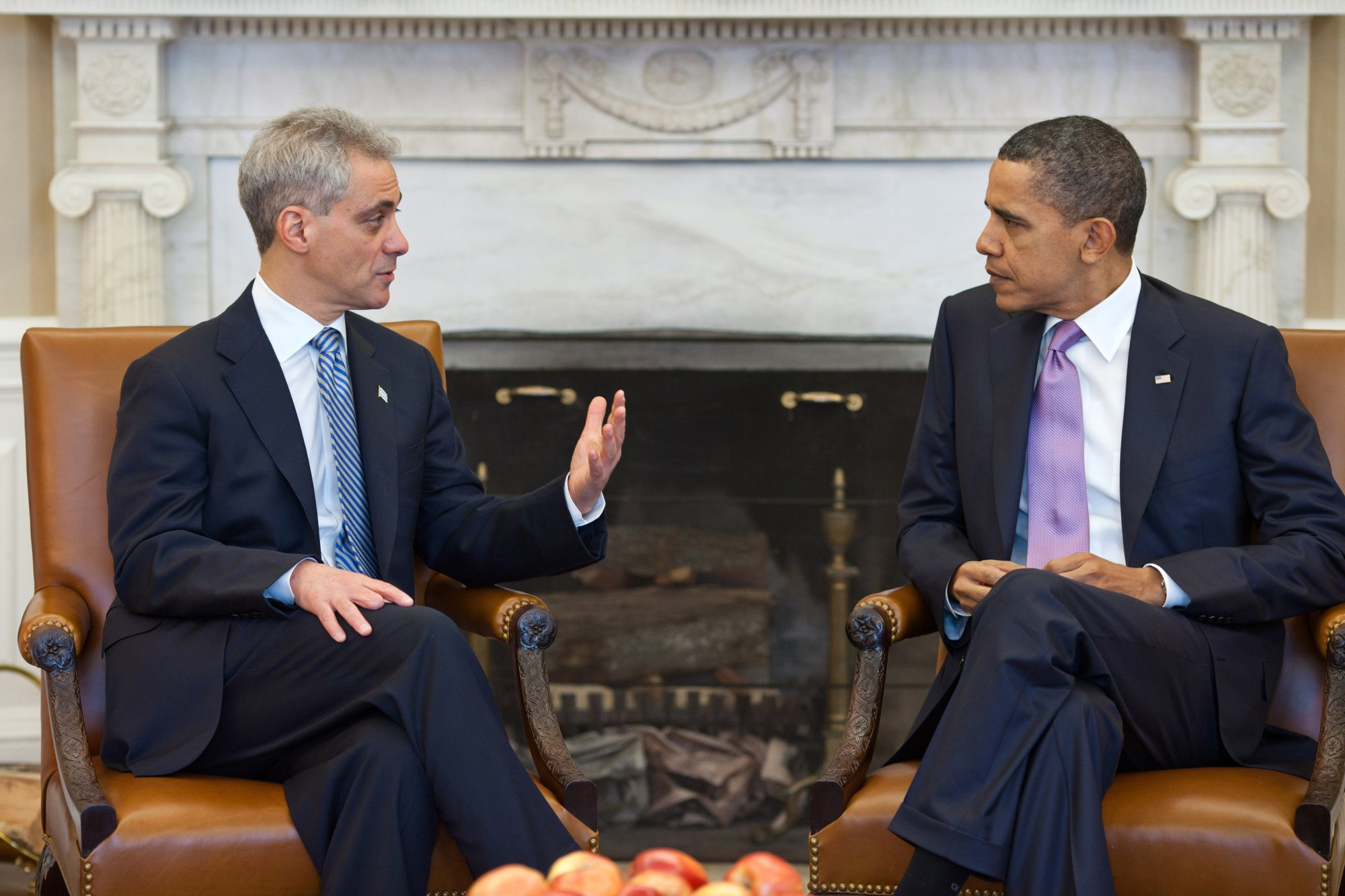
“No decision [Obama] made was wrong, but no decision he made was also right. Because as soon as you went into health care, what happened? Tea Party, a political reaction,” Emanuel said, referring to the conservative backlash to the Affordable Care Act, during an intimate meeting with roughly a dozen students, teachers, and administrators at Equipo Academy, a college preparatory charter school in the working-class neighborhood of East Las Vegas, whose student body is heavily Hispanic.
Once Obama chose to move forward with the health care overhaul, unanimously opposed by Republicans, Emanuel was as committed and involved as any administration official in pressing congressional Democrats to coalesce around the legislation that became the Patient Protection and Affordable Care Act of 2010. And like all prominent Democrats, Emanuel has celebrated the passage of the law, which has grown popular with the public in the years since.
But Obama’s first midterm election might not have wiped out the Democratic Party’s power base had the president followed Emanuel’s advice and pursued financial reform first, he suggested.“Had he done Old Testament justice, I’m not saying he wouldn’t have had a Tea Party, but you would have had a different reaction,” Emanuel said.
The financial reform Emanuel favored followed a little less than four months later.
I caught up with Emanuel last month during a heavily scheduled trip to Nevada, a combination general election battleground and early primary state on the Democratic Party’s presidential nominating calendar. Both days, he dressed country-club casual, donning an open collar button-down shirt, Peter Millar quarter-zip golf pullover, golf pants, and sneakers.
He had meetings with top officials at the Carpenters Union in Las Vegas; meetings with officials and a facilities tour at the Culinary Union’s training academy in North Las Vegas; a keynote address-turned-impromptu town hall for a gathering of Nevada Democratic activists and donors at Lovelady Brewing Company in Henderson; the aforementioned education roundtable, which also turned into an impromptu town hall, at Equipo Academy in East Las Vegas; remarks at a ritzy fundraiser for state Attorney General Aaron Ford, the de facto 2026 Democratic nominee for Nevada governor, in downtown Las Vegas; plus private conversations with other top party officials in and around the Sin City strip.
“I like politics. I don’t think you can govern without liking politics. I like meeting people. I like hearing what they have to say. I’m pretty partisan, pretty political, up front about winning, but I don’t do it at the expense of trust.”
Rahm Emanuel
Unlike some ambitious politicians, Democrat and Republican, who fancy the presidency, Emanuel sounded throughout as though he has figured out a few things. Primarily: what he believes about the major issues voters care about, and that reporters are prone to ask about; the policy priorities motivating him to (maybe) jump into the race for the Democratic nomination; and the strategic foundation for a competitive campaign—primary and general elections—based on what has worked for previous successful candidates. This much was clear from observing Emanuel and talking to him directly in two separate interviews, the second of which occurred in the crowded lobby of the tony Four Seasons Hotel near Las Vegas Boulevard.
Does the Democratic Party need to apologize for masking Biden’s health issues and the resulting 2024 ballot fiasco, to establish a clear break with a recent past that frustrated voters across the political spectrum, I asked? No, he said. But that doesn’t mean Emanuel believes his party has nothing to apologize for. “If you are going to apologize for anything, which I actually think—it’s not only okay to do, should be done—the thing you should apologize for—about—is what happened during COVID,” he charged. “We, in the name of science, screwed over the American people when the science couldn’t back it up.”
“So if you want to apologize,” Emanuel continued, “It’s not for Joe Biden hanging around too long. It’s for us keeping school doors closed way too long, and we have screwed over another generation. And so that’s where the apology—to all the parents who had their entire schedule, had all the … they became teachers, there was no real capacity to teach from a computer. We kept schools, as a country—a little more emphasis on blue states—closed longer, and there was no scientific basis, even though we [ran] around lecturing people.”
“It was because we were politically timid,” he said, flatly. The implication: Democrats feared the teachers unions and an activist base that grew enamored of face masks, social distancing, and other manifestations of coronavirus caution they believed were rooted in science.
This lengthy criticism of fellow Democrats’ pandemic failures may sound surprising. It’s not typical for White House hopefuls to risk sharp breaks with committed primary voters and influential groups before the primary gets underway. But it fits with Emanuel’s aggressive nature and centrist, if not somewhat conservative, approach to education and child welfare policy, two intertwined issues that are animating his foray into national politics and poised to become a centerpiece of any presidential campaign he wages.
In virtually every conversation—with organized labor, educators, students, and party people—Emanuel spotlighted his effort as Chicago mayor to reinvigorate the city’s public schools, sometimes over the objections of the teachers union, a core Democratic constituency. The accomplishment he seemed most proud of was his battle to lengthen the standard school day to 7 hours—and to increase the total days in a school year from 170 to 180. Emanuel also regaled audiences large and small with a policy he championed that made college or vocational school acceptance, or plans for military service, a requirement for most high schoolers to graduate.
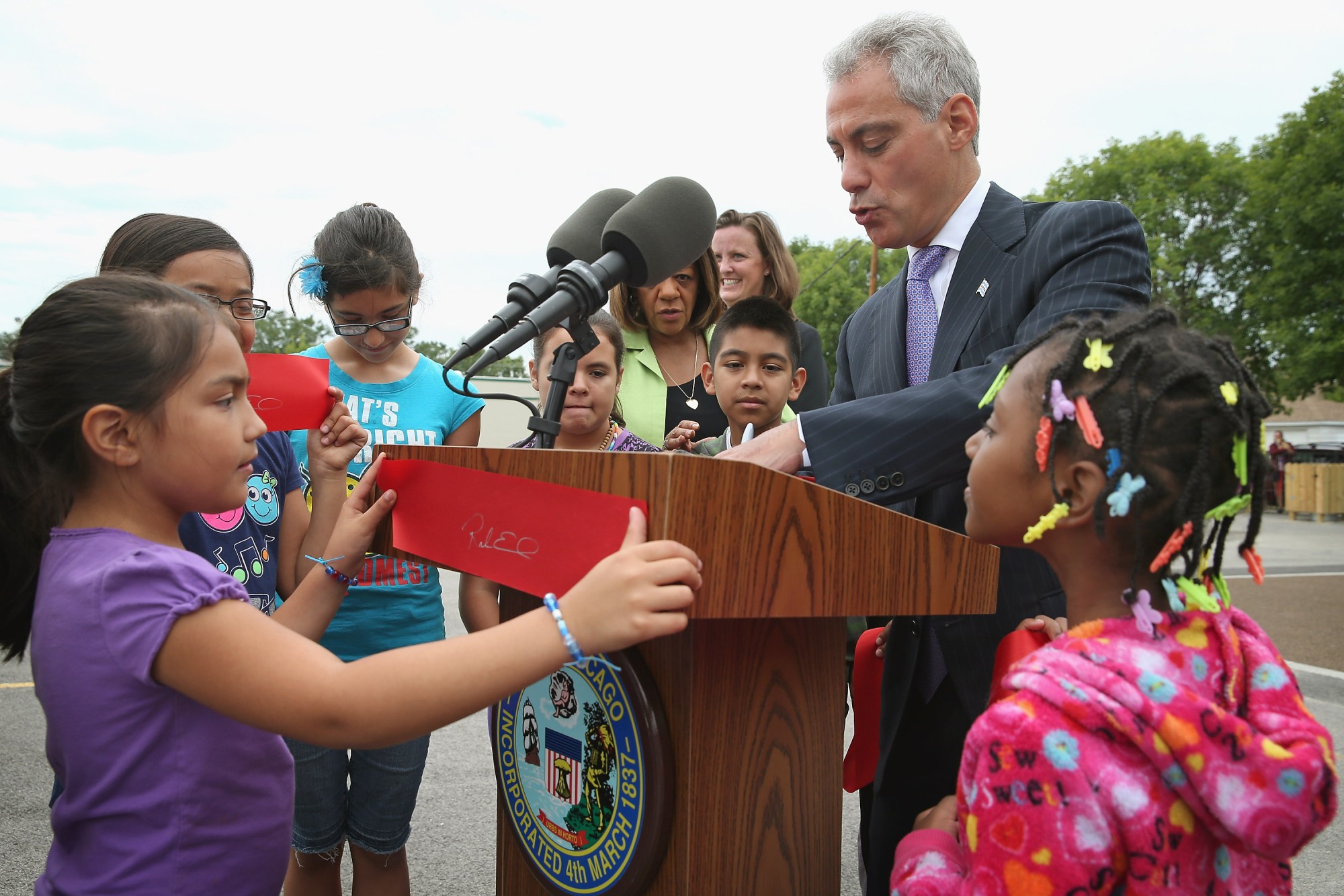
But Emanuel’s passion project, the fresh agenda item that he also happens to believe is a political goldmine, is his proposal to bring Australia’s social media ban for minors to America. Under the law, enacted last month, children under 16 are prohibited from accessing platforms like Instagram, Snapchat, and TikTok unless their parents consent. No matter the audience, Emanuel never missed an opportunity to make the pitch.
“It is as addictive as tobacco,” said Emanuel, who loathes tobacco companies and fought them as mayor, in part because of his mother’s cigarette addiction, during the education roundtable at Equipo Academy in East Las Vegas. “Your adolescence has been stolen.”
To the Nevada Democratic Party activists, donors, and officials who gathered to see Emanuel at the brewery in Henderson, he said: “It’s a battle between the adult in the house and the algorithm. And, right now, the algorithm’s winning. No parent—specifically a mother—should be on their own, trying to battle Facebook, TikTok, Snapchat.”
“I know I’m right on this one,” he told me later, declaring that “I don’t really give a crap” if it costs him with younger voters. (Emanuel spoke at length on this topic on The Remnant with Jonah Goldberg.) As a political matter, Emanuel views this as a potentially campaign-defining issue that separates him from the pack. “Nobody else thinking of running for president [has] said anything—not Gavin, not Josh, not Wes. Now, that’s an indication to me about certain things,” Emanuel said, referring to Govs. Gavin Newsom of California, Josh Shapiro of Pennsylvania, and Wes Moore of Maryland.
Emanuel seemed defensive only twice. The first time, I was asking him about the Democratic Party’s antisemitism problem, driven by overwhelming opposition to Israel on the far left. It happened again when I asked if grassroots Democrats will be receptive to his brand of traditional, center-left politics, hard-nosed as it is, at a time when President Donald Trump, whose name I heard him utter maybe three times in two days, appears to be tearing up the traditional rule book and operating the executive branch like one of his country clubs.
On Israel: “You are talking to the one person, in 2009, before anybody else—who’s the one person Bibi called, publicly, a self-hating Jew? Who’s the one person he attacks in his book? You’re looking at him,” Emanuel, an observant Jew, said, recalling an argument with Prime Minister Benjamin Netanyahu. “Obama had to separate the two of us over housing in the West Bank—we were having this fight in the Oval Office. Google it.” But notably, Emanuel didn’t disagree with the premise of my question, and he addressed it. “There is an antisemitism component, and there’s an anti-Israel component, and there’s a lot of overlap,” Emanuel explained. “Being Jewish and winning the general election will not be a problem. How you articulate your position on Israel in the primary, will be the challenge.”
On succeeding without pandering to the left wing: “Who among us is more progressive?” Emanuel jabbed. “You, who’ve talked about it and done nothing? Or me, who’s done something? From pre-K, to kindergarten, to minimum wage—what makes you progressive, if all you do is talk about it? Now, that’s why I say I’m center-left. The key word of ‘progressive’ is ‘progress,’ not ‘perfection.’” But that’s about policy, I said. What about the political question of why your traditional approach to politicking works at a moment that appears so unconventional to many Democrats? “I play bareknuckle politics to win,” he said. “I’m about winning and making sure we win.”
How Emanuel is talking about the issue of border security and illegal immigration backs up that assertion.
Among the Democratic Party’s key missteps facilitating Trump’s return to the White House, the explosion of illegal immigration during the Biden administration—permitted as part of a misguided effort to placate the party’s liberal base—was perhaps the most egregious. Even many Hispanic voters opted for Trump as a result, although the issue is again politically fraught for Democrats in the wake of the 45th and 47th president’s controversial mass-deportation campaign that has affected not just illegal immigrants but also Hispanic American citizens.
For Emanuel, the issue isn’t just political. He is a first-generation American son of an Israeli immigrant father and has a firsthand appreciation for why so many people around the world have idealized the U.S. and risked everything to come here, the way so many American Jews do. Emanuel believes the U.S. is a richer, stronger, more competitive nation globally because of this tradition of immigration, and believes it should be facilitated by federal policy going forward. He is not without sympathy for millions of illegal immigrants who are in the U.S. because they sought economic advancement and political freedom.
Nevertheless, the border must be secured and illegal immigration punished, Emauel emphasized when I asked him to detail his position.
“We’re a nation of immigrants, and we’re a nation of laws. We’ve got to be true and honest to both,” he said, adding, unprompted: “I was talking about criminal illegal immigrants being deported back in 1994, ’5 and ’6. There’s people on the left who’ve attacked me because of my memos and what I advocated in the Clinton White House.” Politically shrewd, I thought. But more interesting was that he later said, more or less, the same thing to a pair of young Hispanics whose families have been affected by the Trump administration’s ongoing deportation campaign.
During the question-and-answer session at the Nevada Democratic Party’ brewery event, the chair of the state party’s young Democrats chapter shared a personal anecdote. “The conversation we have is, what does Plan A look like if mom gets deported?” What does Plan B look like if dad gets deported? What does Plan C look like if both parents get deported?” Sierra Hernandez said, before asking for Emanuel’s thoughts on the predicament. If Emanuel runs for president in 2028, it’s an issue he’ll be confronted with frequently in the Democratic primary.
Emanuel responded with empathy. He related his own family’s immigrant experience and talked about his adult children’s military service—his son is in the Navy, his daughter is a Navy reservist. He declared that “nobody” voted for hardline government tactics that have seen the often violent detainment of illegal immigrants who are looking for work in hardware store parking lots or appearing at scheduled hearings at federal courthouses attempting to obtain lawful status.
“People are trying to get across the border illegally—it’s illegal. We can’t have the laws we like and the laws we dislike.”
Rahm Emanuel
But Emanuel added: “I don’t also want to misguide you. I believe in tough enforcement at the border because it means that you can’t break the law.” It was the same the next day at Equipo Academy. A Hispanic student worried about how the Trump administration’s deportation operations will affect her family asked Emanuel to address the issue. After promoting at length his support for immigration and its benefits, Emanuel underscored that he didn’t want to engage in “false advertising” for the sake of political expediency. “People are trying to get across the border illegally—it’s illegal,” he said. “We can’t have the laws we like and the laws we dislike.”
A political highwire act in a Democratic primary? Maybe.
But this pragmatic approach to immigration and border security, a cultural touchstone for many working-class voters in critical Midwestern swing states (not to mention Hispanic voters in Texas’ Rio Grande Valley), fits with Emanuel’s strategic framework and understanding of successful presidential campaigns. Winners don’t cower to the base of their party. Candidates who do, lose. The results in 2016 (Trump) and 2020 (Biden) certainly bear that out. But so does Clinton’s victory in 1992, a formative election for Emanuel and a contest that birthed the famous “Sister Soulja” moment of base defiance and helped propel Clinton to the White House.
“People, to project you in the Oval, they’ve got to see that you have strength,” he said. “If you’re willing to tell a member of the family: ‘Shut the f–k up’—it’s not what you pick that counts, it’s that you willingly have balls to do it.”
Emanuel in Las Vegas was personable and inquisitive.
He didn’t hesitate to interject relevant anecdotes about his experiences in the Clinton and Obama administrations, as ambassador to Japan, and especially as Chicago mayor (2011 to 2019), his only role as an elected chief executive. But mostly Emanuel asked questions, listened, took notes, and asked “for paper on that.”
At the Carpenters Union, that meant peppering officials for details about the Nevada job market and broader state economy, but also specific local construction projects—proposed and underway. “What’s the headcount,” Emanuel asked, for union jobs on the stadium project for Major League Baseball’s Athletics franchise in the process of moving here from Oakland? At the Culinary Union, Emanuel wanted to know how the different training programs (for bartender, chef, housekeeping, restaurant server) operated, the percentage of immigrant trainees, and the top three countries they hail from.
In larger public gatherings, Emanuel’s interest in hearing what voters think explains his unprompted decision to turn both the education roundtable at Equipo Academy and keynote remarks to the event hosted by the Nevada Democratic Party into town hall meetings.
The approach allowed Emanuel to gather information for a future campaign in a state where Democratic prospects live and die on activism and turnout by organized labor and party stalwarts. The back-and-forth also offered a testing ground for an emerging stump speech with populist overtones on the economy and a foreign policy defined by Scoop Jackson-style muscular internationalism, especially as it relates to China (which, in today’s world, isn’t far off from the Ronald Reagan-era Republican-style foreign policy).
“On the left, you have a bunch of Marxists and on the right you have a bunch of monopolists,” Emanuel said during his meeting with Carpenters Union officials. “None of them believe in the free market.”
“When I was in Tokyo, I was watching America. Now, I believe China is a threat. But I would rank our not taking care of business for ourselves as a bigger threat,” Emanuel later told the approximately 75 Democrats who packed a brewery on a Wednesday evening to hear from him. “So there’s a real challenge [regarding China], don’t get me wrong. But there are things that we are not doing to take care of the basics that are more of a risk to the United States.”
Emanuel was often remarkably deferential and soft-spoken—at least until he warmed up—ironic given his image in Washington, D.C., and back home in City Hall as a political pit bull with a flair for colorful language.
Chatting with Democratic activists after the state party event at the brewery, one complained to me that the potential 2028 contender was hard to hear, leading him to speculate that the Chicagoan might lack the charisma to be a viable national candidate. Emanuel, who often prefers to speak sans microphone, eventually warmed up, and his voice and enthusiasm filled the room, befitting his reputation for political pugnacity.
But the observation raises an interesting question: Has Emanuel softened?
This election cycle marks 20 years since he was chairman of the Democratic Congressional Campaign Committee. In 2006, in part because of the strong roster of candidates Emanuel recruited—candidates that included conservative and moderate Democrats who could compete in red districts—his party flipped 31 GOP-held seats, winning control of the House of Representatives for the first time since losing the chamber in the Republican revolution of 1994. I asked Emanuel if he’s grown less combative in the subsequent decades.
“I won’t mellow when I think a powerful interest is screwing people over,” Emanuel said, adding that, sometimes, “big, powerful interests need a two-by-four upside their head.” However: “Have I, on other things, learned to take a step—have I learned to maybe take a deep breath? Yeah … Fighting is not a toolbox. It’s a tool in the toolbox. You apply it when you need it.” So, hardly a wallflower, just more measured. Possibly.
And that, basically, was how Emanuel discussed his presumed intention to run for president as he hopscotched Vegas. (He was ferried around in a domestic black SUV, joined by one all-purpose political aide and a security staffer.)
He never said the decision has been made. But in multiple settings, Emanuel referenced the possibility as though it were a fait accompli. “There goes the youth vote for Rahm Emanuel,” he quipped at Equipo Academy, after discussing his goal to limit social media access for teenagers.
“I’m gonna be back a couple more times,” he told the state party crowd at Lovelady Brewing Company, hinting at Nevada’s role as an influential, early primary state. “You’re gonna be tired of this face.” When I told Emmanuel that I had to ask him some version of the 2028 question despite understanding a definitive answer was not forthcoming, his quick retort was classic Rahm: “So don’t ask it.”
I asked anyway, telling Emanuel my assessment was that this trip and others like it amounted to a campaign test run, to see if he wanted to move ahead with a 2028 bid for the Democratic presidential nomination. He played ball. “You’re not 100 percent right; you’re not 100 percent wrong,” Emanuel said, before elaborating. “You’re testing yourself, and you’re testing your arguments. And the jury’s out, although I know where I am emotionally.” Where is Emanuel emotionally?
Earlier in the conversation, I had asked him to talk about the Democratic Party’s antisemitism problem. Since the deadly October 7, 2023, Hamas terrorist attack on Israel that sparked a war in Gaza that raged for two years, American Jews experienced a sharp increase in antisemitic attacks and harassment. Grassroots progressives who oppose the Jewish state have often been the culprits, particularly on college campuses, typically a hotbed of Democratic votes.
I explained to Emanuel, who talks regularly about his faith, that there are Jews in my family who are Democratic voters and partial to Shapiro but fearful the liberal base of the party will reject the Pennsylvania governor because he’s Jewish and a historically outspoken supporter of Israel. Emanuel addressed my question with the seriousness it warrants. But before doing so, he said:
“First of all, what’s wrong with Rahm Emanuel in your family?”