One week after Trump announced that the US would cover insurance for ships transiting the Strait of Hormuz, and would provide them with US navy escorts, Reuters reports that the US Navy has refused near-daily requests from the shipping industry for military escorts through the Strait of Hormuz since the start of the war on Iran, saying the risk of attacks is too high for now.
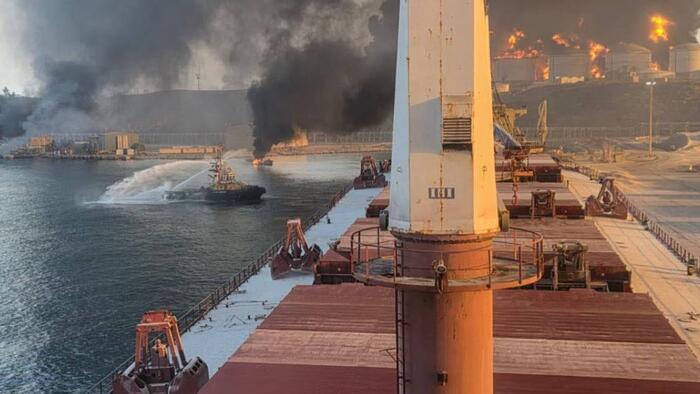
The U.S. Navy has held regular briefings with shipping and oil industry counterparts and has said during those briefings it is unable to provide escorts for the time being, three unnamed shipping industry sources told Reuters. They added that the shipping industry has been making requests almost daily during the calls for naval escorts through the strait. One of the sources said the Navy’s assessment during Tuesday’s briefing had not changed and that escorts would only be possible once the risk of attack was reduced, which judging by images like the one below of a container ship in the Gulf today won’t happen any time soon.
Insane image from the bridge of a container ship arriving at the Port of Salalh in Oman earlier today, as flames engulf multiple port facilities and oil tanks at the MINA Petroleum Facility, resulting from several impacts by one-way attack drones launched by Iran. pic.twitter.com/ePFkxNpOEf
— OSINTdefender (@sentdefender) March 11, 2026
The Navy’s assessments spell continued disruption to Middle East oil exports and reflect a stark divergence from President Donald Trump’s statements that the U.S. is prepared to provide naval escorts whenever needed to restart regular shipments along the key waterway.
Shipping along the narrow strait has all but halted since the start of the U.S.-Israeli war on Iran more than a week ago, preventing exports of around a fifth of the world’s oil supply and sending global oil prices surging to highs not seen since 2022. Some ships – mostly Iranian VLCCs and Chinese tankers carrying embargoed products – have resumed transits with Iran vowing it would only attack western-linked ships, we reported earlier.

The status quo may soon change, however: on Tuesday General Dan Caine, chairman of the Joint Chiefs of Staff, said that the US military has started looking at options to potentially escort ships through the strait, should it be ordered to do so. “We’re looking at a range of options there,” Caine told reporters at the Pentagon.
A U.S. official told Reuters the U.S. military has not yet escorted any commercial ships through the strait. Earlier in the day, U.S. Secretary of Energy Chris Wright deleted a post on X in which he said the Navy had successfully escorted one through.
While there have been some voyages through the waterway in recent days, the majority of shipping traffic remains on hold with hundreds of ships anchored.
Meanwhile, Trump has said repeatedly in recent days that the United States is prepared to escort tankers through the Strait of Hormuz when necessary.
“When the time comes, the U.S. Navy and its partners will escort tankers through the strait, if needed. I hope it’s not going to be needed, but if it’s needed, we’ll escort them right through,” he said on Monday during a press conference at his Mar-a-Lago resort in Florida.
For its part, Iran remains adamant: a senior official with Iran’s Revolutionary Guards has said the strait is closed and Iran will fire on any ship trying to pass, Iranian media reported last week. Several ships have already been hit.
Indeed, earlier in the day, a Thai ship attempting to pass through the Strait of Hormuz, the bulk carrier Mayuree Naree, was struck by projectiles while travelling about 18km north of Oman.
Images released show black smoke coming from a Thai cargo ship near the Strait of Hormuz after it was reportedly struck by an Iranian projectile.
Authorities say it is one of three commercial vessels that were targeted on Wednesday, and several crew members are missing. pic.twitter.com/6yL9U2WOw2
— Al Jazeera Breaking News (@AJENews) March 11, 2026
Never afraid of wading neck-deep in irony, just a few hours after photos of the latest ship to be attacked in the SoH circled the globe, Trump said “you can see great safety in the Strait of Hormuz“, when asked how he’s going to ensure the safety of oil following through it.
When asked by a reporter if Iran laid mines in the Strait of Hormuz, “we don’t think so,” President Trump replied, all signs to the contrary.