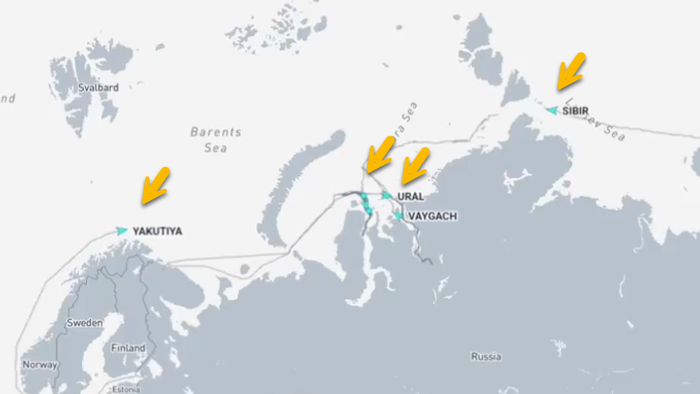
Russia has deployed all eight of its nuclear icebreakers simultaneously in an unprecedented move. The fleet is being used to keep critical winter shipping lanes in the Gulf of Ob and the Yenisei Gulf open, ensuring continued access to key export terminals. The deployment sends a clear signal to the West that Russia can sustain year-round Arctic shipping and maintain its natural resource export revenues.
Ship tracking website MarineTraffic reported earlier this week:
Russia deploys all eight nuclear icebreakers to keep Arctic export routes open.
Russia has, for the first time, deployed its entire fleet of eight nuclear-powered icebreakers simultaneously to maintain winter navigation in the Gulf of Ob and the Yenisei Gulf. #MarineTraffic data shows that the nuclear icebreakers Taymyr, Yamal, Arktika, Yakutiya, Sibir, and 50 Let Pobedy have been operating in the Gulf of Ob since December 14, supporting traffic linked to Arctic Gate, Yamal LNG, and other terminals. Meanwhile, Ural and Vaygach are deployed in the Yenisei Gulf, enabling access to ports and industrial sites deep inside Siberia.
Russia deploys all eight nuclear icebreakers to keep Arctic export routes open
Russia has, for the first time, deployed its entire fleet of eight nuclear-powered icebreakers simultaneously to maintain winter navigation in the Gulf of Ob and the Yenisei Gulf. #MarineTraffic data… pic.twitter.com/mjBE03RKYl
— MarineTraffic (@MarineTraffic) December 16, 2025
Maritime news website gCaptain added more color to this unprecedented move by Russia:
For the first time, all four of Russia’s new Project 22220 Arktika-class nuclear icebreakers are deployed simultaneously. Arktika, Ural, Sibir, and Yakutiya represent the future of Russia’s nuclear icebreaking capability, offering greater power, improved efficiency, and the ability to operate both in deep Arctic seas and, with adjustable draft, in shallower coastal waters.
Looking ahead, Russia has three additional nuclear icebreakers of the new Arktika class under construction. Chukotka, Leningrad, and Stalingrad are expected to enter service in 2026, 2028, and 2030, respectively, bringing the new Arktika class to a total of seven vessels, though western sanctions against Rosatomflot have slowed construction.
In parallel, the massive Leader-class icebreaker Rossiya is intended to enable year-round navigation along the Northern Sea Route by around 2030, but its completion timeline has been pushed back multiple times. It is currently around 30 percent complete based on progress updates.
To sum up, Russia’s export system has come under intense Western sanctions, with the threat of another round if Moscow does not agree to a near-term peace deal with Ukraine. The deployment of the icebreakers sends a clear message to Brussels and Washington that Arctic energy will continue to flow, whether they like it or not.
Loading recommendations…