One week ago, when fears that the Strait of Hormuz blockade would mean a permanent collapse in oil supply (we have since seen that Iran is allowing “friendly” ships to cross the strait, especially if they grease the toll-keeper with $2 million per crossing) hit a fever pitch and pushed the price of Brent to $120, we said that “Saudi Arabia Has Already Revived More Than Half Its Oil Exports Via Hormuz Bypass.”
With Iran blocking Saudi ships from cross Hormuz for the time being, the Kingdom had drastically ramped up its oil exports to more than half of normal levels despite the disruptions from the Iran war, a successful sign for the kingdom’s ambitious contingency plan to bypass the Strait of Hormuz. To do this, Saudi Arabia has ramped up crude shipments from Yanbu export terminals on the Red Sea coast as it diverted supplies away from the Persian Gulf and the Strait of Hormuz via the East-West pipeline.

Saudi Arabia, along with the UAE, is one of only two countries in the region that can divert significant amounts of oil to bypass Hormuz, providing a crucial lifeline for supply. And since the start of the war, the Saudis had been rerouting oil through the 1,200 kilometer (746 mile) East-West pipeline to the western port of Yanbu. At the same time, it’s quickly amassed a huge armada of tankers that have streamed toward the Red Sea to load the oil and are now piling up around the port.
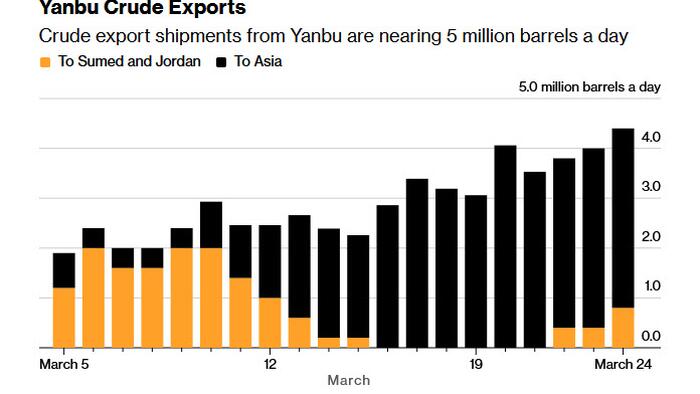
Fast forward to today when Bloomberg reported that Riyadh now aims to boost export shipments from its Red Sea ports to 5 million barrels a day, a target within reach. The East-West pipeline, linking the Abqaiq processing hub to Yanbu, has a nominal capacity of 7 million barrels a day. But 2 million of those are required to supply refineries in Riyadh and on the Red Sea coast at Yanbu and Jizan, near the Yemen border, as well as power generation and desalination plants.
Crude shipments for export from the Yanbu South and Yanbu North terminals averaged 4.4 million barrels a day in the five days to Tuesday, according to vessel tracking data compiled by Bloomberg. Flows through Yanbu have been rising steadily after the kingdom moved quickly to pump crude through the 746-mile conduit to the Red Sea.

Remarkably, the kingdom’s rerouting efforts have seen it double crude exports from Yanbu in just over two weeks. Even so, the diversions will only be enough to offset about half the lost Persian Gulf shipments this month. Even at target levels, Yanbu exports would still leave Saudi Arabia’s crude exports roughly 2 million barrels per day below pre-war levels, which however is a far cry from some of the worst case scenarios contemplated just days ago.

According to Bloomberg calculations, there are about 56 million barrels of Saudi crude held on tankers that are stuck in the Gulf. Those cargoes loaded in late February and early March, but have been unable to transit the Strait of Hormuz to the open seas.
At least 40 oil tankers, most of them very large and capable of hauling about 2 million barrels of crude each, are now anchored near Yanbu waiting to take on cargoes, the tracking data show.
Additionally, several ships stopped transmitting automated position signals in the Arabian Sea while en route to the Saudi port and may not reappear on tracking systems until they are well clear of the region. This could result in upward revisions to export figures.
Tankers that have loaded since the diversions began have mostly headed to Asia, with shipments to China and India dominating the flow. Cargoes are also bound for South Korea, Pakistan and Thailand. Customers in Japan have been supplied from storage tanks on the island of Okinawa, where the Saudi national oil company Aramco leases storage tanks that can hold 8.2 million barrels of crude.
In the early days of the conflict, shipments from Yanbu mostly went north to the Sumed pipeline that crosses Egypt to bypass the Suez Canal. Saudi Arabia typically loads crude for its customers in Europe and along the east coast of North America from a terminal at Sidi Kerir on Egypt’s Mediterranean coast.