from the please-support-techdirt dept
Yesterday, Rep. Harriet Hageman released her bill to repeal Section 230. She’s calling it “reform,” but make no mistake—it’s a repeal, and I’ll explain why below. The law turns 30 in February, and there’s a very real chance this could be its last anniversary.
Which is why we’re running Techdirt’s fundraising campaign right now, offering our very first commemorative coin for donations of at least $100 made before January 5th. That coin celebrates those 30 years of Section 230. But more importantly, your support funds the kind of coverage that can actually cut through the bullshit at a moment when it matters most.

Because here’s the thing: for nearly three decades, we’ve been one of the only sources to report fully and accurately on both how Section 230 works and why it’s so important. And right now, with a bipartisan coalition gunning to kill it based on myths and misinformation, that expertise is desperately needed.
Just in the last week or so on Bluesky I’ve posted two separate threads debunking some blatantly false narratives around Section 230 (one claiming that Section 230 means you’re not a publisher and another claiming that Section 230 is a “get out of jail free” card).
Section 230 remains one of the most misunderstood laws in America, even among the people in Congress trying to destroy it. Some of that confusion is deliberate—political expediency wrapped in talking points. But much of it has calcified into “common knowledge” that’s actively wrong. The “platform or publisher” distinction that doesn’t exist in the law. The idea that 230 protects illegal content. The claim that moderation choices forfeit your protections. All myths. All dangerous. All getting repeated by people who should know better.
So below, I’m highlighting some of our essential Section 230 coverage—not as a greatest hits compilation, but as a roadmap to understanding what’s actually at stake. If you believe in the open internet, you need Section 230. And if you need Section 230, you need someone who actually understands it fighting back against the tsunami of bullshit. That’s what you’re funding when you support Techdirt.
Let’s start with the big one. Our most popular post ever on Section 230:
Five years later, this is still the single most useful thing you can hand someone who’s confidently wrong about Section 230. It systematically demolishes every major myth—the platform/publisher nonsense, the “neutrality” requirement that doesn’t exist, the “good faith” clause people misread, all of it—in a format designed to be shared. And people do share it, constantly, because the same wrong arguments keep recycling. Consider this your foundation.
Why Section 230 ‘Reform’ Effectively Means Section 230 Repeal
This is the piece that exposes the semantic game. Politicians love to say they’re not repealing 230, just “reforming” it. But as Cathy Gellis explains, nearly every reform proposal accomplishes the same thing: it forces websites into expensive, extended litigation to reach an outcome the law currently reaches in weeks. That’s not reform—it’s sabotage by procedure. The real benefit of 230 isn’t the outcome (most of these cases would eventually win on First Amendment grounds anyway), it’s that you get there for $100k instead of $5 million. Strip that away and you’ve effectively repealed the law for everyone except the richest companies. Which, spoiler alert, is exactly the point of most “reform” proposals.
Those Who Don’t Understand Section 230 Are Doomed To Repeal It
A near universal trait of those who show up with some crazy idea to “reform” Section 230 is that they don’t understand how the law works, despite the many explainers out there (and an entire book by Jeff Kosseff). And that’s why, as with Cathy’s article above, the advocates for reform lean in on the claim that they’re just “reforming” it when they’re actually leading to an effective repeal.
Everything You Know About Section 230 Is Wrong (But Why?)
Law professor James Boyle asks the more interesting question: why do smart people keep getting this so catastrophically wrong? His answer—cognitive biases, analogies to other areas of law that don’t actually apply, and the sheer difficulty of thinking clearly about speech policy—explains why the same bad ideas keep resurfacing despite being debunked repeatedly. Understanding the psychology of the confusion is almost as important as correcting it.
Your Problem Is Not With Section 230, But The 1st Amendment
So many complaints about Section 230 are actually complaints about the First Amendment in disguise. People angry that a website won’t remove certain speech often blame 230, but the reality is that the First Amendment likely protects that speech anyway. Prof. Jess Miers explains why killing 230 won’t magically enable the censorship people want—it’ll just make the process more expensive and unpredictable. Some people hear that and think “great, we can rely on the First Amendment alone then!” Which brings us to:
Why Section 230 Is Better Than The First Amendment
This is the piece that clicks it all into place. Prof. Eric Goldman’s paper explains that 230 isn’t an alternative to First Amendment protection—it’s a procedural shortcut to the same outcome. Without 230, most of these lawsuits would still eventually fail on First Amendment grounds. The difference is it would cost $3-5 million in legal fees to get there instead of $100k. That $100k vs $5 million gap is the difference between an ecosystem where small companies can exist and one where only giants survive. Anyone telling you we can just rely on the First Amendment either doesn’t understand this or is deliberately trying to consolidate the internet into a handful of megacorps.
NY Times Gets 230 Wrong Again; Misrepresenting History, Law, And The First Amendment
And now we get to the part where even the supposed experts fuck it up. The NY Times—the Paper of Record—has made the same basic factual error about Section 230 so many times they’ve had to run variations of this correction repeatedly:
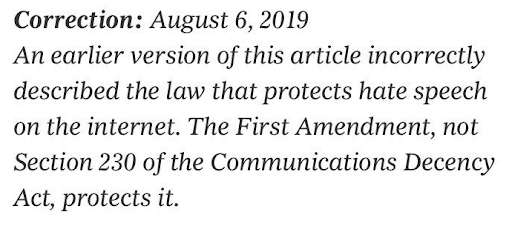
If it feels like you can’t trust the mainstream media to accurately report on Section 230, you’re not wrong. And that’s why we do what we do at Techdirt.
Even the tech press—outlets that should know better—regularly faceplants on this stuff. This Wired piece was so aggressively wrong it read like parody. The value here is watching us dissect not just the errors, but how someone can write thousands of words about a law while fundamentally misunderstanding what it does.
The title says it all. When former members of Congress—people who theoretically understand how laws work—produce something this catastrophically wrong, it reveals the scope of the problem. These aren’t random trolls; these are people with institutional credibility writing op-eds that influence policy. The danger here is that their ignorance carries weight.
Before Advocating To Repeal Section 230, It Helps To First Understand How It Works
The pattern is almost comical: someone decides 230 is bad, spends zero time understanding it, then announces a “solution” that would either accomplish nothing or catastrophically backfire. This piece is representative of dozens we’ve written, each time responding to a new flavor of the same fundamental confusion, like no other publication online.
No, Revoking Section 230 Would Not ‘Save Democracy’
People have assigned Section 230 almost mystical properties—that it’s the reason democracy is failing, or that repealing it would somehow fix polarization, or radicalization, or misinformation. The law does none of these things, good or bad. This piece dismantles the fantasy thinking that treats 230 like a magic wand.
Five Section 230 Cases That Made Online Communities Better
Amid all the doom-saying, it’s worth remembering what 230 actually enables. Jess Miers walks through five specific cases where the law protected communities, support groups, review sites, and services that improve people’s lives. Repealing 230 doesn’t just hurt Facebook—it destroys the ecosystem of smaller communities that depend on user-generated content.
Please support our continued reporting on Section 230
There are dozens more pieces in our archives, each responding to new variations of the same fundamental misunderstandings. We’ve been doing this for nearly three decades—long before it was politically fashionable to attack 230, and we’ll keep doing it as long as the law is under threat.
Because here’s what happens if we lose this fight: the internet consolidates into a handful of platforms big enough to survive the legal costs. Smaller communities die. Innovation gets strangled in the crib. And ironically, the problems people blame on 230—misinformation, radicalization, abuse—all get worse, because only the giants with the resources to over-moderate will survive, and they’ll moderate in whatever way keeps advertisers and governments happy, not in whatever way actually serves users.
That’s the stakes. Not whether Facebook thrives, but whether the next generation of internet services can even exist.
We’re committed to making sure policymakers, journalists, and anyone who cares about this stuff actually understand what they’re about to destroy. But we need support to keep doing it. If you agree that Section 230 matters, and that someone needs to keep telling the truth about it when even the NY Times can’t get basic facts right, support Techdirt today. Consider a $230 donation and get our first commemorative coin, celebrating 30 years of a law that’s under existential threat and making sure it survives to see 31.
Filed Under: journalism, section 230
Companies: techdirt