from the who-has-time-for-all-this-nonsense? dept
Not this shit again.
A bipartisan group of the most anti-internet Senators around have released their latest version of a plan to “sunset Section 230.” We went over this last year when they floated the same idea: they have no actual plan for how to make sure the open internet can continue. Instead, their “plan” is to put a gun to the head of the open internet and say they’re going to shoot it… unless Meta gives them a different alternative. Let’s bring back Eric Goldman’s meme:
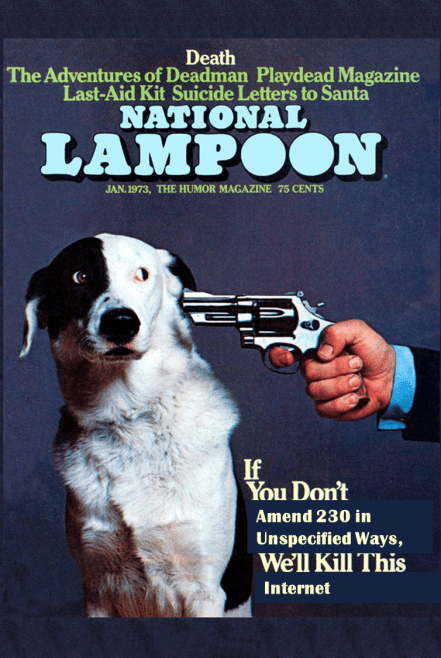
There is no plan for how to protect speech on the internet. There’s just hostage-taking. And remarkably, the hostage-takers are saying the quiet part out loud. Here’s Senator Dick Durbin’s comment on releasing this bill:
“Children are being exploited and abused because Big Tech consistently prioritizes profits over people. Enough is enough. Sunsetting Section 230 will force Big Tech to come to the table take ownership over the harms it has wrought. And if Big Tech doesn’t, this bill will open the courtroom to victims of its platforms. Parents have been begging Congress to step in, and it’s time we do so. I’m proud to partner with Senator Graham on this effort, and we will push for it to become law,” said Durbin.
Read that bolded part again. Durbin is admitting—in a press release, for the record—that he wants Big Tech to write internet policy. He’s threatening to blow up the legal framework that allows everyday people to speak online unless Mark Zuckerberg comes to his office and tells him what laws to pass. This is Congress openly abdicating its responsibility to govern in favor of letting a handful of tech CEOs do it instead.
The problem? The people who benefit from Section 230 aren’t the big tech CEOs. They’re you. They’re me. They’re every small forum, every Discord server, every newsletter with comments, every community space online where people can actually talk to each other without first getting permission from a building full of lawyers.
They want “big tech” to come to the table, even though (as we’ve explained over and over and over again) the damage from repealing 230 is not to “big tech.” Hell, Meta has been calling for the removal of Section 230 for years.
Why? Because Meta (unlike Durbin) knows exactly what every 230 expert has been saying for years: its main benefit has fuck all to do with “big tech” and is very much about protecting you, me, and the everyday users of the internet, creating smaller spaces where they can speak, interact, build community and more.
Repealing Section 230 doesn’t hurt Meta at all. Because if you get rid of Section 230, Meta can afford the lawsuits. They have a building full of lawyers they’re already paying. They can pay them to take on the various lawsuits and win. Why will they win? Because the First Amendment is what actually protects most of the speech these dipshit Senators are mad about.
But winning on First Amendment grounds probably costs between $2 million and $5 million. Winning on 230 grounds happens at an earlier stage with much less work, and probably costs $100k. A small company can survive a few $100k lawsuits. But a few $5 million lawsuits puts them out of business.
We already know this. We can see it with the DMCA, which was always weaker than Section 230. A decade and a half ago, Veoh was poised to be a big competitor to YouTube. But it got sued. It won the lawsuit… but went out of business anyway, because the legal fees killed it before it won. And now YouTube dominates the space.
When you weaken intermediary protection laws, you help the big tech providers.
Separately, notice Durbin’s phrasing about children being exploited. Can some reporter please ask Dick Durbin to explain how removing Section 230 protects children? He won’t be able to answer, because it won’t help. Or maybe he’ll punt to Senator Graham, whose press release at least attempts an answer:
“Giant social media platforms are unregulated, immune from lawsuits and are making billions of dollars in advertising revenue off some of the most unsavory content and criminal activity imaginable. It is past time to allow those who have been harmed by these behemoths to have their day in court,” said Graham.
Day in court… for what? Most “unsavory content” is constitutionally protected speech. The rap sheet is mostly First-Amendment activity—Section-230 just spares hosting it; repeal means litigating over legal speech, one plaintiff at a time.
As for criminal activity, well, that’s a law enforcement issue, not related to Section 230. If you don’t think that criminal activity is being properly policed online, maybe that’s something you should focus on?
Section 230 gives companies the freedom to make changes to protect children. That was the entire point of it. Literally, Chris Cox and Ron Wyden wanted a structure that would create incentives for platforms to be able to protect their users (including children!) without having to face legal liability for any little mistake.
If you take away Section 230, you actually tie the hands of companies trying to protect children. Because, now, every single thing they do to try to make their site safer opens them up to legal liability. That means you no longer have trust & safety or child safety experts making decisions about what’s best: you have lawyers. Lawyers who just want to protect companies from liability.
So, what will they do? They’ll do the thing that won’t protect children (which is risky), the thing that avoids liability, which tends to be to putting your head in the sand. Avoiding knowledge gets you out of these lawsuits, because under existing distributor liability concepts, knowledge is key to holding a distributor liable.
The only benefits to killing Section 230 are (1) to the biggest tech companies who wipe out competitors, (2) to the trial lawyers who plan to get rich suing the biggest tech companies, and (3) to Donald Trump, who can use the new rules to put even more pressure on the internet to suppress speech he doesn’t like.
I know for a fact that Senator Wyden has tried to explain this to his colleagues in the Senate, and they just refuse to listen.
This is exactly why Techdirt needs your support. When the most powerful people in government are ignoring experts and pushing legislation based on lies, someone needs to keep explaining what’s actually happening. We’ve been doing that for over 25 years, and we’re going to keep doing it—but we need your help to make sure that continues.
Meanwhile, the actual users of the open internet—and the children Durbin claims to be protecting—come out worse off. Senator Durbin and his cosponsors (Senators Graham, Grassley, Whitehouse, Hawley, Klobuchar, Blackburn, Blumenthal, Moody, and Welch) know all this. They’ve been told all of this. Sometimes by Senator Wyden himself. But all of them (with the possible exception of Welch who I don’t know as much about) have a long and well-known history of simply hating the fact that the open internet exists.
The bill isn’t child protection, and it sure isn’t tech regulation. It’s a suicide pact drafted by people who’ve always despised an internet they don’t control. Zuckerberg gets handed the pen; we get handed the bill—and the bullet.
Filed Under: amy klobuchar, chuck grassley, dick durbin, josh hawley, lindsey graham, marsha blackburn, open internet, richard blumenthal, ron wyden, section 230, sheldon whitehouse, sunset