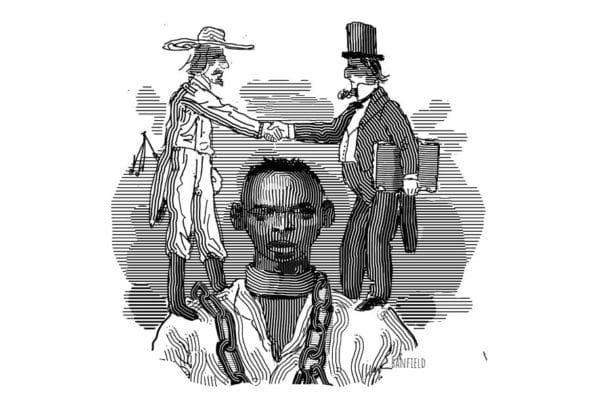
“A central argument of this book,” writes Brown University labor historian Seth Rockman, “is that plantation goods played a key role in nineteenth-century race-making.” “Race-making,” as understood by Rockman and other contemporary academics, is the assignment of meaning to categories of people divided by skin color. In America, that meant the creation of whites as a superior race and blacks as an inferior and subordinate one. “Plantation goods” are the shirts, shoes, hats, axes, hoes, chains, and whips that were manufactured in the North and sold to Southern slaveholders. The division of Rockman’s Plantation Goods: A Material History of American Slavery follows the products’ life cycle: production (part 1), distribution (part 2), and consumption (part 3). The story travels from the North, where plantation goods were produced, through the commercial middlemen who straddled both regions, to the South, where slaveholders bought, and slaves used, those goods.
Like many historians these days, Rockman advances strong moral positions. The most consequential of these is that by making money from the sale of plantation goods, the white North was a direct stakeholder in slavery and therefore culpable in its atrocities. As “a geographically un-bounded institution,” slavery was a national crime, not simply a Southern one. Rockman’s position—that the North was wrong to have made plantation goods for slaveholders—mirrors abolitionist William Lloyd Garrison’s cry, “No Union With Slaveholders.” Today, Garrison’s stance survives in the form of economic boycotts and shunning sinners in other ways—and raises serious moral and political questions. Real life requires more than just sound principles and courage, both of which Garrison had (and many of our boycotting friends have as well). Prudence is also required.
***
Was humanity better served by selling plantation goods to slaveholders or by breaking fellowship with them? Rockman dismisses out of hand the former prospect. The central figures in his book, Rhode Island textile magnates Isaac and Rowland Hazard, “would have rejected the suggestion that they were parasitic feeders upon the stolen wealth of slave labor,” Rockman acknowledges. Instead, they saw themselves as promoters of “the harmony of the nation, the well-being of their employees, and comfort of the slave.” Rockman supplies ample evidence that this species of business strengthened connections between sections of the country and countered the centripetal forces tearing America apart. Amid the acrimony caused by tariffs, rising abolitionism, and the Fugitive Slave Law, Rockman’s history recounts trading partners and middlemen, North and South, advising and supporting each other concerning how to maintain their business relations and to avoid the wrath of inflamed partisans. These economic cords helped to hold the Union together.
But of what value was the Union to the cause of humanity? On this question, Rockman is unfortunately silent. The Union’s formation and preservation limited the aspirations of Southern states to expand their slaveholding oligarchy into a larger monster than it was. Every fight in Congress obstructed the slaveholders from extending slavery into new territories (they later remedied this by a provision in the Confederate constitution that made slavery legal in all future territories). Present-day Garrisonian-progressive scholars lament the Federal Convention in 1787 for its concessions to slavery—especially its prolongation of the slave trade to at least 1808—meant to preserve and strengthen the Union. In 1861, Leonidas Spratt, delegate to the Confederate constitutional convention, lamented this provision because, as James Wilson had argued, it allowed Congress to ban the slave trade after 1808 and guaranteed its suppression. But with the breakup of the Union, Spratt was optimistic: the South could hold 40 million more slaves imported from Africa, even before factoring in the expected expansion of Confederate borders. Spratt’s statements give us some taste of what the intentions of the slaveholding oligarchy were. The preservation of the Union restrained their ambitions and prevented a greater humanitarian calamity.
***
Prudence has something to say in favor of Rockman’s side of the argument, as well. In repeating his mantra that he didn’t care if slavery was voted up or down, Stephen Douglas exhibited the limits of the case for Union, as Abraham Lincoln pointed out. The body of the Union ought to be preserved, but not at the cost of its republican soul. Slavery did corrupt Northerners, and Rockman provides new evidence that supports Lincoln’s fear of moral decline. When slaveholders could not pay back their Northern suppliers, they sometimes offered to put up slaves for sale or surrendered slaves as collateral. Some Northern firms thereby became direct recipients of slaves and slave profits.
Corruption took other forms. The market that plantation goods served was literally captive, which facilitated mass purchasing and, therefore, mass production. Previously, the entire labor market in the North was a gig economy. Everyone was a free agent. Farmers and their families worked second jobs at home on contract and earned income by the quantum of production. But the mechanization of Northern production moved the place of labor to the factory house and changed the measure of labor, in Rockman’s words, into “a quantum of time with a price.”
New business conditions were challenging the republican organization of Northern society. Samuel Collins, an owner of a Connecticut factory that made axes, hoes, and other tools, demanded that employees sign labor contracts that held back pay for a year or more and that included non-compete clauses, blocking worker mobility. Rockman writes that “Collins spoke of workers needing to be ‘bridled and spurred every day.’” In saying this in 1830, Collins had knowingly or unknowingly inverted the famous line borrowed by Thomas Jefferson in a letter four years earlier, that “the mass of mankind has not been born, with saddles on their backs, nor a favored few booted and spurred, ready to ride them.” To what extent the market for plantation goods precipitated this change in business conditions is not clear, but the connection cannot be doubted.
Northern corruption even extended to attempts to suppress Northern liberties. In 1835, members of the Hazard family became leaders of a campaign that petitioned the Rhode Island legislature to silence abolitionists. What Rockman does not relate is that this was the same year South Carolina governor George McDuffie demanded that Northern states ban abolitionist speech. Refusal to do so, he said, would be considered an act of war. Some members of the Hazard family obeyed.
***
Northerners fare poorly under Rockman’s pen. How he handles the Hazard brothers is illustrative. The brothers employed free black Rhode Islanders, provided support and legal protection for a manumitted black family in Charleston, intervened on behalf of free black sailors unjustly incarcerated in Southern ports, and supported the anti-slavery Republican Party and Lincoln for president. Most remarkably, Rowland Hazard put himself in physical danger to secure the liberation of a hundred free black sailors in New Orleans. Yet Rockman is not impressed: Rowland “was much more troubled that free people of color might lose their precarious liberty without due process than that millions of enslaved people had already lost it.” He was a moral fake, a poseur. The Hazard brothers made “negro cloth” for slaveholders, and that is all the proof needed to doubt their probity.
With respect to slaveholders, Rockman scatters clues that could be picked up, reorganized, and given a better general explanation. First, they were not punctual in the payment of their debts, which irritated Northern firms. Yankees were accustomed to tougher fiscal discipline. Samuel Rodman, for example, was a successful textile manufacturer and state legislator. But he had been born poor in New England and saw his father, Robert, put into debtor’s prison despite his chronic typhus. The slaveholders didn’t have to fear such rough Yankee treatment for non-payment of debts. Rural courts and the law favored them, allowing them to choose the order of their creditors and to retitle assets to kinfolk. Second, slaveholders generally demanded low prices from Northern firms. They were cash-poor, attested Rowland Hazard, because whenever they had cash, “they generally expend again in the purchase of land and negroes.” Third, though encouraged by growing sectional animosity, they never could develop their own manufacturing and free themselves from their dependency on the North for plantation goods. Rockman relates that they even had a model ax in their midst that had won a fortune for a recently deceased Northern producer but, “owing to ‘Carolina Stupidity,’ no local producer had stepped into the void. Accordingly, the market was wide open for anyone who could produce this ‘exact’ ax.”
In the South, wealth and credit were measured by land and slaves, and so the disposition of cash was biased toward reinvestment in the same. Business ventures that targeted new markets with new products were risky. The formula for getting rich, as a planter, was as close to risk-free as passively investing in equity markets and real estate have been in America for the past 40 years. Then as now, the rich have an advantage. They can finance new purchases while prices rise beyond the reach of the less rich and the poor. If that economic oligarchy edges into political oligarchy—as it did in the slaveholding South—then they can control the law to serve their interests. No debtors’ prison for them.
***
Filling out Rockman’s picture of oligarchy is the brief appearance of the poor, non-slaveholding whites—a majority of the Southern population—who were deemed, as Rockman notes, “close to the slave in status.” Some Southerners argued that ramping up manufacturing in the South could provide employment to poor whites. This proposal was shot down by the future Confederate secretary of the treasury, C.G. Memminger, who feared it would make them “hot Abolitionists.” A rising middle class might threaten the oligarchy’s power and wealth, which rested on slaveholding. Despite the evidence, Rockman does not recognize that his frequently repeated phrase “white supremacy” is a misnomer as applied to the antebellum South. The South’s ruling class consisted not so much in white over black, as rich whites over poor whites and blacks—an oligarchy.
To the Yankee, Southern reluctance to take advantage of an obvious entrepreneurial opportunity appeared stupid because Northern and Southern economies and habits differed widely. In the North, wage labor was expensive. Northerners could not grow their land holdings larger than what their own families could work but they could earn good wages. Investment was biased toward labor-saving machinery and processes. Technological entrepreneurship was the result. Rockman captures the energy and ingenuity of the Yankee entrepreneurs as they chased down markets and innovated business functions—product design, product management, version control, business development, branding, collections, and marketing. To combat the slow-paying slaveholders they invented credit reporting, the predecessor of Experian. What was the source of this energy and ingenuity? Unlike other political societies, in which upward mobility is impossible for most and downward mobility impossible for a few, the Yankees could fall and rise in freedom. They were governed by a realistic hope of success and an equally realistic fear of debtors’ prison. Hard, intelligent work was the only way forward.
In his zeal to develop his thesis about race, Rockman delivers a well-researched book that is useful to an end that he did not intend: illustrating the contrast between oligarchic and republican economies.