One of the more depressing parts of being an awake physician in the medical system is reading the drug lists of the patients you see and realizing how many prescriptions they are on that do not benefit them, and in many cases harm them. Presently, 68% of U.S. adults are estimated to have at least one prescription and on average, American adults are on four different medication.
Since doctors are extremely reluctant to terminate existing prescriptions, this creates a scenario where people get placed on more and more drugs as they age (some of which are for treating the side effects of other drugs they are taking).
This situation is even worse for the elderly, who have more time to be put on an increasing number of medications, and due to their altered physiology, are also the most vulnerable to the harmful effects of those medications. For example, from 2009-2016, after two billion office visits were assessed, it was found that for adults over 65, 65.1% were on two or more drugs, 48.9% were on four or more, and 36.8% were on more than five (with the highest use occurring in the oldest Americans).
One of the best illustrations of the problem came from a study that compared 119 disabled elderly adults living in nursing homes to 71 matching controls. These patients (on average, were on 7.09 medications) were screened for which of their medications clearly met the existing criteria for being discontinued (on average 2.8 per patient). After those medications were discontinued in the test group, when compared to the controls who remained on all of their existing prescriptions, it was found that:
•The death rate dropped by 53% (in one year, 45% of the control group died, whereas 21% of the test subjects died).
•The annual rate of hospital referrals dropped by 60.7% (30% of the controls vs. 11.8% of the study).
•Not surprisingly, there were also significant cost savings from withdrawing the unneeded medications.
In short, doing nothing except terminating some of the most egregious prescriptions for our elders (who often lack the autonomy to refuse their prescriptions) resulted in a 23% reduction in their death rate. When you consider that many of these drugs are approved for much smaller reductions of the death rate, and that they frequently have a variety of other concerning side effects (e.g., triggering dementia), the absurdity of this situation (e.g., that this pivotal study never changed how we practice medicine) becomes apparent.
For example, almost everyone is put on statins—especially as they get older. Yet in trials evaluating statins, for instance, their effect on 50-75 year old patients’ risk of heart disease, statins caused a 0.4% reduction in the annual risk of a major cardiovascular event (most of which are not fatal) and no benefit in the overall death rate. Likewise, according to the existing trials (which are almost certainly biased to favor the pharmaceutical companies funding them), it was found on average that taking a statin for five years would increase your expected lifespan by three to four days. In contrast, statins are notorious for causing adverse effects which affect at least 20% of recipients. These effects include cognitive impairment and dementia, personality changes, loss of sensation throughout the body, and significant muscle weakness or muscle aches.
This seems absurd until you also consider that statins are also one of the most profitable drug markets in existence.
Note: a more detailed summary of the great statin scam and the tragic adverse effects of statins can be found here.
The Worst Drugs on The Market
A frequent question I receive is what the most harmful medications in America are. Prior to the COVID-19 vaccines (which I feel have earned that distinction). While a case can be made many drugs and vaccines are worthy of that distinction, almost every integrative doctor I ever asked this question to (prior to the COVID vaccines) would include the following drugs in their top 5:
• Proton pump inhibitors (PPIs—the most potent stomach acid blocker and focus of this article)
• SSRI antidepressants (e.g., Prozac)
• Statins
• NSAIDs (e.g., Ibuprofen)
Note: while there are more harmful drugs on the market, these were typically selected due to just how many people are put on them. Additionally, birth control pills, corticosteroids, bisphosphonates for osteoporosis, or antipsychotics were often (but not always) the fifth drug selected.
In sales, a common practice is to start with a free or low cost item, and then from the pool of people who get it, use their investment to sell them a moderately priced item, and then from the pool of those buyers, sell a more expensive item and so forth. This business practice, in turn, is known as creating “sales funnels.”
Frequently, with the above drugs (and many others), I see a variety of sales funnels. For instance, adolescent girls are frequently put onto birth control pills by their pediatricians (e.g., this survey found 54% of women aged 15-19 had used the pill)—often for reasons unrelated to sex (e.g., painful periods or PMS in a twelve year old).
Birth control pills, in turn frequently cause significant mood swings and mood alterations (e.g., a large study detected a 130% increase in the rates of depression during the first two years of using the pill), which often leads to these new mood disorders being “treated” with an SSRI antidepressant (which now more than 10% of teenage girls are on). In turn, one of the more common side effects of SSRIs are other new psychiatric disorders (bipolar I is the most common) which are then treated with an antipsychotic (or another mood stabilizer).
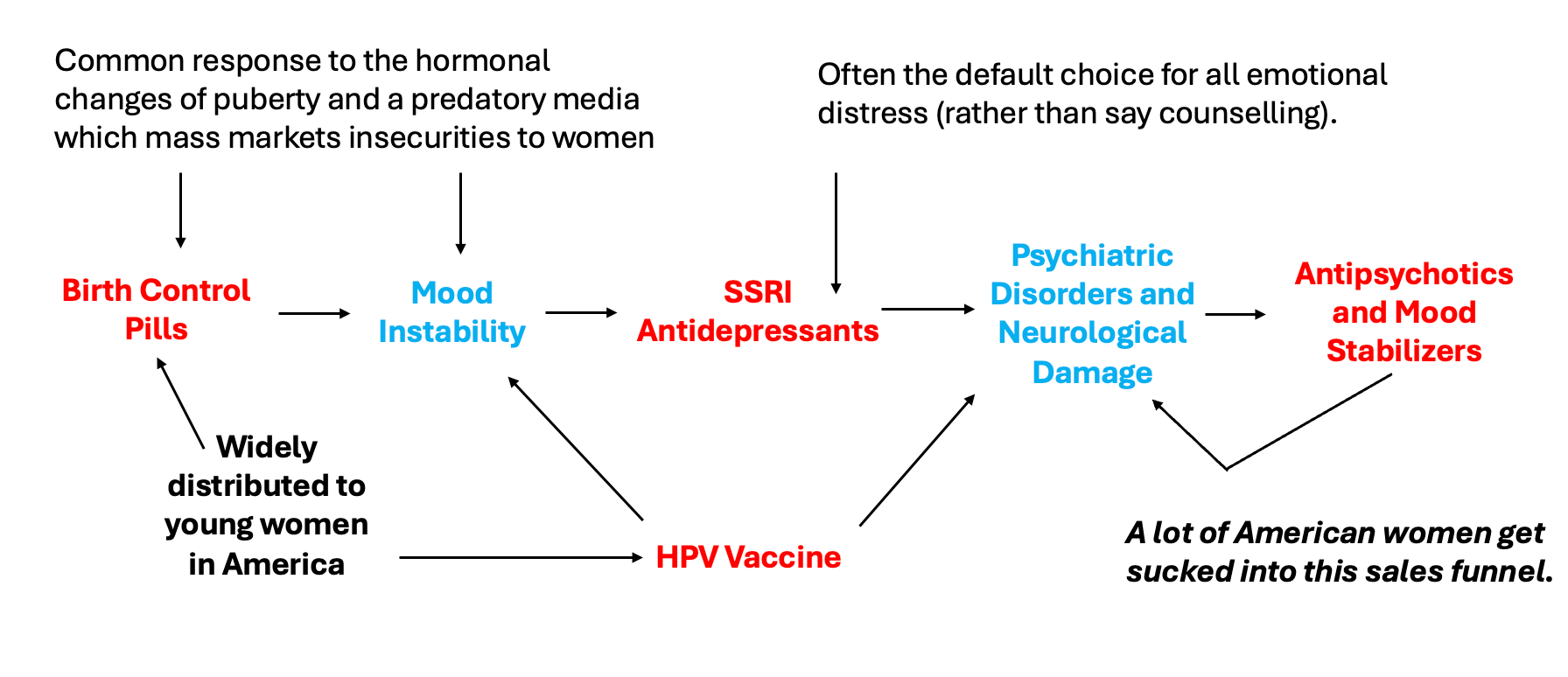
As a result, I often meet young women who went through this sales funnel in their adolescent years and now are on damaging antipsychotics. Additionally, I’ve also spoken to a few people who had been on this pipeline and said the neuropsychiatric damage they developed from the HPV vaccine ultimately tipped them over the edge (which then required taking an antipsychotic which frequently caused even more chronic psychiatric and neurological issues for them).
Note: one of the primary issues is that they cause so many different chronic illnesses (e.g., here I show all the studies which compared vaccinated to unvaccinated children found vaccination typically caused a 3X to 10X increase in the rate of common chronic illnesses).
As you might guess, I am not a fan of this business model, and one of my goals here is to gradually go through why each of these malignant drugs can cause so many problems. Fortunately, we are at last seeing a massive cultural shift on this issue, highlighted by things like a recent interview (viewed 57 million times) where Tucker Carlson and Elon Musk discussed the birth control-antidepressant sales funnel:
Elon Musk is all in.
(0:00) Elon Musk Is All in on Donald Trump
(6:35) Providing Starlink to Victims of Hurricane Helene
(9:22) If Trump Loses, This Is the Last Election
(21:49) The Epstein and Diddy Client List
(33:38) Vaccines
(35:49) The Movement to Decriminalize Crime… pic.twitter.com/jNqB1ThqQz— Tucker Carlson (@TuckerCarlson) October 7, 2024
Translational Medicine
Since medicine is supposed to be “science based,” a recurring question is why the most important scientific discoveries are never adopted into clinical practice, or if they are, it often takes years if not decades to be (this is what the discipline of translational medicine seeks to address).
When I first started my medical education, a mentor told me:
The medical profession has always been remarkably conservative in adopting new ideas. Try not to get frustrated if they won’t consider the evidence you present to them.
In turn, in this publication, I’ve tried to gradually review examples of the medical profession’s widespread refusal to consider critically important evidence that was being presented to them again and again and again, such as the fact many widely prescribed medications are harmful and unnecessary, or that much safer and effective alternatives (e.g., DMSO) exist.
One key innovator in the integrative medicine field was Jonathan Wright MD, a physician researcher with a unique knack for digging up forgotten studies that were extremely relevant to patient care. Many of these related to natural alternatives to pharmaceuticals, and were so effective Wright’s work ultimately shaped a significant portion of the natural medicine.
Likewise, Wright’s clinic attracted so much attention (due to the fact it frequently treated “incurable” cases and had patients from around the world come to visit) that the FDA frequently targeted the clinic and eventually conducted an inappropriate raid at gunpoint to confiscate Wright’s vitamins which enraged the public and caused one of the most critical health freedom laws in American history to be passed—a 1994 one which took away much of the FDA’s ability to regulate natural supplements.
One of Wright’s critical insights was that our entire understanding of acid reflux was completely incorrect and that immense health consequences followed from it. Wright eventually wrote a 2001 book on the subject, Why Stomach Acid Is Good For You, which not only synopsized the entire issue but also accurately predicted many of the harms longterm research into PPIs (proton pump inhibitors) would actually show. Sadly, like many things in medicine, decades later, there is still only a partial recognition of the critical points Wright laid out in his book.
What Is Acid Reflux?
Your stomach contains acid it uses to digest food (primarily by turning on powerful enzymes that digest protein). When the stomach is digesting food, the acid should stay inside the stomach, but sometimes it instead leaks back up into the esophagus (your throat) because the muscle that seals the top of the stomach fails to fully seal it. Since stomach acid is irritating, when it refluxes into the throat (which unlike the stomach does not have tissue designed to resist stomach acid), it frequently creates the irritating condition known as heartburn.
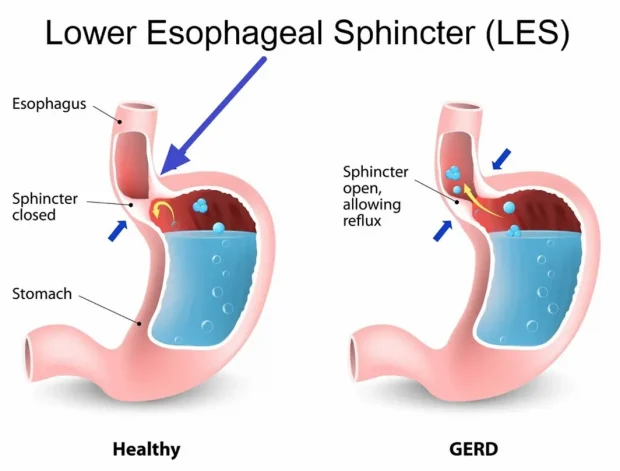
Gastroesophageal reflux disease (GERD) is a very common condition, estimated to affect 20% of adults (ranging between 18.1% to 27.8% of adults in the USA), is slightly more common in women, and those numbers have been gradually increasing globally. Since the heartburn it typically triggers causes immediate discomfort, people with GERD typically want it to be treated, especially once their doctor encourages this (e.g. because otherwise your esophagus can get damaged and potentially turn cancerous).
In addition to overt acid reflux, another condition also exists, known as silent reflux (or laryngopharyngeal reflux), where more minor reflux occurs without causing overt heartburn. Although I believe the medical industrial complex tends to overhype diseases so more medications can be sold for them, I feel silent reflux belongs to the other camp, as it is frequently not recognized as the root cause of a variety of other symptoms such as:
• Allergies
• Asthma and reactive airway diseases
• Burning in the mouth or on the tongue
• Chronic sore throat
• Ear pressure and ear infections
• Frequently feeling like you need to clear your throat (and sometimes cough)
• Post-nasal drip
• Sensation of a painless lump in the throat
• Sinus issues
The specialty of otolaryngology (ears, nose, and throat [ENT] medicine) best illustrates the impact of silent reflux as a surprisingly high number of the issues patients see an ENT for are actually just due to silent reflux. In turn, more observant ENTs can recognize and fix those symptoms by focusing on silent reflux rather than trying to treat the symptoms with medications directed at each individual issue. More importantly, silent reflux tends to have a greater response to lifestyle changes (e.g., eating different foods) and thus can often be easily treated without medications (although a brief course of medications is often used to help patients recognize that silent reflux is causing their issues).
Stomach Acid Is Good For You
One of the things I always marvel at is how subtle distortions tend to occur in science which lead to everyone having a false conception of reality that conveniently allows a profitable industry to exist. One such example can be found with stomach acid, something the medical field views as largely unnecessary and thus possible to justify eliminating with acid suppressing medications.
Stomach acid for context, serves a variety of critical functions. They include:
• Making it possible to fully break down protein.
• Sterilizing the stomach so foreign bacteria, viruses, yeasts, and parasites cannot enter the digestive tract.
• Chelating minerals from food so they can be absorbed.
• Making it possible to absorb certain vitamins and nutrients (e.g., vitamin B-12).
• Regulating the rest of digestion.
Yet, most of these are “forgotten sides of medicine” as the critical functions of stomach acid besides digesting protein are typically barely mentioned within the medical curriculum. For instance, medical students are taught to believe protein digestion occurs primarily within the small intestine and that the digestive enzymes from the pancreas alone are sufficient to digest protein once it reaches the small intestine, thereby eliminating any remaining need for the stomach’s acid. Within this paradigm, it thus becomes justifiable to suppress stomach acid as much as possible with acid blocking medications.
Let’s now look at why these functions are in fact vitally important.
Note: typically with medical interventions and correlated conditions, you see small to moderate correlations between them. One of the most striking things about stomach acid is over and over again how large the effect of adequate vs. inadequate stomach acid is—in most of the studies Wright cited that we will discuss in the following sections, between a two to ten-fold difference in health could be observed once sufficient stomach acid was present.