You’re reading The Morning Dispatch, our flagship daily newsletter explaining all the news you need to know today in fewer than 15 minutes. To unlock the full version, become a Dispatch member today.
Happy Monday. It was a momentous weekend for the people of Iran and the Middle East.
Quick Hits: Today’s Top Stories
U.S. and Israel Strike Iran
U.S. and Israeli forces launched a military operation against Iran over the weekend, with Israeli strikes targeting the regime’s senior leadership, including Iranian Supreme Leader Ali Khamenei, and U.S. planes and missiles targeting the country’s military and nuclear facilities. Hours after the strikes against Iran commenced, U.S. and Israeli officials announced Khamenei had been killed, which Iranian state media later confirmed. Iran responded by firing on Israel, the United Arab Emirates, Qatar, Kuwait, Bahrain, Oman, Jordan, Iraq, and Saudi Arabia, hitting local targets and U.S. military facilities. U.S. officials said that three American military service members have been killed in the operation thus far, though their identities have not yet been made public, while five other soldiers were seriously injured. To learn more about the operation, read the full piece in today’s TMD.
- Iran has since named a three-person interim council to lead the regime following the death of Khamenei, which includes Iranian President Masoud Pezeshkian.
- The Israel Defense Forces also said that the Lebanese-based, Iranian-backed terrorist group Hezbollah launched attacks directed at Israel, which Israel responded to with strikes on Lebanon.
- A girls’ elementary school in the southern town of Minab—adjacent to an Islamic Revolutionary Guard Corps naval base—appears to have been hit by one of the initial strikes, with Iranian state media claiming more than 175 people were killed. U.S. Central Command said it was “aware of reports concerning civilian harm” and was “looking into them.”
- Three American F-15 fighter jets crashed in Kuwait overnight in what appears to be a friendly fire incident, according to U.S. Central Command. None of the crew was hurt.
Shooting in Austin
A 53-year-old gunman shot and killed two people outside a bar in Austin, Texas, early on Sunday morning, wounding 14 others. Police arrived at the scene and opened fire on the suspect, killing him. Witnesses said that the suspect first drove around the block several times before firing shots from his vehicle at people gathering outside the bar. He then parked his car and fired additional shots before law enforcement fatally struck him. The gunman, who officials later said was a U.S. naturalized citizen from Senegal, wore a shirt depicting an Iranian flag design, and a hoodie reading “Property of Allah.”
- According to Alex Doran, Acting Special Agent in Charge of the FBI’s San Antonio Field Office, the agency is investigating whether the attack was terrorist-motivated or linked.
- Authorities uncovered “indicators” on the suspect’s person and vehicle that suggested a “potential nexus to terrorism.”
- Officials have not yet announced a motive for the attack.
Pakistan Forces Kill Pro-Iranian Regime Demonstrators
Security forces in Pakistan clashed on Sunday with pro-Iranian regime demonstrators, leaving at least 22 people killed in two separate areas, and wounding more than 120 others. In the southern Pakistani port city of Karachi, demonstrators gathered outside the U.S. consulate in the city, clashing with Pakistani police and setting a vehicle on fire. Reuters reported that the crowds were critical of the U.S. and Israeli strikes against Iran, with crowds in the Pakistani city chanting, “Death to America! Death to Israel!” Some attempted to breach the building, prompting consulate security officials to open fire. Demonstrators also targeted a United Nations office building in the northern Pakistani region of Gilgit-Baltistan on Sunday, sparring with law enforcement before setting the building on fire. There were no reported deaths of any U.S. consulate or UN employees.
- Pakistani government officials said peace has been restored to both sites after soldiers were sent in to disperse the crowds of demonstrators.
- Taliban-ruled Afghanistan announced that it had carried out defensive strikes in its capital city of Kabul, targeting Pakistani warplanes that were attacking the city.
Ukraine Negotiation Developments
Kyrylo Budanov, the chief of staff for Ukrainian President Volodymyr Zelensky, said on Saturday that, during recent peace deliberations in Geneva, Russia’s negotiating team said it would accept terms for a U.S.-proposed post-war security guarantee for Ukraine. Budanov added that Russian officials have not yet agreed to a potential in-person meeting between Zelensky and Russian leader Vladimir Putin in the near future. Meanwhile, Russia launched aerial attacks across several Ukrainian regions on Saturday night and into Sunday, killing one civilian and wounding four others in Ukraine’s Dnipropetrovsk Oblast. Russia’s targets in the attacks included residential areas, according to Ukraine’s military. Also, local Russian officials claimed a woman was killed in a Ukrainian drone attack in the western Russian village of Chernookovo.
- Russian officials said that Ukraine targeted oil facilities in an attack in the Russian port city of Novorossiysk, setting one terminal on fire.
- According to analysis from the French-based news outlet AFP, Russia fired 288 missiles into Ukraine overnight in February, the most of any month in the war since the beginning of 2023, and more than double the 135 total number of missiles Russia fired in January.
OpenAI Raises $110 Billion
OpenAI announced Friday that it had raised $110 billion in its latest investment funding round, which valued the company at $730 billion. Amazon committed to investing $50 billion in cash—$15 billion now, and a further $35 billion when the AI company either launches an initial public offering or creates an artificial general intelligence tool—and is Amazon’s largest investment to date. In return, OpenAI will help integrate AI tools into Amazon’s platform, including deploying customized AI models to improve Amazon’s consumer-facing platforms. NVIDIA and SoftBank are each investing $30 billion, and OpenAI said that more investors are expected to join. OpenAI’s previous valuation, from a secondary share sale in October 2025, was $500 billion.
- On Friday, OpenAI reached a deal with the Defense Department to allow the agency to use its AI tool in its operations, while outlining that it will not allow its technology to assist autonomous weapon systems or mass surveillance programs.
- The Defense Department cut ties with Anthropic, which developed AI tools used by the U.S. in its military operation in Venezuela last month, after the AI company shared similar redlines with the Defense Department.
On Friday morning, TMD asked, “Is War With Iran Imminent?” Within hours, President Donald Trump had provided the answer.
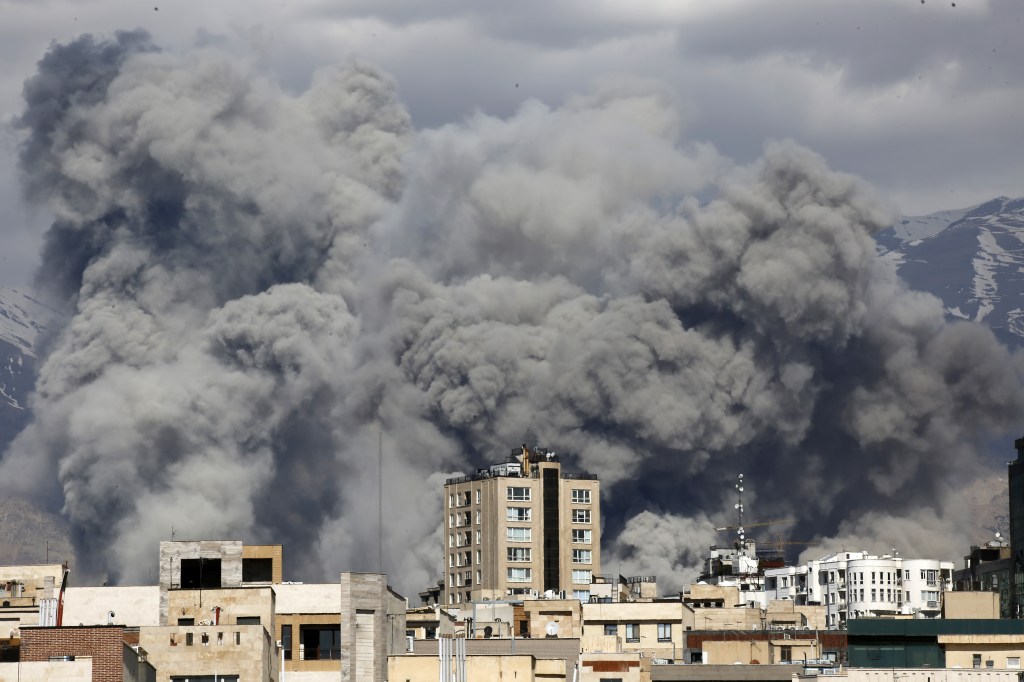
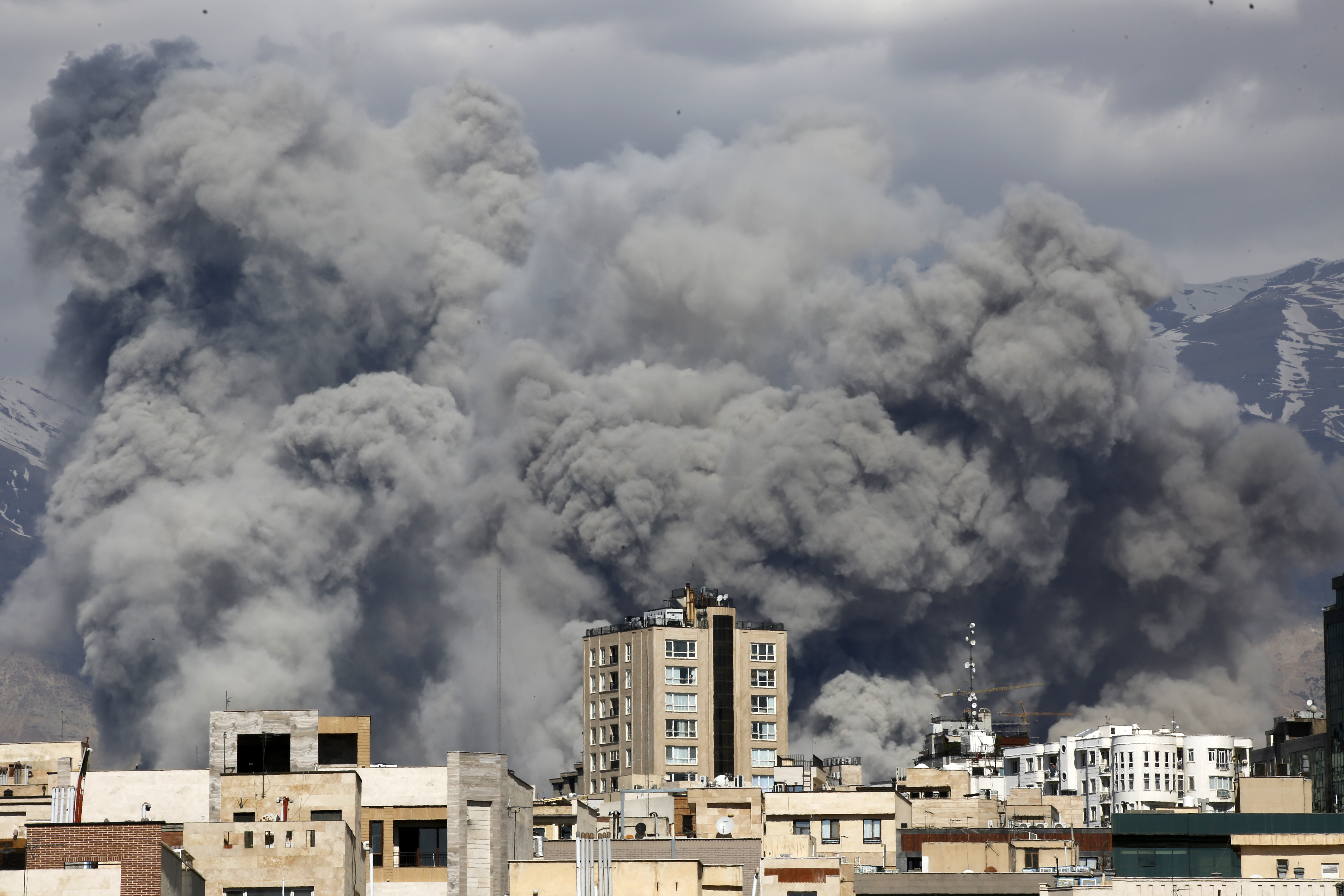
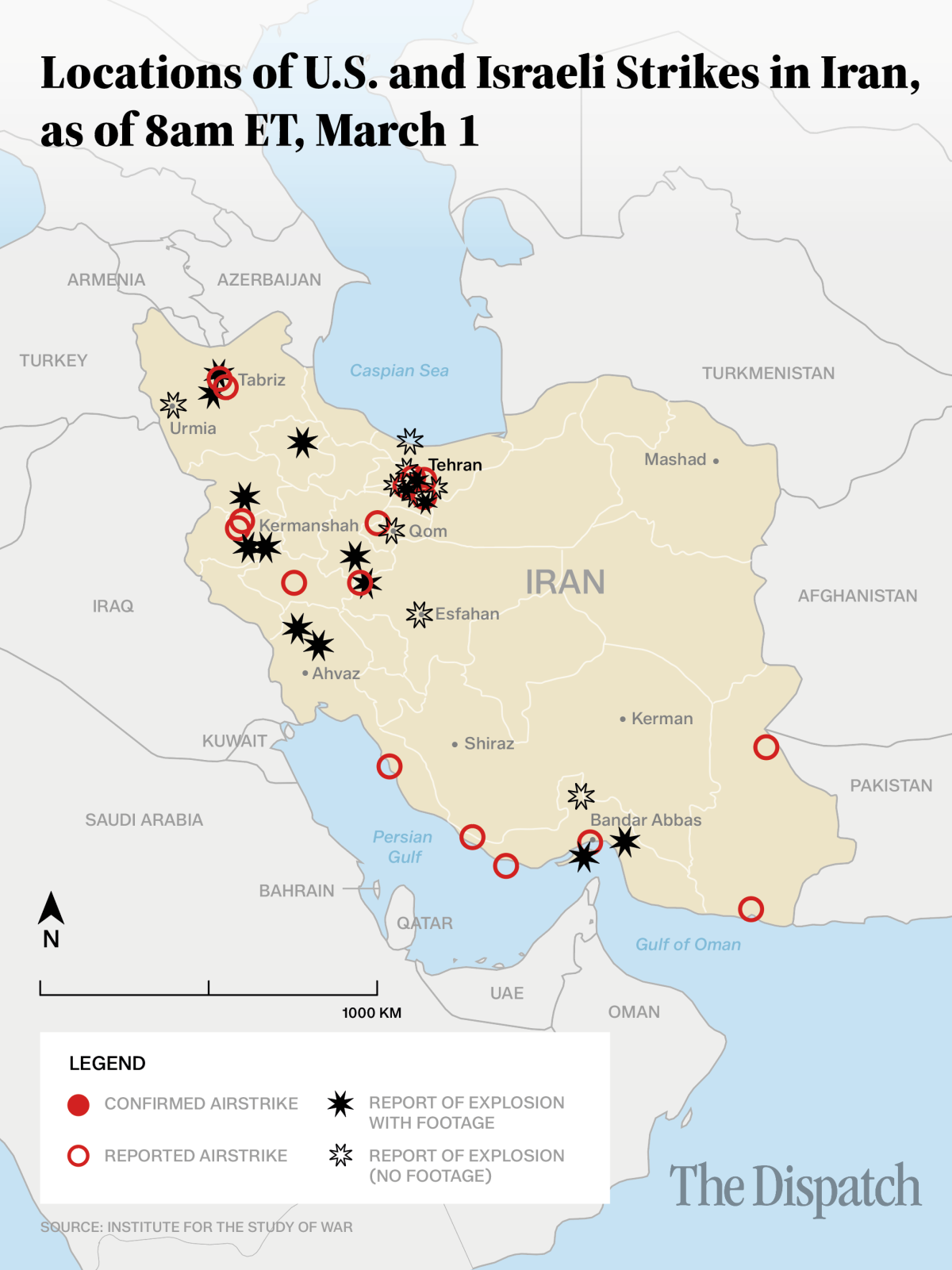
Early Saturday morning, the United States and Israel launched Operations “Epic Fury” and “Roaring Lion,” respectively: a coordinated assault on Iran involving B-2 stealth bombers, Tomahawk cruise missiles, F-35 and F-22 fighter jets, and (for the first time for the U.S.) one-way attack drones striking more than 1,000 targets. Targets included air defense systems, ballistic missile sites, Islamic Revolutionary Guard Corps (IRGC) headquarters, naval vessels, and the compound of Supreme Leader Ayatollah Ali Khamenei, on which Israeli jets dropped 30 bombs. Further strikes on Saturday and Sunday hit regime leadership compounds in central Tehran, the headquarters of Iran’s internal security forces, and state radio and television facilities.
Like last summer’s “Operation Midnight Hammer” targeting Iranian nuclear facilities, this weekend’s assault was a collaboration between Israel and the U.S., with the two allies striking different parts of the Iranian regime. The United States focused on military and nuclear infrastructure, while the Israel Defense Forces targeted regime leadership. Israeli leaders claimed that they killed approximately 40 Iranian officials within minutes of launching their attack, and the New York Timesreported that CIA intelligence on Khamenei’s location—gathered over months of tracking movement patterns—was used by the Israelis to strike his compound.
Shortly before 5 p.m. on Saturday, Trump confirmed news that had begun swirling on social media hours earlier. “Khamenei, one of the most evil people in History, is dead,” he wrote on Truth Social. “This is not only Justice for the people of Iran, but for all Great Americans, and those people from many Countries throughout the World, that have been killed or mutilated by Khamenei.” Iranian state media would later announce that the country’s Supreme Leader—who had ruled Iran since 1989—was dead. A state broadcaster delivered the news in tears.
Iran retaliated swiftly, launching missiles and drones at least six U.S. military bases, and other targets, across Israel, the United Arab Emirates, Qatar, Kuwait, Iraq, Bahrain, Jordan, and Saudi Arabia. A strike on Camp Arifjan in Kuwait—a base housing American troops—killed three U.S. service members and seriously wounded five others, and a strike on the Israeli city of Beit Shemesh on Sunday afternoon killed nine. In a video released Sunday, Trump vowed to “avenge” the fallen troops, but warned that more American casualties “are likely.”
Hezbollah fired rockets and drones at northern Israel early Monday morning, marking the first time the terror group had attacked Israel since agreeing to a ceasefire in November 2024. A spokesperson described the assault as “revenge for the blood of the Supreme Leader” and pledged Hezbollah would “continue its jihad and resistance” alongside Iran. Israel responded with strikes across Lebanon, hitting targets in Beirut’s southern suburbs and the Beqaa Valley.
Iran’s top national security official, Ali Larijani, vowed on Sunday to hit the U.S. and Israel with “a force that they have never experienced before,” and a far more aggressive and deadly wave of retaliation could be on its way. Nate Swanson, director of the Atlantic Council’s Iran Strategy Project and former director for Iran on the National Security Council, said “maybe the opening salvo was so effective that they can’t [strike back effectively],” but he warned Iran may simply be “calibrating—taking stock of what happened.” Robert Pape, a professor of political science at the University of Chicago and author of Bombing to Win, told TMD that Iran is “probably just being restrained right now,” and noted that retaliation—in large-scale terrorist attacks, or attacks on civilian areas—can come long after the initial strike. “The retaliation can come quickly,” he said. “It can be delayed. And the big thing is, it’s coming not on the schedule of the attacker.”
America is now at war with Iran—though that war hasn’t been, and likely won’t be, formally declared by Congress. In yesterday’s video, Trump said that the military operation would continue “until all of our objectives are achieved,” and he told the New York Times that the operation would take “four to five weeks” if necessary, adding that doing so “won’t be difficult.”
But how did the strikes come about? What is the White House trying to accomplish? And what comes next for the Middle East?
You are receiving the free, truncated version of The Morning Dispatch. To read the full newsletter—and unlock all of our stories, podcasts, community benefits, and our newest feature, Dispatch Voiced, which allows you to listen to our written stories in your own podcast feed—join The Dispatch as a paying member.

The strikes followed several weeks of negotiations, during which Special Envoy to the Middle East Steve Witkoff and Trump’s son-in-law Jared Kushner worked to secure commitments from the Iranian government to bring back to the president. The U.S. wanted guarantees on Iran’s weapons program, its funding of terrorist groups, and nuclear enrichment, but Iran refused to discuss anything beyond the nuclear issue—and even those talks proved futile. The U.S. demanded Iran permanently destroy its main nuclear sites at Fordow, Natanz, and Isfahan, hand over enriched uranium, and accept a deal with no sunset clause. During the final round of talks, which reportedly devolved into shouting, U.S. representatives offered to give Iran nuclear fuel in perpetuity. Iran’s negotiators declined. “They weren’t willing to say they will not have a nuclear weapon,” Trump later told NBC News. “Very simple.”
As talks were underway, the United States was assembling the largest U.S. military buildup in the Middle East since the 2003 Iraq War, and the president was receiving private encouragement to strike. Israeli Prime Minister Benjamin Netanyahu continued his long advocacy for attacking Iran, but the Washington Post also reported that Saudi Crown Prince Mohammed bin Salman also made multiple private calls to Trump, warning that Iran would grow “stronger and more dangerous” without military action. European leaders declined to participate in the attacks, but didn’t explicitly condemn them, only issuing statements against Iran’s retaliatory attacks. British Prime Minister Keir Starmer said the UK was not involved and would not join offensive operations, but agreed to let the U.S. use British bases for “specific and limited defensive” strikes.
Israel’s Netanyahu and many hawkish American lawmakers have long supported regime change in Iran, but the White House’s rationale for the strikes has been inconsistent. During his State of the Union address last week, Trump warned that Iran would soon have intercontinental ballistic missiles capable of hitting the United States—but the Defense Intelligence Agency said last year that there was no indication Iran was developing an ICBM, and that if it decided to, it would take a decade to do so. Witkoff told Fox News last week that Iran could be “about a week away” from having bomb-making material, but the administration had also maintained that U.S. and Israeli strikes against Iranian nuclear facilities in June 2025 destroyed Iran’s enrichment facilities at Fordow and Natanz, its nuclear technology center at Isfahan, and thousands of centrifuges. Israeli targeted killings during the Twelve-Day War eliminated many of the country’s nuclear scientists. Late last night, the Associated Press reported that Trump administration officials had briefed congressional staff over the weekend and said that U.S. intelligence did not suggest Iran was preparing to preemptively strike the continental U.S., but that there was more of a threat to U.S. personnel in the region.
Trump had promised Iranian protesters agitating against the regime in January that “help is on its way,” and at the end of his 8-minute statement announcing the attacks on Saturday, he addressed the Iranian people directly. “The hour of your freedom is at hand,” he said. “When we are finished, take over your government. It will be yours to take. This will be probably your only chance for generations.” But when Trump was asked by The Atlantic whether Iranians would continue to get support if it takes time to overthrow the regime, the president was noncommittal: “I have to look at the situation at the time it happens.” Trump was already talking about “off ramps” in a conversation with Axios on Saturday: “I can go long and take over the whole thing, or end it in two or three days and tell the Iranians: ‘See you again in a few years if you start rebuilding [your nuclear and missile programs].”
“Assuming regime change is the objective,” Swanson, the Atlantic Council fellow, told TMD, “that is a very, very big objective, and I think runs into a lot of problems.” Taking out regime leadership is one thing, but for a president whose political rise was partly built on opposition to extended regime-change operations in the Middle East, the appetite for a longer engagement may be limited. “Maybe there’s an off-ramp for him to just rhetorically go big and then quit,” Swanson added.
Pape argued that the weight of the evidence is firmly against the idea that bombing campaigns alone can achieve regime change. “For over 100 years, states have been trying to use air power alone to topple a government, and it has never—and I’m choosing my words quite deliberately here—never worked in 100 years,” he told TMD. “Are we getting closer to regime change? I say the answer is no, pretty dramatically no, because these are just drops in the bucket of what you would actually need.” Iran, he noted, is a society of 92 million people, one in eight of whom work for the government, with millions in the armed forces.
Though Khamenei and many other senior leaders are dead, the regime still stands. The Iranian regime announced 40 days of mourning and formed a three-member leadership council to govern until the Assembly of Experts can select a successor. Janatan Sayeh, a research analyst at the Foundation for Defense of Democracies who was born and raised in Tehran, said the Islamic Republic shouldn’t be compared to one-man regimes like those of Maduro or Saddam Hussein. “In those instances, that leader was the regime,” he told TMD. “That’s not the case for the Islamic Republic,” where the Revolutionary Guards already exert significant control. With Khamenei gone, Sayeh expects the IRGC to assume day-to-day authority outright: “They were already doing it anyway.”
Even so, Iranians around the world are celebrating the death of Khamenei, as they are within Iran, with footage showing cheering crowds in cities Karaj, Shiraz, Kermanshah, Isfahan, and Sanandaj. “There was an idea out there that if you bomb Iran, the average Iranian is going to turn against America and Israel,” Sayeh said. “So wrong. They’re bombing the Islamic Republic, and Iranians are cheering, dancing on the streets as fighter jets are flying.”
Today’s Must-Read


Anthropic has billed its major large-language model, Claude, as the most ethical model on the market. But in his latest piece for The Dispatch, contributing writer Nathan Beacom questions whether LLMs can or should be used in ethical decision-making on personal and societal scales. Beacom analyzes how moral philosophy is driving AI innovation, what the philosophers at Anthropic are imparting into their programs, and how the programs are impacting their creators. “If it is true that the mathematical model known as Claude does not have a soul, then the people of Anthropic are perhaps just the latest victims of a form of AI psychosis,” he writes. “Even a philosopher who spends all her days ‘talking’ to a machine, receiving back the products of its statistical sorting, apparently, can be fooled.”

In Other News
- Attorney General Pam Bondi announced that the Justice Department charged an additional 30 people who allegedly participated in an anti-immigration enforcement demonstration at a Minnesota church.
- Defense Secretary Pete Hegseth said that Scouting America, formerly known as the Boy Scouts of America, agreed to remove diversity policies as a requirement to retain current ties and support from the Defense Department.
- The Trump administration reportedly stalled in announcing a Taiwan weapons sales package previously approved by Congress until after Trump’s trip to Beijing in April, in an attempt to avoid angering Chinese leader Xi Jinping.
- The Homeland Security Department said that 13 people held at an immigration detention center outside El Paso, Texas, have contracted measles.
- Venezuelan pro-democracy opposition and 2025 Nobel Peace Prize recipient María Corina Machado announced she will return to Venezuela in the next few weeks.
- European Commission President Ursula von der Leyen said that she will begin the process to “provisionally implement” the European Union’s trade deal with the South American regional trade bloc, Mercosur.
- Belgium, in cooperation with an international task force, boarded and seized a Russian oil tanker that was part of the Kremlin’s “shadow fleet” used to transport illicit Russian oil.
- Argentina’s legislature passed a labor reform bill backed by the country’s president, Javier Milei, that gives employers more influence in hiring and firing practices over worker unions.
- Burma’s ruling junta launched airstrikes that targeted a trading hub, killing more than 24 people and wounding 20 others.
- The online prediction platform Polymarket recorded a total of $529 million in bets placed on outcomes of events in Iran. Six newly created accounts that bet on the timing of U.S. strikes collectively earned about $1 million, drawing scrutiny from blockchain analysts over potential insider trading.
- A new report from the Bureau of Labor Statistics found that the producer price index, which measures changes in wholesale prices, increased 2.9 percent year-over-year in January, up 0.5 percentage points from December.
- The Justice Department filed a complaint in U.S. federal court seeking to obtain the legal rights to seize ownership of a sanctioned oil tanker that assisted Venezuela’s illicit oil trade, in addition to nearly 2 million barrels of petroleum aboard the ship.
- Australia’s government said it is considering requiring search engines and app stores to block services to AI platforms that do not verify user ages, as required by Australian law.
- Berkshire Hathaway’s operating earnings fell more than 29 percent to $10.2 billion in Q4—Warren Buffett’s final quarter as CEO—driven by a 54 percent drop in insurance underwriting profits.
- “Inside the Cutthroat Competition for the Best Baguette in Paris” (Washington Post)
- Lucas Shaw, Michelle Davis, Josh Sisco, and Jeff Mason report on how influence and connections potentially helped Paramount Skydance CEO David Ellison purchase Warner Bros. (Bloomberg)
- Rivka Galchen highlights an overlooked positive development in the updated Health and Human Services’ vaccine schedule guidelines. (The New Yorker)
- Brooke Steinberg and Andrew Court reflect on Barbetta, the oldest Italian restaurant in New York City, which closed on Friday after opening in 1906. (New York Post)
ABC: Iran Football Chief Pessimistic About FIFA World Cup Following US Air Strikes
The Hill: Education Department Hangs Banner of Charlie Kirk
Associated Press: Sleepy Owl Found Resting Among Items on a New York Antique Store Shelf
Let Us Know
Have any thoughts or questions about today’s newsletter? Drop us a note in the comments or via email at tmd.questions@thedispatch.com. We read every submission, and your message could be featured in an upcoming “Behind the Scenes” segment.
Have any thoughts or questions about today’s newsletter? Become a member to unlock commenting privileges and access to a members-only email address. We read every submission, and answer questions in the following edition of TMD.