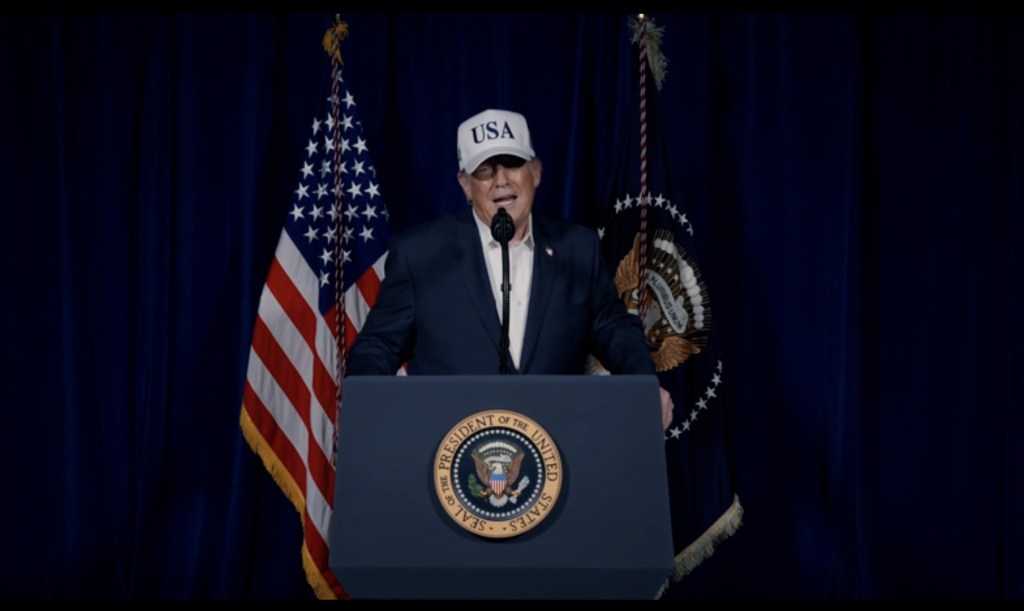
Hello. The United States and Israel launched a major strike on Iran overnight. President Donald Trump released a video statement labeling Iran the “world’s number one state sponsor of terror,” and calling on Iranians to “take over your government.” The Washington Post reports that military operations are expected to continue through the weekend. Iran has already retaliated by firing missiles and drones at Israel and attacking a U.S. naval base in Bahrain.
We’ll have much more to say on all of this soon. For now, I’ll point you to yesterday’s now-prescient Morning Dispatch—“Is War With Iran Imminent?”—and contributing writer Mike Nelson’s recent piece on the case Trump could make for striking the regime, and why such a move would be a departure from his administration’s previous military action. “Unlike Midnight Hammer, wherein the United States destroyed physical capabilities, this new campaign would likely be targeting Iranian will,” Nelson wrote yesterday. “In other words, increasing the pain on the regime until such a time that the mullahs agree, in some verifiable way, to abandon their nuclear weapons program. That might look like an initial, overwhelming strike over a single period of darkness, but then the next step is waiting for Iran to wave the white flag. If its leaders do not, that calls for a sustained campaign until such a time as they do.”
Elsewhere at The Dispatch this week, we focused this week on the reaction to the Supreme Court ruling a week ago Friday that Trump had exceeded his authority when he implemented tariffs under the International Emergency Economic Powers Act (IEEPA) as Article I, Section 8 of the Constitution vests Congress with the power to levy taxes and tariffs.
The case the court decided was consolidated from two similar lawsuits. Ilya Somin served as co-counsel on the related case considered in the ruling, VOS Selections v. Trump, and he wrote for The Dispatch on Monday:
The framers of the Constitution wanted to ensure the president would not be able to repeat the abuses of English kings, who imposed taxes without legislative authorization. Under Trump’s interpretation of the law, the president would have virtually unlimited tariff authority, similar to that of an absolute monarch of the kind King Charles I aspired to be. The court decisively rejected this aspiration to unconstrained presidential power. Roberts’ majority opinion, a concurring opinion by Justice Neil Gorsuch, and one by Justice Elena Kagan (writing for all three liberal justices) all, in different ways, emphasized this aspect of the case. As Gorsuch put it, “Our system of separated powers and checks-and-balances threatens to give way to the continual and permanent accretion of power in the hands of one man. That is no recipe for a republic.”
In Wanderland, Kevin D. Williamson put it a little less delicately:
Attention to Mike Johnson, the gutless worm who serves as speaker of the House—that is the sound of history calling your name. The Supreme Court has done what the Supreme Court can do, but now it is time for Congress to get in the game—long past time, in fact. The best time for Congress to rediscover its self-respect (as opposed to its self-importance) would have been 40 years ago—the second-best time is now. … Congressional Republicans, having grown accustomed to (and perhaps even fond of) the taste of cordwainer’s leather, will not be weaned from their boot-licking ways so quickly. What could be done instead—what should be done but almost certainly will not be done—is to remove all of the president’s current statutory authorities touching trade in such a way as to invite his taking the opportunity “to exploit questionable statutory language to aggrandize his own power.”
In Boiling Frogs, Nick Catoggio wrote about the new tariffs that Trump announced hours after the court handed down its opinion. Although that ruling barred him from imposing tariffs under the International Economic Emergency Powers Act (IEEPA), there are several statutes that grant presidents limited tariff powers. Trump cited Section 122 of the Trade Act of 1974 to impose global tariffs of 10 percent (before announcing the next day that he would actually make them 15 percent). By law, the tariffs are limited to 150 days. Nick, however, expects Trump to issue an executive order extending them rather than working with Congress. He wrote:
He did something similar, remember, when he repeatedly extended the deadline for TikTok’s sale despite the fact that nothing in the statute allowed it. Extending the Section 122 deadline unilaterally would be even more absurd, as the whole point of the 150-day time limit is to bar the president from setting trade policy indefinitely without congressional approval.
But he’s going to try it—not primarily because he’s worried that Congress won’t pass an extension, I suspect, but because he resents in principle the idea that he should have to ask the legislature for permission to do anything. We live in a world in which Trump’s party controls the House, the Senate, and the Supreme Court and yet he still grasps for excuses not to seek authorization from other branches. It’s not because he can’t win a vote in Congress, it’s because the thought of having to do so offends his Caesarist prerogatives on trade.
In a piece we published Friday, Charles Hilu went to Capitol Hill to ask lawmakers what they thought about passing tariff legislation, and he found little enthusiasm. GOP Rep. Greg Murphy of North Carolina told Charles that because the House is so divided, “being able to be nimble in negotiations would be exceedingly challenging,” and GOP Rep. Claudia Tenney said, “I don’t have a lot of confidence in Congress to be able to manage this.”
Charles writes: “While this Congress is far from the first to give power away to the executive, there is no sign that it will be the one to take such authority back. Instead, lawmakers have argued that the legislature should not have a privileged position in crafting trade policy. That’s one of several reasons why the likelihood of any congressional action on tariffs in the next few months is low.”
Thank you for reading and have a great weekend!

If anyone could figure out how to arm America to confront the Axis powers, it was GM President Bill Knudsen. That Tuesday, President Roosevelt called up Knudsen, who agreed to take a job in Washington the very same week. The pair arranged a meeting for Thursday, May 30. … Almost from the moment he arrived in Washington and had his first meeting with FDR and the newly appointed board he was supposed to head, the National Defense Advisory Commission, Knudsen realized no one knew how to meet the possible Axis threat—not only in Europe but also in Asia against imperial Japan. The most popular solution being proposed was that the federal government take over key industries like automobiles and steel, and simply order them to make whatever was needed for the war effort. “Democracy must wage total war against totalitarian war,” FDR’s closest adviser, Harry Hopkins, had written in a secret memo for the president. “It must exceed the Nazi in fury, ruthlessness, and efficiency.” But Knudsen knew that kind of takeover was doomed to failure. Instead, he offered FDR a counterproposal: Give me 18 months, and my industry colleagues and I can produce for you more arms than you’ll know what to do with.

Privileged politicians have learned that the old line about the elder Bush—“a man who was born on third base and thinks that he hit a triple”—can sting. And Newsom is nothing if not privileged. He grew up not quite rich, but rich-adjacent (his father managed the Getty family trust), attractive, and extremely well-connected. I also have no problem being honest about his disability. It’s the way he’s using it that bugs me. The interesting thing about Newsom is that he overcame his disability, not that he has one. But he’s touting it as if it defines him, so that he can claim to be like the little people who can’t read or score poorly on tests. I understand that the trial-lawyer-inflected political culture of California—which gives us hazardous chemical signs posted in businesses and those warnings about flashing lights at the beginning of TV shows—has turned every affliction into a monetizable form of identity politics. But the simple fact is that his dyslexia isn’t a ticket to membership in the proletariat. He didn’t get where he is by attending the “Derek Zoolander Center for Children Who Can’t Read Good and Wanna Learn to Do Other Stuff Good Too.” He got there because he worked really hard and is a talented politician, but also because he pushed on a lot of doors that were opened by rich and powerful people.

Society has become dramatically more inclusive over the past few generations, and this has largely been a good thing. Discrimination has become less and less acceptable over time, and many barriers for marginalized groups have crumbled. But somewhere along the way, we became so obsessive about never excluding anyone that we failed to realize that over-inclusivity might carry its own harms. In our public transit systems, the demand for maximal compassion and inclusivity towards homeless people runs squarely into the fact that disruptive, antisocial behavior ruins public spaces for everyone else. If buses and subway cars are riddled with people openly using drugs, engaging in lewd behavior, and experiencing untreated mental illness, they become unusable for other people—that is, the majority. Public libraries in many cities have become de facto homeless shelters, scaring away other citizens. Some school districts have grown so reluctant to fail students that they pass them along even though they can’t meet basic educational benchmarks, as if it would be bigoted or exclusionary to fail anyone. These policies may seem empathetic and spare feelings in the short term. But they undermine our civic structures and degrade the public spaces that benefit us all.