Cpl. Miyamura, a member of Company H, distinguished himself by conspicuous gallantry and intrepidity above and beyond the call of duty in action against the enemy. On the night of 24 April, Company H was occupying a defensive position when the enemy fanatically attacked, threatening to overrun the position. Cpl. Miyamura, a machine-gun squad leader, aware of the imminent danger to his men, unhesitatingly jumped from his shelter wielding his bayonet in close hand-to-hand combat, killing approximately 10 of the enemy. Returning to his position, he administered first aid to the wounded and directed their evacuation. As another savage assault hit the line, he manned his machine gun and delivered withering fire until his ammunition was expended. He ordered the squad to withdraw while he stayed behind to render the gun inoperative. He then bayoneted his way through infiltrated enemy soldiers to a second gun emplacement and assisted in its operation. When the intensity of the attack necessitated the withdrawal of the company Cpl. Miyamura ordered his men to fall back while he remained to cover their movement. He killed more than 50 of the enemy before his ammunition was depleted and he was severely wounded. He maintained his magnificent stand despite his painful wounds, continuing to repel the attack until his position was overrun. When last seen he was fighting ferociously against an overwhelming number of enemy soldiers. Cpl. Miyamura’s indomitable heroism and consummate devotion to duty reflect the utmost glory on himself and uphold the illustrious traditions on the military service.
Hiroshi Miyamura was the son of Japanese immigrants who owned a diner in New Mexico, and he did his parents’ new country proud. Trump is the son of a mobbed-up Queens slumlord and the grandson of a Yukon whorehouse operator who has, in a perverse feat, managed to tarnish the already stained family name he inherited. Trump is no Hiroshi Miyamura: In his own infamously ungrateful words, he prefers the ones who didn’t get captured. Trump’s military record, if there were one, would convey only the information that his chiseling bigot of a father paid a crooked doctor to invent a phony diagnosis of “bone spurs” to keep the sniveling little coward out of service during the Vietnam War—and that those bone spurs magically disappeared, without treatment, vanishing alongside the danger that supposed tough guy Donald Trump might face the burden of service to his country in wartime.
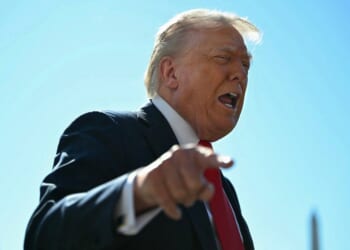
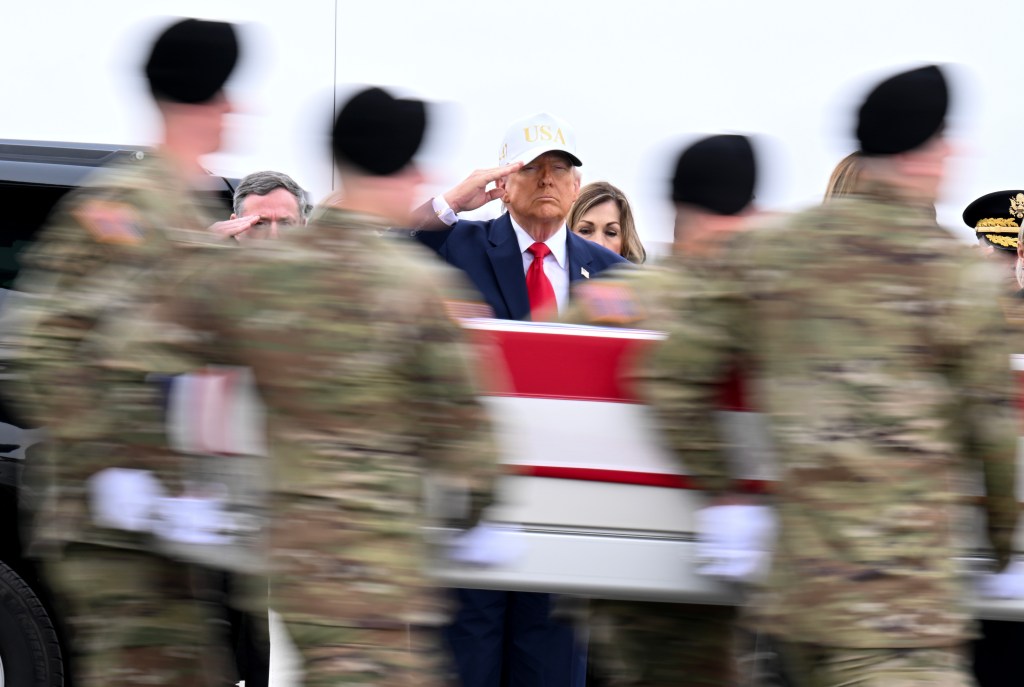
That sort of contemptible shirker has no business saluting dead American soldiers, whatever his station in life. But if the casualties of Trump’s illegal war in Iran must endure the indignity of being saluted by such a lowlife as he, the least the commander in chief could do would be to comport himself like a man of almost 80 years rather than a boy of 8 years and take his @#$%&! baseball cap off.
Trump is both stupid and ignorant—those are not the same things—and maybe nobody ever told him that it is bad manners to wear a hat on such an occasion. We live in a world in which vulgarians far less consequential than the president of these United States insist on wearing hats in restaurants, in church, and in other settings where men’s headwear ought properly to be removed.
Or maybe he was just having a bad hair day—which, in Trump’s case, is another way of saying “a day.” Trump still has the dumbest hair in America, which is a hell of a thing to write about a man standing next to Pete Hegseth, the Brylcreem-addicted grandstanding dipsomaniac peacock who is so committed to the principle that our military must stop waging war like a bunch of teenaged girls that he apparently has decided to wage war against teenaged girls in Iran, though the supposedly fearless and plain-speaking Secretary of Don’t You Dare Call It “War” apparently lacks the moral courage to take any responsibility for what his Department of Don’t You Dare Call It “War” has done.
My theory is that these guys just don’t have the guts to put on the armbands and jackboots that their hearts desire. Trump and those around him are in the habit of inventing pseudo-uniforms for themselves—Trump with his caps, Hegseth with his American-flag pocket square carefully folded to look like a military decoration on his chest, Gregory Bovino’s seasonal Gestapo-chic look in Minneapolis. The MAGA cap is the swastika armband of America’s regnant national-socialist movement. Trump’s white-and-gold variation simply adds a note of imperialism to the affectation.
Seriously: Take your @#$%&! hat off.
Elizabeth Marvel’s short but winning turn as a grown-up Mattie at the end of the 2010 version of True Grit ends with her learning of Rooster’s death from Cole Younger, who stands to deliver the sad news, and the infamous outlaw Frank James, who remains conspicuously seated. Mattie nods and, as she withdraws, turns to Frank James, spitting: “Keep your seat, trash.” Some people need that scene explained to them, and some don’t.
Most of us will never be asked to serve our country in the way those dead Americans transiting through Dover Air Base did. Donald Trump was asked. He refused, and did so in a particularly dishonorable way—and then spent much of his life joking about how he had gotten one over on those poor dumb rubes who actually went to Vietnam to get killed and maimed. The least he could do is demonstrate some basic courtesy in the presence of the bodies of those Americans who had the honor and sense of duty to do what Trump would not.
Take your @#$%&! hat off.
Economics for English Majors
Tariffs, as I and others have argued at great length in these pages, are a dumb policy—a sales tax our government imposes on our own people in order to punish an overseas business for having the unspeakable temerity to provide Americans with goods and services they desire at prices they are willing to pay. But tariffs can change the transnational flow of goods, services, and money—provided you, meaning we, are willing to pay the price for doing so. The Trump administration has, in the main, not been willing to pay that price, intervening to suspend, reduce, or remove tariffs when it became too obvious to deny the fact that they were imposing specific costs on Americans unhappy about bearing that economic pain. The Supreme Court has partially relieved the Trump administration of the burden of managing its own economic illiteracy entirely on its own, but the stupidity and the political cowardice remain.
Like tariffs, economic sanctions are destructive as a matter of economics—but sanctions, properly understood, are not economic policy. In the case of U.S. sanctions against Moscow—enacted in response to Russia’s brutal and criminal war to exterminate Ukraine as a nation—those sanctions are foreign policy and national-defense policy. Like other efforts to interfere with the ordinary operation of global markets, they were always going to impose an economic price that would be paid, at least in part, by Americans, in this case mainly in the form of higher energy prices. Even after the recent run of destructive inflation in the post-COVID era—the result of a bipartisan spending mania affecting both Democrats under Joe Biden and Republicans under Donald Trump—Americans were reasonably well-suited to bear the costs associated with sanctions on Russian petroleum exports. Oil and gas are commodities with prices set in global markets, but the United States is home to the world’s most productive oil-and-gas industry, which is able to respond to higher prices the way you’d expect from that one chart you remember from Econ 101: with additional production.
Economic sanctions are like immigration restrictions: They end up looking like economic policy, and they may even be disguised as economic policy, but they are really only useful for non-economic concerns.
Economic concerns and national-security concerns are wrapped up in one another, but it is important to remember that they are not the same thing. We don’t need to send thank-you notes to the oil-and-gas companies for the development of the domestic energy industry—those guys are doing just fine, and they don’t mind your being ungrateful as long as they keep getting paid—but it is worth understanding that the existence of that industry is one of the things that allows the United States to enjoy that “strategic autonomy” the Europeans are always going on about wistfully.
We have the autonomy to make hard decisions and do hard things. But doing so requires political intelligence and political courage, which are in short supply right now, the United States being under the leadership of a dim and neurotic retired game-show host and his Republican sycophants in Congress.
The war in Iran—an illegal war with desirable aims—was always going to lead to higher energy costs for Americans. Even a more intelligently conceived policy perfectly executed by an administration not dominated by grifters, drunks, and imbeciles would have meant some big bumps in the energy trade. The United States can endure these. Removing sanctions on Russian oil exports in response to a short-term spike in consumer gasoline prices in the United States is the wrong policy. It is a cowardly policy, but it also weakens the United States’ long-term national security capacity by demonstrating to the world just how little discomfort Americans are willing to endure in pursuit of our national interests overseas. It is another example of Donald Trump’s shameful subservience to Vladimir Putin.
It is too much to wish for Congress to assert itself and do its constitutional duty, but sanctions on Russia should be put back into force immediately—indeed, they should be deepened and broadened.
Maybe it is the case that the American people are not willing to “bear any burden”—including rising gasoline prices—to do whatever it is the Trump administration means to do in Iran. Fair enough. That is the sort of thing we might have learned in the course of a debate about launching a war against Iran—if Congress would do its constitutional duty when it comes to the power to decide when and if to go to war, a power that is invested in Congress, not in the president.
And Furthermore
The Hungarian-born U.S. historian John Lukacs had some illuminating observations about presidential salutes during the George W. Bush era, which he wrote about in the New York Times in 2003. He is pretty hard on Reagan—but he also is prescient.
Sometimes, a very old column is worth re-reading:
In the past, even presidents who had once been generals employed civilian manners. They chose not to emphasize their military achievements during their presidential tenure—in accord with the American tradition of the primacy of civilian over military rule. Of their constitutional prerogatives these men were of course aware. Lincoln would dismiss and appoint generals, and Truman knew that he had the right to fire MacArthur. During World War II, while Churchill often wore a uniform or at least a military cap, Roosevelt remained determinedly in his civilian clothes. Indeed, none of the presidents who governed this country during its great wars defined themselves as commanders in chief—not Washington, not Lincoln, not Wilson, not Roosevelt.
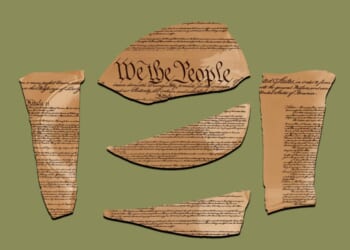
Yes, Section 2 of Article II of the Constitution says: “The president shall be commander in chief of the Army and Navy of the United States, and of the militia of the several states, when called into the actual service of the United States …” Thereafter that very paragraph lists other presidential powers that have nothing to do with military matters. The brevity of the mention of a commander in chief—it is not even a full sentence—suggests that the country’s founders did not attach very great importance to this role.
… When the Roman republic gave way to empire, the new supreme ruler, Augustus, chose to name himself not “rex,” king, but “imperator,” from which our words emperor and empire derive, even though its original meaning was more like commander in chief. Thereafter Roman emperors came to depend increasingly on their military. Will our future presidents? Let us doubt it. And yet …
Words About Words
About last week’s Hannibal-istic observations, a reader writes:
Speaking of “shameless pedantry” about Carthaginian generals, the Washington Nationals had two players named after Barcids during the previous decade, when they were excellent. Infielder Asdrubal Cabrera played for the NL East champions in 2014, and pitcher Anibal Sanchez starred for the World Series winners in 2019.
When the subject is baseball, we call it “historiography,” not “pedantry.”
Elsewhere
You can listen to Jonah Goldberg, Steve Hayes, Alex Trembath, and your favorite correspondent talking about energy and Iran at our Dallas event here.
If you missed my Saturday essay about the secretly devout character of Kevin Smith’s Dogma, recently made available to stream after a very long absence from public accessibility, you can read it here.
You can buy my most recent book, Big White Ghetto, here.
You can buy my other books here.
You can check out “How the World Works,” a series of interviews on work I’m doing for the Competitive Enterprise Institute, here.
In Closing
The problem with Timothée Chalamet’s remarks about opera and ballet is not that he is wrong—the problem is that he is right. There has always been a distinction between high culture and popular culture, of course—the difference is that in our time the kind of social and intellectual elites who once sustained high culture have become hostages to popular culture, in part because they are hostages to popularity per se, dreaming of being influencers with big social-media followings, of being famous, and—above all—of being envied and admired. The desire to be envied and admired is the great widespread public psychosis of our time, warping everything from art and culture to politics and religion. When I wrote this week about George Carlin’s smarmy, “relevance”-obsessed cardinal in Kevin Smith’s Dogma, I did not mention—though I should have—that the characterization was prophetic.
It is good to bring great things—high art, music, even the Good News—to the people, but the people have to be willing and able to receive them. That which is true and beautiful, or even enviable, is true or beautiful or enviable irrespective of whether a few people know it or a great many. The people get a vote on their political representatives, but they do not get a vote on everything, because some things are not a matter of popular opinion—or of any other sort of opinion.
We can look at, listen to, or read anything we want on the internet. What we want, in no small part, is pornography and sports betting and rage-inducing social-media discourse. That is not the fault of the people who run the opera houses, as poorly as they often do their work, or the fault of Timothée Chalamet, callow as he is. It is not even the fault of the schools and the churches, though these should be doing a better job in their role as cultivators of human potential. You know whose fault it is. And, thinking about what I have read this year and what I haven’t, so do I.