Authored by Kimberley Hayek via The Epoch Times,
Tennessee Gov. Bill Lee granted a pardon Thursday to Grammy-nominated country artist Jelly Roll for his previous criminal convictions, noting the musician’s journey from incarceration to advocacy and stardom.
The pardon, one of 33 clemency actions granted by the Republican governor in light of the Christmas season, celebrates Jelly Roll’s personal growth.

Born as Jason Bradley DeFord on Dec. 4, 1984, the Nashville native spent much of his youth in juvenile facilities, including more than three years at the Davidson County Juvenile Detention Center beginning at age 14 and has been jailed around 40 times for offenses including aggravated robbery and drug possession. He earned a high school equivalency degree at 23 while incarcerated.
Jelly Roll’s most serious convictions include a 2002 robbery at age 17, when he and others, including an armed individual, stole $350 from victims in a home. He served one year in prison, as well as probation. In 2008, police discovered marijuana and crack cocaine in his vehicle, leading to eight years of court supervision.
Lee said Jelly Roll’s application underwent the same rigorous, months-long review as others, with the state parole board unanimously recommending approval in April.
“His story is remarkable, and it’s a redemptive, powerful story, which is what you look for and what you hope for,” Lee told reporters.
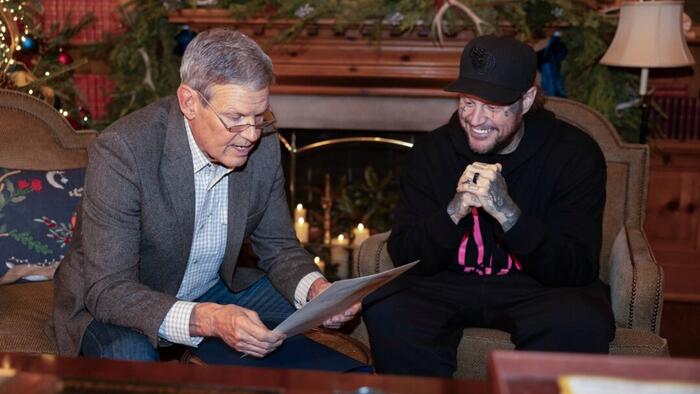
The governor first met Jelly Roll on Thursday at the Governor’s Residence, where they embraced one another amid holiday decorations. Unlike federal pardons that can enable an individual to avoid prison time, Tennessee’s pardons offer forgiveness post-sentence, sometimes restoring rights such as the right to vote with some limits. Jelly Roll has said a pardon would make international tours and missionary work easier, since he’d no longer have to do paperwork due to his criminal history.
In a June interview with “Interview Magazine,” he discussed issues he has faced with traveling.
“It’s funny, America has finally agreed to let me leave and give me a passport, but some countries won’t let me come because of my felonies,” he said. “We’re working on that. I think it’s going to work in my favor.”
Jelly Roll received support from peers and local leaders, including attorney David Raybin who worked on his pardon, and Davidson County Sheriff Daron Hall, who administered the jail where Jelly Roll experienced his transformation.
“I think he has a chance and is in the process of rehabilitating a generation, and that’s not just words,” Hall said. “I’m talking about what I see we need in our country, is people who accept responsibility, accept the fact that they make mistakes and accept the fact that they need help.”
Live Nation CEO Michael Rapino has highlighted Jelly Roll’s charitable donations from performances to at-risk youth programs.
Jelly Roll changed his ways in 2008 upon learning of his daughter Bailee Ann’s birth while imprisoned. He began selling mixtapes from his car, blending genres like country, hip-hop, and Southern rock. His professional breakthrough occurred with 2022’s “Son of a Sinner,” which climbed to the top of country radio, followed by hits including “Save Me” and “Need a Favor.”
His 2023 album “Whitsitt Chapel” marked a country pivot, earning multiple CMT Music Awards and a Country Music Association New Artist of the Year honor. He has garnered seven Grammy nominations across his career. Themes of adversity permeate songs like “Winning Streak,” about the first day of sobriety, and “I Am Not Okay.”
“When I first started doing this, I was just telling my story of my broken self,” Jelly Roll said. “By the time I got through it, I realized that my story was the story of many. So now I’m not telling my story anymore. I’m getting to pull it right from the crevices of the people whose [stories have] never been told.”
Jelly Roll has also been working on making amends.
“I’m rounding third on my amends list, and I think when I get there, I’ll feel a little better,” he said.
Jelly Roll said he found songwriting therapeutic while in custody, telling the parole board it had become a passion that “would end up changing my life in ways that I never dreamed imaginable.”
His advocacy has encompassed testifying before the U.S. Senate on the dangers of fentanyl, while admitting his past dealing of the drug.
“I was a part of the problem,” he said. “I am here now standing as a man that wants to be a part of the solution.”
He opened a music studio in February at the Nashville juvenile center where he was incarcerated, donating concert proceeds and partnering with The Beat of Life nonprofit for workshops.
He told the more than 30 songwriters gathered at the studio’s launch about what the studio and its opening meant to those behind bars.
“You wrote with some real kids that are going through the realest and hardest … moment of their entire life,” he said. “I beg y’all to come back and be patient with them. I beg you to love them. … Those kids got a small sliver of hope they’ve never had in their life today and the hope is the seed that grows into change.”
He reflected on his time in juvenile hall.
“When I was in juvenile, we never got a visitor. We never had a mentor, nobody ever came to see us. To be able to come back on these terms is a dream that I had and this is only the beginning.”
Loading recommendations…