As the United States approaches its 250th year, Americans are taking stock of more than just their history. They are increasingly asking whether the promises that once animated the country still hold. Chief among them is the American dream. According to a recent poll, 46 percent of Americans believe that the American dream no longer exists—almost double the share who still do, at 26 percent.
Of course, this sentiment isn’t new. In 2020, Democratic Rep. Alexandria Ocasio-Cortez of New York went viral for berating a witness during a committee hearing over the idea of “pulling oneself up by one’s bootstraps.” Her point—that the metaphor is self-defeating—wasn’t entirely wrong (I have yet to see someone physically try to haul themselves up by their shoelaces). Still, it obviously missed what the phrase was meant to capture: the idea that discipline and effort might yield advancement, against all odds.
But there’s another way that people get the American dream wrong.
Indeed, we seem to have forgotten that the American dream was never merely about wealth. Robert Clark, one of my history professors at Cedarville University, used to tell my class that “the American dream was never about going from rags to riches but about going from rags to respectability.” This idea is borne out in public opinion as well. A 2017 study by Pew Research found that just 11 percent of Americans saw “being wealthy” as essential to achieving the American dream—whereas almost half of Americans (48 percent) saw making valuable community contributions as essential to the same.
In light of this, it is worth asking why the government’s response to the public problems of our day so often defaults to giving people more money. Since President Lyndon B. Johnson launched the “War on Poverty” in the mid-1960s, federal spending on the social safety net has exploded to unprecedented levels, amounting to tens of trillions of dollars in assistance, according to the Office of Management and Budget (OMB). But despite this influx of cash, data from the Center on Poverty and Social Policy at Columbia University shows that poverty before taxes and transfers has actually risen from 21.9 percent in 1967 to 23.67 percent in 2024. This data is accompanied by symptoms of this erosion in the hope of the American Dream—declining trust in government, stagnant economic mobility, growing social decay, and more.
But if, by broad consensus, money is not the key to the American dream, why do our elected officials continue to respond to these warning signs predominantly by approving ever-larger, debt-financed expansions of the social safety net?
Perhaps this incongruous response exists because the sense that the American dream is in decline says less about economics than about exhaustion. Americans appear to be admitting that the social contract between citizens and country has frayed—that the ladder, once steadier, now feels frighteningly unstable.
Nothing exposes this reality more clearly than the way we have structured public assistance. Programs like the Supplemental Nutrition Assistance Program (SNAP), Medicaid, and Medicare are, in many respects, good and necessary. They feed families. They keep people alive. On average, 42.4 million people receive SNAP benefits each month. Chances are you know someone who does. But we have built these programs in such a way that, for many Americans, while survival becomes possible, advancement does not. The “benefits cliff”—when a small increase in income causes someone to lose public benefits, actually leaving them worse off than before—is tragically real. A modest raise, a few extra hours, or a better-paying job can cause the sudden loss of thousands of dollars in assistance. Under these circumstances, the promise of work disappears.
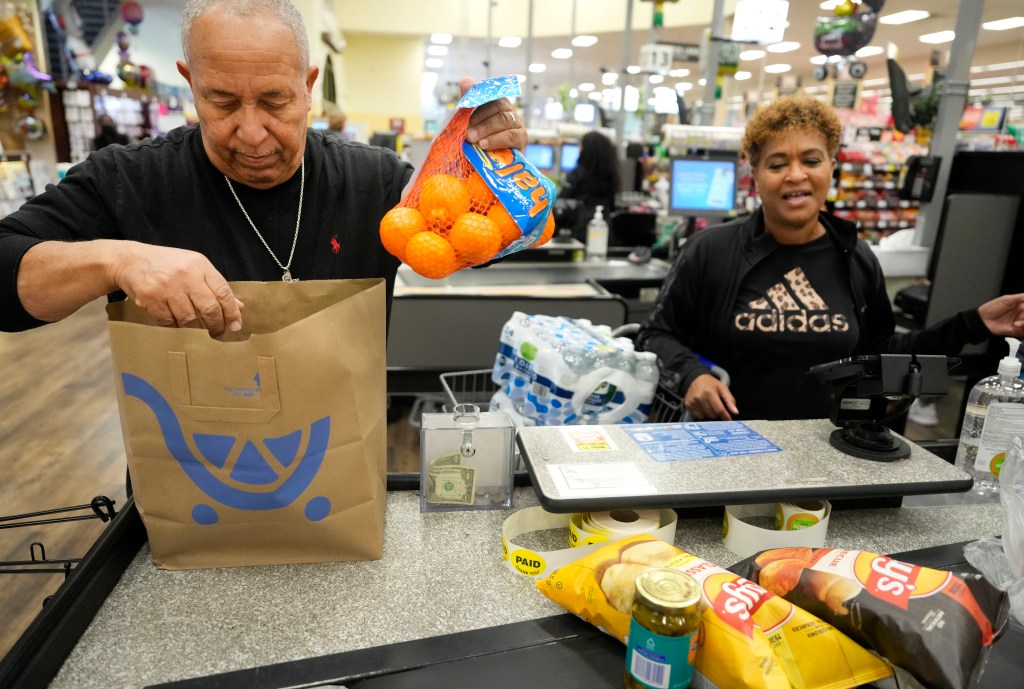
My understanding of that reality is shaped less by ideology than by experience—beginning with my first job, which I got when I turned 16 because my dad told me one was required to get a driver’s license in his household. So, living in rural Ohio where you couldn’t get anywhere without a car, I walked into my hometown Kroger and began what would become a seven-year career at one of America’s largest grocers. An inglorious job from start to finish, I started out as a “courtesy clerk” making $7.25 an hour. After a year of schlepping carts in heatwaves and snowstorms, cleaning bathrooms, and bagging groceries, I was promoted to cashier. It was in this role that some of my most enduring memories from the job were formed.
There is something remarkably intimate about handling every piece of food someone is likely to consume in a week. It leaves very little room for pretense. My time at Kroger gave me a front-row seat to how Americans actually live—and to the benefits systems so many quietly navigate every day.
I have seen every criticism of entitlement programs under the sun, firsthand. I’ve checked out customers paying with SNAP while gripping keys to a Mercedes. I’ve rung up carts stacked with soda and processed food, entirely paid for by the taxpayer. Those moments are real, and pretending otherwise does no one any favors. But they are not what has stayed with me.
No, the moments that have lingered were much quieter: the pause before someone mentioned they’d be using a benefits card, the way their voice dropped, the apology that often followed—offered to no one in particular. Worse were the moments when something went wrong. The balance wasn’t what it should have been. The PIN didn’t work. An item wasn’t covered. And there, beneath fluorescent lights and the impatience of a growing line, a parent had to decide—aloud—which necessities could wait. Milk or diapers. Bread or produce. I watched people stare at the conveyor belt, the despair and anxiety on their faces evident as I scanned items out of their order to bring the total down to what they could afford.
I had customers break down sobbing at the register in moments like this. Others lashed out, angry at me for a system I neither designed nor could fix. These raw moments often exposed onlookers’ character. Too often, I saw quiet judgment from those waiting in line—raised eyebrows or impatient arrogance. I also saw strangers step forward—hugging a mother with an infant in her cart or paying for hundreds of dollars in groceries without a word. These stories only begin to scratch the surface of the quiet indignity endured by millions of Americans navigating a benefits structure that keeps them afloat but rarely helps them move forward.
And yet, year after year, knowing that these programs and the market failures they seek to address fall short, legislatures respond with the same reflex: more spending. Larger packages, broader eligibility, higher benefit levels—each sold as the long-awaited solution to poverty in America. The assumption is persistent: If the problem is economic hardship, money must be the answer.
That assumption, however, would have puzzled one of the fathers of the free-market tradition itself. Adam Smith is often invoked as an apostle of profit and efficiency, but his vision of a functioning market economy rested on something far sturdier than money alone. In The Theory of Moral Sentiments, published 17 years before The Wealth of Nations, Smith argued that markets depend on moral formation—on habits of self-command, responsibility, and mutual regard—alongside prices and incentives. “Society,” he wrote, “cannot subsist among those who are at all times ready to hurt and injure one another.” Markets, in other words, presuppose virtues they cannot themselves manufacture.
Smith understood that economic exchange works best when individuals are animated not merely by self-interest, but by a sense of obligation—to their families, their neighbors, and the communities that make productive life possible. Money could facilitate exchange, but it could not supply meaning. It could reward effort, but it could not cultivate the character required to make work worth sustaining.
This is where so much of our modern policy conversation goes astray. When faced with real hardship, we reach first—and often only—for fiscal tools, treating moral and social breakdown as problems that can be solved by appropriations alone. But no amount of spending can substitute for the stabilizing institutions that once gave work its promise. Government was never intended to replace those institutions. It was shaped to exist outside these institutions—families that formed character, schools and teachers who shaped habits of discipline and aspiration, churches and associations that bound people to one another, and neighborhoods that noticed and intervened. These institutions do not eliminate hardship, but they give hardship a horizon—one in which effort still points somewhere beyond survival. In this vision, government exists to protect the rights of citizens who form civil society, not replace civil society itself.
The American dream once named a shared moral expectation: that work would be met with opportunity, that neighbors would not be left alone, and that assistance would be ordered toward restoration rather than mere survival. When our systems offer short-term relief without a clear path forward, they reflect less a failure of effort than a hesitation to affirm what we owe one another.
From behind a Kroger register, I saw how easily dignity can fray when care is reduced to transactions and policy becomes a substitute for moral imagination. If Americans are losing faith in the American dream, it is not because the dream was false, but because sustaining it has always required more than budgets and programs. It requires a people willing to pair compassion with responsibility, generosity with expectation, and freedom with love of neighbor—work that belongs not only to markets or governments, but to all of us.