
Editorial note: this essay originally appeared at The Giving Review.
***
Karl Zinsmeister has devoted a significant portion of his impressive career to American philanthropy—the explanation and serious study of it, the offering of well-informed advice to those who practice it, and the steadfast promotion and protection of it and its freedom.
After been a director of the White House Domestic Policy Council during the George W. Bush Administration, Zinsmeister was a vice president of The Philanthropy Roundtable from 2011 to 2020. During his time at the Roundtable, among other things, he conceived and created The Almanac of American Philanthropy, an encyclopedic volume totaling 1,342 pages.
Philanthropy and charity, Zinsmeister believes, should be honored and defended, which he’s done and still does well in so much of his professional life. “[T]he charitable impulse can be misused and manipulated,” however, and “it’s absolutely appropriate for regulators to crack down when this happens,” he writes in his new book Sweet Charity: Why Private Giving Is So Important to America (And Must Not Be Wrecked By Politics), recently excerpted by RealClearPolitics.
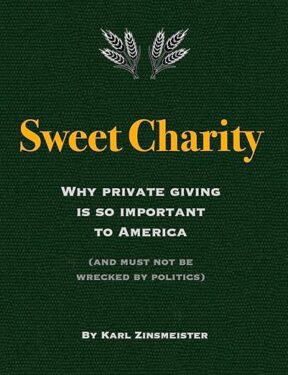
“Charities are given tax and legal protections on the grounds that they are truthful and earnest, that they build up citizens, and bolster society,” Zinsmeister continues. “Their donations are not supposed to go to partisan causes or overt political activism, personal enrichment, or violence. If charitable gifts are being exploited in this way,” and he provides evidence of this misdeeds in this category, “there must be a law-enforcement response—but a cautious one,” reasons for which he then provides in Sweet Charity.
He notes that “liberals—with their visceral attraction to state-driven ‘change’—have been more willing to squeeze and shape charitable giving for political ends.” Among critics of philanthropy, though, he thinks there’s a cross-ideologically mistaken analysis. “[C]ritics of left and right all make one massive misdiagnosis—which is to paint U.S. philanthropy as primarily a game of national manipulation played by ‘the billionaire boys’ club.’
“The billionaires who get all the attention from the press and from critics are small potatoes in American philanthropy,” according to Zinsmeister.
It is continuous giving by more than a hundred million generous and sensible everyday Americans that constitutes the main branch of U.S. charity. Most of their donating is invisible and unappreciated because it takes place out of sight, beneath the visible surface, beyond the media glare, in small gifts. That’s middle-America in action, and it’s much larger than the attempted culture capture by woke tycoons and corporations.
Measurements difficult to make, defenses often invoked
This highly decentralized philanthropy of middle-America in action is, as Jeff Cain has noted here, essentially unmeasurable and falsely invoked by the biggest philanthropists to defend themselves. It does not take advantage of the available charitable tax-incentivizations to the large extent that the big mega-givers do. It is not dependent on them. It would likely occur anyway, without them.
More largely, “rather than being an instrument of plutocracy,” Zinsmeister writes, this decentralized giving in America “is actually one of our most pluralistic and democratic elements. Philanthropy disperses authority,” he continues—similar to the characterization by one of my mentors, Bill Schambra, of true charity as subversive of the state. Zinsmeister goes on: everyday, small philanthropy “gives individuals direct opportunities to change their communities. It lets non-mainstream alternatives have their day in the sun.”
He writes that “today’s bloom of partisan ‘charity’ has been building for a decade” and, again, notes that “[l]eft-wing billionaires have been particularly active in this growing politicization of charity.” He readily acknowledges that “of course right-wing billionaires have also donated actively to other causes and charities that carry political implications,” but issues a qualification.
Most of these conservative charities, however, have been more cautious about blurring the lines separating civil-society organizing from partisan action. And as a simple matter of math, the amount of money steered to the right has been vastly smaller than the gush of funding devoted to progressive nonprofits over the last two decades.
Zinsmeister urges improved Internal Revenue Service enforcement of the law regarding tax-exempt status generally and, specifically, proposes seven policy reforms from Congress to curb politicization that’s abusive of that law’s original intent. Those who see it as their role to promote and protect donor freedom would likely object to some or all of them. Specifically:
- “The surge of foreign philanthropy that has helped politicize American charities should immediately be cut off.”
- Internal Revenue Code § 501(c)(3) groups’ “‘voter registration’ efforts that quickly veer into politicking … should be stopped.”
- (c)(3)s “should not be involved in ballot initiatives, as some currently are,” either.
- Nor should (c)(3)s “be allowed to take donations and re-grant them to politically involved” § 501(c)(4) groups.
- “The tax-law language” allowing (c)(4)s to “get involved in politics so long as it is not their ‘primary activity’ should also be tightened and specified.”
- “Congress should consider placing time limits on foundations.”
- And to maintain their tax-preferred status, “foundations should be expected to distribute into society every year a much larger fraction of their endowment,” up from the current five-percent level to something like 10% or 12%.
“Refined rules and improved enforcement could make philanthropy even better,” according to Zinsmeister.
But it is vital we not throw out the baby with the bathwater. Trumpers disturbed by flares of ideological charity have recently joined progressive projectors of a ‘billionaire boys’ club’ in assailing philanthropy broadly. While taking sensible criticisms seriously, we must make sure that politicos don’t destroy one of America’s most important secret weapons: the decentralized giving and organizing that solves millions of community needs through spontaneous, voluntary, grassroots action.
Maintaining a necessary distinction without indulging an unfair conflation
If the “baby” is the small, decentralized giving and the “bathwater” is the “small-potato” but big, tax-benefitted billionaires’ causing Trumpers to be—with cause, even to Zinsmeister—“disturbed by flares of ideological charity,” then it doesn’t really seem as if there’s much real risk of them both being “thrown out” together. This is an easily recognizable distinction, and Zinsmeister makes it. It need be maintained—in discourse in general, politics specifically, and policymaking and reform in particular. Trump’s Truth Social, or even executive-order, bluster notwithstanding.
If it’s only the bluster about which Zinsmeister is bothered, that might be a little overwrought. When has any bluster ever been directed at everyday citizens coming together to help solve a community problem with donations and volunteering? Trump’s opponents are purposely unfairly conflating the populist reaction against politicized, progressive Big Philanthropy with a trumped-up “authoritarian attack on civil society.” This unfair conflation needn’t be indulged. There is and will be a place for civil society in the realigned right.
We should all be, as Zinsmeister puts it, “disturbed by flares of ideological charity”—anti-elite progressives too, by the way, “projectors” of a “club” or not—and we should look to ally with each other in responding to it, including through policy reform, if and when possible. Including by together considering Zinsmeister’s good proposals in Sweet Charity.