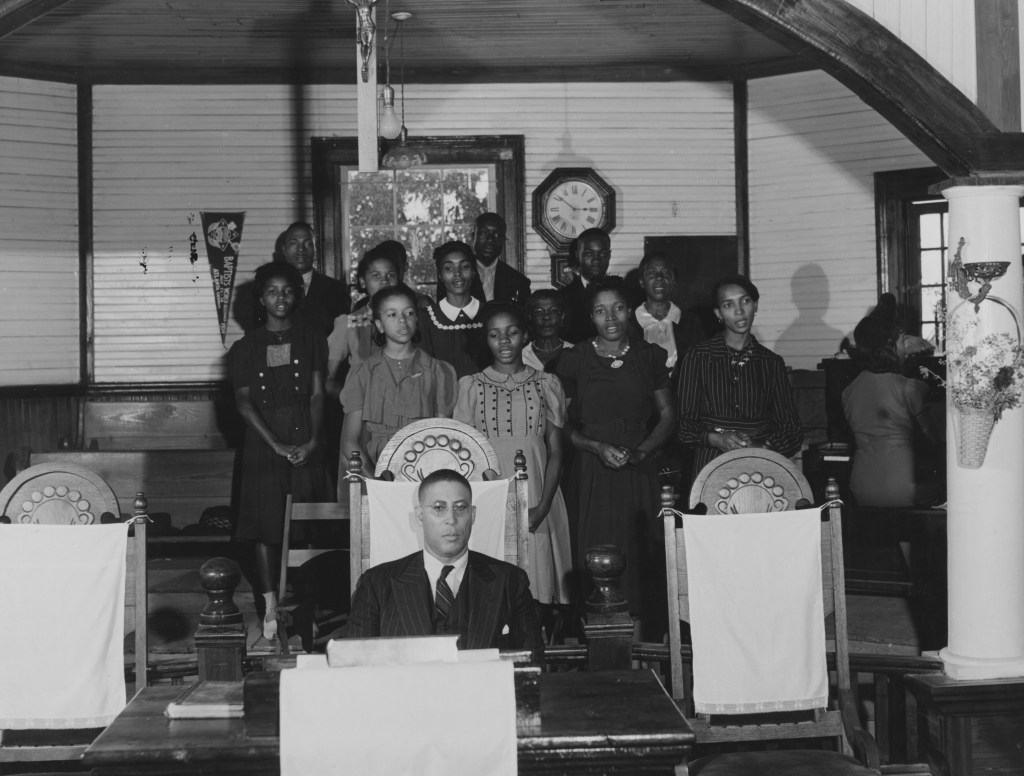
It was a Sunday in Chicago, sometime in the mid 1950s. The Rev. C.J. Rodgers–a large, handsome, dark-skinned man–stepped into the pulpit of Mount Eagle Missionary Baptist Church to preach to the congregation that packed the building and to an even larger audience tuning in by radio broadcast. During the week, Rodgers said, someone had warned him that the broadcast would be cut immediately if he chose to speak about the Freedom Riders who were heading south to work for voting rights. George Greer, who was a little boy in the congregation that Sunday, still remembers the determination in Rodgers’ voice as he boomed, “Well, if you’re gonna cut me off, you better slice that cut, because I’m gonna speak the truth.”
They did cut him off. But, he kept speaking. The hundreds who had gathered that Sunday at Mount Eagle were more than sufficiently inspired to make sure the message got out, perhaps more effectively than the radio broadcast.
Greer, now 79, recalled that Rodgers drove a Cadillac Fleetwood with a telephone–in the 1950s. The church at 4559 South St. Lawrence Ave. was always packed. The Staple Singers performed there regularly. Community meetings were held. And it is where, as a 7-year-old, Greer was one of many people who walked the aisle and committed his life to Christ. Rodgers baptized him in water the very next Sunday.
Rodgers was large, loud, and free in a city and a century that offered black men very few freedoms. His freedom was not accidental. It was institutional. Rodgers could say what he wanted to say because his congregation owned its building, paid his salary, and expected him to speak. He was economically independent of every white power structure in Chicago—the schools, the private businesses, the government agencies that held the livelihoods of his members in their hands.
Rodgers’ example illustrated a larger truth: The black church was the engine of the civil rights movement because it was institutionally robust.
The foundation of the black church.
The Rev. C.J. Rhodes, one the most careful scholars of the black church tradition today, traces its foundation to two parallel movements that emerged from the same soil. “The black church was a church born fighting for freedom,” he told me this week, drawing on the work of Sen. Raphael Warnock (himself an ordained pastor). “But it was also a theological reform movement, seeking to reform the broader Christian landscape in America.” Both movements required institution building. And so, almost from the moment slaves were emancipated, black church communities began to build.
They built property. The first structures many freed communities constructed after 1865 were church buildings—sometimes simple wooden frames, sometimes brick and mortar, grown over generations into campuses that black congregations owned outright. By 1906, the U.S. Census Bureau’s Religious Bodies report documented that black Baptist and Methodist denominations alone reported more than 35,000 church edifices with property valued at $56 million. The nonprofit African American Registry identifies the black church as the first source of land ownership for black Americans. The ownership of land and buildings was a foundation for everything else.
The church also built financial independence. Congregations paid the preacher’s salary from their pockets, which meant he answered to God and to the people—and no one else. Rhodes put it plainly: “They gave the preacher a kind of economic liberty to speak out. And it was sort of expected, in many churches, for the pastor to speak out.” A schoolteacher or a government worker had to watch what they said. The pastor, whose salary came from the collection plate, had much greater liberty.
The church built and trained leaders. The pipeline of historically black colleges and universities, for example, was born out of the black church. Morehouse College opened in Atlanta in 1867 specifically to train ministers and educators, for example. These institutions produced a preaching class that was often the most literate in the community. Rhodes notes that most black elected officials during Reconstruction were clergy; they were the ones who could read contracts, write petitions, and interface with other elected leaders on equal terms. Hiram Revels was a minister and the first black U.S. senator. He left the Senate to become the first president of Alcorn Agricultural and Mechanical College, now Alcorn State University, in Mississippi. The line from pulpit to public leadership was a feature of the black church as an institution.
Perhaps most importantly, the black church built a theology that made its members’ demands legible to a watching nation. This is probably the least understood of the capacities developed in the black church that drove the civil rights movement. Rhodes identifies imago dei—the concept from Genesis 1 that all humans are created in the image and likeness of God—as the political theology underpinning everything. “The creator created black folk too,” he told me. “And we, therefore, deserve the inalienable rights not given by the government, but given by God.” The civil rights movement’s demands were not sectarian. They were grounded in the United States’ own stated values, called forth by a theological tradition that read Exodus and Daniel and Luke 4 and said: The God who liberates is the God of this people, and this nation must be held to what it claims to believe.
Alongside the liberation theology there was the development of a theology of moral excellence; a call to a nation that identified with Christian values to live up to the moral standard found in scripture. Rhodes called it “the sanctification argument.” It was plain, devastating, and impossible to dismiss. “You can’t claim to believe in the Bible or the God of the Bible and be a mean person,” Rhodes said. “Everyone talking about heaven ain’t going to heaven.” This was holiness theology deployed as civic demand. The movement called the nation not to a foreign standard, but to rise to its own.
Beneath all of it—the property, the financial independence, the trained leaders, the theology—was something that George Greer described to me when we spoke in language no academic study can replicate. “What made the black church strong was a commitment from the people. The discipline of the people,” he said. “We depended upon ourselves, and each other.”
He described Sunday as an all-day affair: Sunday school in the morning, followed by corporate worship, fellowship through the evening, families together in the same building for seven hours or more. He described a mutual network so dense that when his stepfather had surgery and missed weeks of work, it was “brothers from the church” who brought groceries every week without being asked. “The church was the only institution we had,” Greer told me. “And people respected the church.”
This was the social infrastructure that made the civil rights movement possible. The Montgomery bus boycott, for instance, worked because the churches in that city could organize a carpool system of 300 cars operating across 48 pickup zones, funded through weekly meetings, sustained by a community dense enough to bail out the arrested neighbors and feed families whose breadwinners lost their jobs. Sociologist Aldon Morris, in his foundational 1984 study The Origins of the Civil Rights Movement, documented that the movement was not spontaneous but deliberately built on organizational networks that had been constructed over generations. The church was the architecture of the movement.
The black church moving forward.
The honest question for the next 250 years in America’s story is whether the black church infrastructure that carried the weight of the civil rights movement still exists. It has been affected by at least four major forces.
The first is theological drift. The movement’s theology was simultaneously a theology of justice and a theology of holiness; each required the other. Justice without holiness produces grievance. Holiness without justice produces pietism. What Rhodes calls “theological diversity”—that is, the proliferation of spiritual frameworks within black Christian life—has diluted that specific formation. Black Christians have found homes in mainline theological spaces, holiness-pentecostalism, and contemporary evangelicalism. But, I would argue that the prosperity gospel has most directly replaced the liberation and sanctification frameworks. Where the movement’s preaching produced collective moral imagination, the prosperity gospel produces individual self-optimization. More than 20 years ago, commentator and writer Melissa Harris-Perry documented the political consequence with survey data: Those who understand God primarily through a prosperity lens are measurably less likely to vote, organize, demonstrate, or engage collectively.
Then there is the dismantling of family and community infrastructure. To be clear, the neighborhood ecosystem George Greer describes was not lost simply because black people stopped valuing it. From 1890 until the 1960s, black Americans married at higher rates than white Americans. In 1960, less than 2 percent of black children lived with a never-married parent. Research consistently shows that black Americans value marriage more than their stated rates of formation would suggest. While cultural and behavioral shifts certainly have contributed to the decline of the black nuclear family, the gap is not all values. Much of it is structure. Urban renewal—a federal policy operating between 1949 and 1974—displaced a minimum of 1.2 million Americans, 55 percent of them black, shattering neighborhood ties at the exact moment civil rights victories were being won. Mass incarceration removed marriage-eligible men from communities at scale. Deindustrialization collapsed the economic floor beneath black male employment. Policy dismantled the structures, taking families with them. In 1970, 64 percent of black adults were married. By 2023, that figure was 31 percent.
The church did not cause this. But the church was embedded in the ecosystem that was destroyed, and when the ecosystem went, the church lost social density—those families that were the building blocks that made its institutional power possible.
The black church also retains something not many other American institutions hold: the moral authority of having been right. … The movement’s theological argument was correct. The nation that claimed to believe all men are created equal was not living by its own words, and the church said so, at cost, for generations.
The third force is political capture. The black church’s prophetic power depended on its independence from political parties. It was a reform movement, Rhodes argues, which meant it could never be “wholly vested in a political machine.” But a decades-long alignment with the Democratic Party—which deepened through the Mississippi Freedom Democratic Party, Jesse Jackson’s 1984 and 1988 presidential campaigns, and the election of the first black president, Barack Obama—transformed the church from a prophetic institution to a reliable constituency. The church took the role of what Rhodes calls “court prophecy” in place of what he named as prophecy “from the margins.” As it gained access, it lost some independence.
Finally, there is the issue of institutional decline. In 1970, the black church sat at the center of black American life. Today, 24 percent of black Americans are religiously unaffiliated. Among black millennials, 33 percent are unaffiliated. Among black Gen Z, it’s 28 percent. The denominational infrastructure that sustained coordinated movement action has also weakened.
But Rhodes pushes back on simple decline narratives, and the data supports him. Black Americans remain more religiously affiliated than any other demographic group. Forty-seven percent of black Americans attend church at least once a week, more than Latinos, whites, or any other major group. Even among the unaffiliated, as Christianity Today has reported, black “nones” are far more connected to the black church than white nones are to Christianity overall; they pray more, attend church more, and see religion as more significant. The cultural and spiritual connection holds even where the institutional connection has frayed.
And Rhodes observes something the membership numbers don’t capture: The strength has shifted from the denominational level to the local and congregational level. Individual pastors and individual churches are filling the void that denominations no longer can. “The black church will still remain a saving grace for the nation,” he told me. “It’s going to look a little different, but it still remains very powerful.”
The black church also retains something not many other American institutions hold: the moral authority of having been right. The movement’s theological argument was correct. The nation that claimed to believe all men are created equal was not living by its own words, and the church said so, at cost, for generations. That moral credibility is not extinguished by institutional decline. It is available to any generation willing to pick it up and carry it—at cost.
This will mean, among other things, a new emphasis on family and community formation, not as a concession to conservative politics, but as a demand of the prophetic tradition. You cannot sustain institutions of neighbor-love without families and neighbors who are bound to one another.
But, the church will have to recapture the political prophet’s posture. Rhodes is clear: The early black church would not have conceived of itself as part of the machinery of a particular political party. It has always had to have “some degree of liminality.” That means not being too at home in either party’s coalition.
This won’t be easy. “Right now, many black Christians are voting against Republicans rather than for Democrats,” my good friend and President of the AND Campaign Justin Giboney told me. “They’re not in love with Democrats.” That’s the opening. But, he said, “conservative politics would need to have a ‘Sister Soulja’ moment in regard to racist elements of the party. It wouldn’t be wise for black Christians to give their political capital to a group that hasn’t even shown an interest in protecting their right to vote.”
Still, the black church must be willing to name family formation as a justice issue, not because conservatives say so, but because a movement requires it and the data shows the consequences of its absence. It means having the courage to challenge our own cultural failures even if it seems sometimes that we are handing ammunition to those who would use our self-critique as a weapon against us. It means holding both truths: Injustice helped strip away the infrastructure, and we have the obligation to rebuild it. Both are true, and neither cancels the other.
The civil rights generation built cross-racial alliances without surrendering prophetic independence. The movement demanded rights in language that transcended race—imago dei, inalienable rights, the nation’s own stated values—while never pretending that the suffering of black Americans was not specific. This generation must do the same, even if racial struggle is not the dominant framework of American politics in 2026. New coalitions are necessary. I am not talking about the erasure of black particularity in exchange for acceptance into a coalition. The framework must be able to name the unique challenges facing black communities without surrendering to either racial grievance or racial denial.
Members of the civil rights generation built with what they had. They had a church that owned its buildings, paid its preachers, trained its leaders, held its families, and refused to be owned by anyone. They had a theology that named the nation’s sin in the nation’s own language. They had neighborhood ecosystems dense enough to sustain boycotts and protect neighbors.
We do not have all of that. Some of it was taken. Some of it we surrendered. Some of it we traded for access and comfort and a seat at a table that was never fully ours.
But we have the tradition. We have the theological inheritance. We have local churches and local pastors, some of whom are associated with traditional black denominations, some of whom are not. We have a generation that is spiritually hungry even when it is institutionally unattached. We have a moral authority earned by suffering that no institutional decline can extinguish.
The question is not whether the black church can once again be the energy behind a social movement that calls America to be a higher and better version of itself. The question is whether this generation will do the unglamorous work that makes the doing possible.
The civil rights generation built with what they had. This generation must do the same.