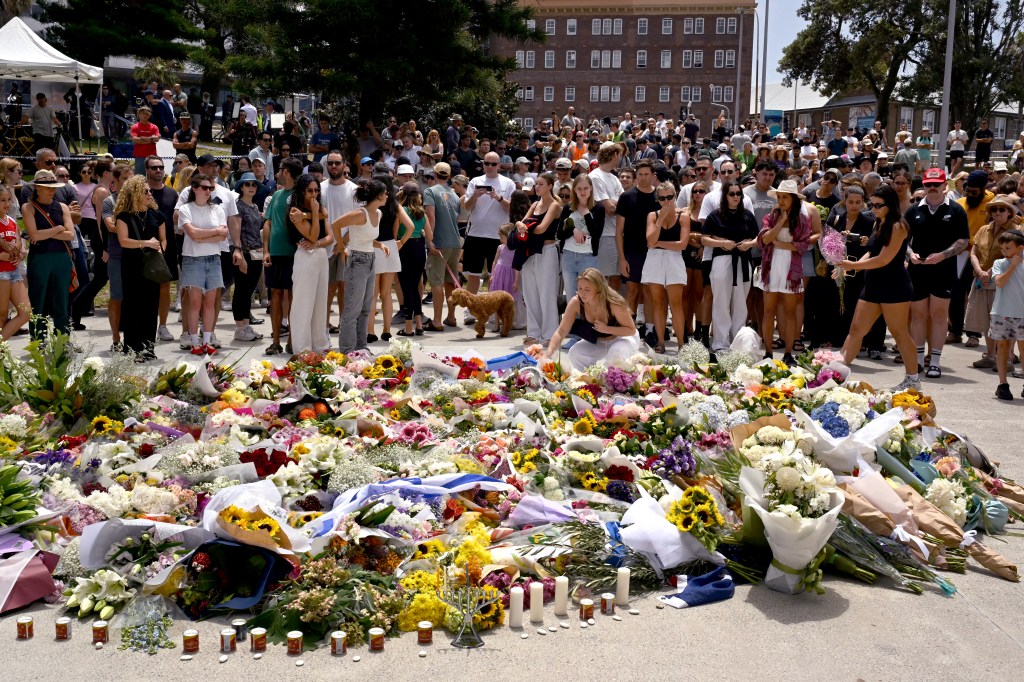
But now, she says, many Jewish people are avoiding gatherings, and outdoor celebrations have been moved inside. “This is the most unfair thing in the world, because Australians don’t practice their religion like this. They’re not forced to be behind bollards and air-locking doors like I am when I go to a synagogue.”
Australia is still grieving, but politicians across Australia’s political divide are pushing for changes which they believe would have prevented this attack. “The government is prepared to take whatever action is necessary,” Albanese said Monday. “Included in that is the need for tougher gun laws.”
But Australia already has among the strictest gun laws in the world. After a gunman used two semi-automatic rifles to kill 35 people at Port Arthur, Tasmania, in 1996, the Australian state and federal governments instituted a large-scale mandatory gun buyback program, restricted private ownership of semi-automatic rifles and shotguns, and expanded gun license requirements. In Australian political culture, the response to Port Arthur is cited as the example of national resolve in combating gun violence and the main reason that Australia experiences far fewer mass shootings than the U.S.
Sajid Akram—who came to Australia in 1998 from an unspecified country on a student visa—held a gun license that permitted him to hunt recreationally. Police recovered six guns from the scene and a search of Akram’s home, and also found several improvised explosive devices and two homemade ISIS flags in his car. Albanese and others have proposed periodic reviews of licenses, along with limits on the number of guns a person can own.
It’s not clear that tightening already-strict gun laws would have a measurable effect on mass shootings—Australia had few before Port Arthur and has had few since. Periodic license reviews might have flagged the Akrams’ radicalization, but without the post-Port Arthur restrictions, they could have used semi-automatic weapons rather than bolt-action rifles and shotguns—almost certainly producing a far higher death toll.
There’s also the matter of motivating beliefs. John Howard, Australia’s center-right former prime minister who passed and championed the gun control laws in the wake of Port Arthur, said he supports strengthening gun laws “where sensible tightening can occur.” But, he also underlined that he didn’t want “the focus on guns [to] be used as a pretext to avoid the broader debate about the spread of hatred of Jewish people and antisemitism.”
Jillian Segal, whom Albanese appointed in 2024 as a special government envoy to combat antisemitism, said Monday that the Bondi attack was the result of “hatred that has seeped into our society.” In her statement, she also called for the government to act on an antisemitism plan she had developed earlier this year that called for withholding funding from universities that responded inadequately to antisemitic incidents, the introduction of government media monitoring, and passing online regulations meant to curb hate speech. The plan had been controversial when it was first released—critics say it would threaten free speech—but Jewish community advocates claim that the government’s responses to antisemitism, which they characterize as weak, have created a “permissive” culture of hate.
Precise numbers on hate incidents are often unreliable. But, since October 7, 2023, the Executive Council of Australian Jewry has tallied 3,700 anti-Jewish incidents, ranging from disruptive anti-Israel protests, to graffiti calling for violence against Israel and Jews, to arson attacks on a kosher deli in Bondi and a synagogue in Melbourne (both of which were linked to the Iranian Islamic Revolutionary Guard Corps). From 2013 to 2023, Australia averaged 342 such incidents a year. Over the past two years, that rate has increased more than fivefold, to 1,858 incidents a year.
Adam Lankford, a professor at the University of Alabama’s criminology department who studies the psychology of terrorism and mass shooters, told TMD that a climate of increasing antisemitism may contribute to a greater likelihood of terrorist attacks, like what happened on Bondi Beach. While political ideology often determines the targets of terrorist violence, it “also affects the likelihood of attack,” he said. “because [attackers] think what they’re doing will be celebrated by members of the general population, and they feel like there’s a bigger audience of more people who will be cheering.”
But it also seems that Naveed Akram, at least, was beginning to radicalize well before the war in Gaza. Australian security agencies first became aware of him in 2019, during an investigation into extremist associates who were allegedly part of an Islamic State cell in New South Wales. Australian counterterrorism officials on Tuesday told the Australian Broadcasting Corporation that Naveed Akram had links to Wissam Haddad, a notoriously antisemitic, pro-Islamic State preacher based in Sydney. Haddad has denied knowledge of the attacks.
Even if the Akrams acted as “lone wolves,” their attack has gruesomely illustrated how unsafe many Jewish Australians now feel in their own country. Kaltman told TMD that Jews from a variety of communities and denominations feel that the government has ignored their warnings, wishing the problem of antisemitism away while not doing much to combat it. “Australia can be absolutely brutal and ruthless when it wants to methodically enforce a state of being,” she noted, pointing to the severity of the country’s lockdown measures during the COVID pandemic. In contrast, very few people have been charged under hate-crimes legislation in Australia over the last several years.
Pauline Hanson, a member of the Australian Parliament whose right-populist One Nation party has recently surged in the polls, has blamed Australia’s immigration policies. “The wrong people have been brought in here, with the wrong ideology, the people that will not assimilate into Australian culture and values,” she said on Sky News on Monday. Australia has seen high levels of immigration over the last several years, primarily due to a backlog of visa applications created by the pandemic.
But Australia already has tight immigration controls. Visa applicants need to meet a strict points-based standard—based on factors such as education and income—and pass character requirements, requiring applicants to submit documentation from their home country’s police forces, and pass security screenings conducted by the country’s intelligence services. Sajid Akram likely entered Australia under looser standards—before security measures were tightened after the 9/11 attacks—but authorities never flagged him or his son as posing an imminent risk. And Naveed Akram was born in Australia.
In the coming weeks, whether the government could have done anything differently and what it should do going forward will be a matter of intense debate in Australia. But the country’s relationship to its Jewish citizens has changed, perhaps irrevocably.
“Nobody took our community’s warning seriously,” said Kaltman. “And now we’re burying our dead and mourning the loss of life, but also the loss of the way of Australian life that we thought we were part of in this country.”