Authored by ‘No1’ via Gold and Geopolitics substack,
The bombs make headlines. The economic unraveling happening quietly underneath them don’t. So before we get back to the daily carnage, let’s talk about money. It used to be funny, in a rich man’s world.
The world didn’t wake up one morning and decide to distrust the dollar. It was a process. Gradually, then suddenly, as these things tend to go.

It started with Venezuela. In 2019, Caracas asked the Bank of England to return its own gold – 31 tonnes, sitting in a vault in London, belonging to the Venezuelan central bank. The Bank of England said no. The justification was creative: London had decided to recognise a man who had never won an election as Venezuela’s “legitimate” president, so it couldn’t very well hand $2 billion in gold to the actual government. Problem solved. Maduro was a dictator, everyone agreed he was terrible, and so the consensus was essentially: who cares.
Everyone filed it under “rogue state gets what it deserves” and moved on.
Then Russia invaded Ukraine in 2022, and $300 billion in Russian sovereign reserves got frozen overnight. Again, the justification was airtight, the villain was obvious, and the Western financial world applauded itself. What nobody wanted to discuss was the precedent. Assets held in Western financial institutions were no longer safe if the political winds shifted against you. That was new. That was genuinely new. And every central bank and sovereign wealth fund on earth noticed, even if they did say nothing publicly.
Then Trump came back. Tariffs on allies. Threats to annex Greenland. The implicit message that the post-war security architecture was now a negotiable service rather than a commitment. The dollar’s reserve currency status had always rested on two pillars: the dominance of the US economy, and the reliability of the US government as a custodian of the system. One of those pillars was now being kicked.
By the time the Iran war started, the trust account was already badly overdrawn.

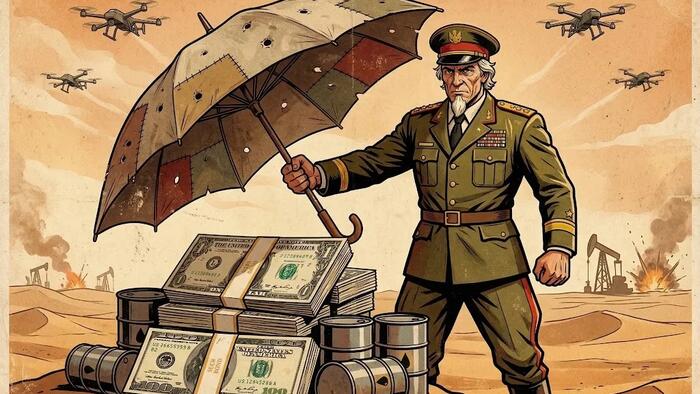
The petrodollar was a simple deal. The Gulf states price their oil in dollars, recycle the surplus into US Treasuries, and in exchange get American military protection. Clean, elegant, and – for fifty years – it actually worked. The US got permanent demand for its currency and its debt. The Gulf got security guarantees backed by the most powerful military on earth.
Five decades of procurement scandals and DEI hires later, someone called the bluff.
US bases across the Gulf – Bahrain, Qatar, Kuwait, the UAE – were always sold as the physical expression of the guarantee. The muscle that backed the paper. They were protection. Except now those bases are targets. The countries hosting them are getting hit precisely because they host them. What once was “US military presence as shield” has collapsed and became “US military presence as a bullseye”.
Medvedev put it with the particular relish of someone who has been waiting years to say it:

You can dismiss Medvedev on most things. On this one, his timing is sublime.
I already cover the daily physical damage to Gulf infrastructure in my Iran series, so I won’t repeat it here. The point here aren’t the bombs. The point is what the bombs have made obvious: the protection America sold the GCC was a liability dressed up as an asset.
And increasingly it seems that the Gulf states are discussing pulling their investment commitments from the US. Not done yet. Discussing. They are not floating the possibility quietly in private rooms – they are saying it out loud, which means the market already knows which direction they’re heading.
Capital won’t wait for a formal declaration. It will already leave in advance, quietly, and then when the announcement comes, everyone will pretend to be surprised…
This is the engine that kept the whole fiat USD thing running: Gulf sells oil → receives dollars → buys Treasuries → US borrowing costs stay manageable → repeat. For decades. And what keeps that loop turning isn’t economics. It’s trust. The belief that Washington is a reliable partner, that dollar-denominated assets are safe, and that the security umbrella is real.
But the trust was already shredded before the first bomb fell on Iran.

The US Treasury market is in a bit of a pickle. I believe the technical term is “clusterfuck”.
About $9.2 trillion in US Treasuries rolled over in fiscal 2025 – roughly a third of all outstanding federal debt – and the 2026 refinancing wave is already building. Annual interest payments on the federal debt have crossed $1 trillion for the first time. The Treasury is buying back its own debt in tranches to keep the market from seizing up. But the 10-year yield keeps moving higher regardless.
The petrodollar recycling loop was one of the structural forces keeping Treasury auctions clearing. When Gulf sovereigns stop buying – or start selling – somebody else has to absorb that supply. At higher rates. Which makes the interest burden worse. Which makes the deficit worse. Which requires more issuance. The spiral is not complicated.
And underneath all of this sits a deeper shift that doesn’t get enough attention. The world is migrating from a currency-based monetary order to a collateral-based one. For decades, Treasuries were the global safe asset – the thing you held when you didn’t know what else to hold. That status is eroding. What’s replacing it, are commodities. Physical stuff™. Things you can actually use. Which is – not coincidentally – exactly what the GCC is sitting on, and exactly what the US has just demonstrated it cannot protect.
Gold and silver hit record after record last year for the same reason. Not inflation. Not rate expectations. Something older and simpler: people are looking for a store of value that doesn’t require trusting a government that has made itself unpredictable.
Meanwhile, private credit is starting to make interesting noises.

Blue Owl gated its retail private credit fund in February after redemption requests doubled through 2025. Today, BlackRock announced its $26 billion private credit fund is limiting withdrawals too [-4% at the open]. The same BlackRock that just wrote a private loan to zero – a loan marked at par three months ago. The second time it’s done that.
Rubric Capital – a Point72 spinout – sent a letter to its own LPs this week calling private credit a fraudulent bubble and accusing players of “Enron-like accounting” to hide the rot.
Whether Gulf sovereign wealth funds are behind any of this is speculation. What isn’t speculation is the pattern. Capital that was deployed into US private markets on the assumption of political stability and reliable returns is trying to get out. “Canary in the coal mine” is how one analyst described the Blue Owl situation. The canary is dead. It has ceased to be. It is an ex-canary. And BlackRock just joined the funeral.
Nobody told the AI crowd. The Mag7 have committed $600 billion in AI capex for 2026 alone – an amount so large it requires its own stable financial universe to make sense. Cheap dollars. Stable long-term rates. A Treasury market with reliable buyers. As I wrote in “The Trillion Dollar Oops” (link), it’s a beautiful circular system: Big Tech borrows cheaply, buys GPUs, GPU makers reinvest in Big Tech, everyone marks up each other’s valuations, and round it goes. The whole thing runs on the assumption that the dollar system stays intact.
It’s currently on fire.
Capital is already rotating out – emerging markets have dramatically outperformed the S&P since January 2025, and it’s accelerating. The AI capex cycle and the capital flight cycle are running in opposite directions.
Something has to give. Burning refineries don’t care about your capex commitments.

The entire purpose of US power projection in the Middle East – the bases, the carrier groups, the security guarantees – was always to protect the dollar system. To keep the oil flowing in dollars, the recycling loop turning. Not out of the goodness of its heart. It allowed the US to run deficits indefinitely, export inflation to the rest of the world, and borrow at rates no other debtor could ever dream of.
Whether Washington chose this war or simply couldn’t say no when Israel saw its chance and leapt – that’s still an open question. What isn’t open is the result. The Gulf states are under attack because they host US bases.
Either way, the GCC is finding out what “ally” means in practice.
Views expressed in this article are opinions of the author and do not necessarily reflect the views of ZeroHedge.
Loading recommendations…