You could argue with my mother about many things, but not about abortion. She believed in a woman’s right to choose in the same way that she believed in a woman’s right to vote. There was no point in arguing either issue, and as far as I can remember, we never even tried. When my younger sister briefly joined a pro-life group right after she graduated college, she told me, but she prudently did not mention it to my mother.
Unfortunately, New York State Right to Life was not in on the secret, and one day when Nora was not home, they called the house. I was living at home as I prepared to go to business school, so I happened to be standing in the kitchen when the phone rang.
I only saw one side of the conversation, but it was quite a sight. If there is an opposite to “resting bitch face,” my mother had it; her broad-boned features defaulted to crinkly eyes and a slight smile. As she listened, I watched that expression turn confused, then incredulous, and then to something like horror.
“No one in this household would belong to any such organization,” she said vehemently. “Please don’t call here again.” And then, quite uncharacteristically, she slammed down the phone.
During the ensuing half-hour, as she calmed herself down, my mother managed to convince herself that the pro-lifers had somehow added Nora’s name to their list by mistake. I nodded along and offered a non-committal “huh” at appropriate intervals.
I suppose the brave, honest thing would have been to tell her the truth. But I was not inclined to pick a fight, even vicariously, because I sympathized with both of them too much to take a side. For as long as I can remember, I have believed that a woman should be able to decide whether to become a mother, and also believed that the life growing inside her should get the same shot as the rest of us at life, liberty, and the pursuit of happiness. Since these two beliefs are fundamentally incompatible, I usually managed the contradiction by avoiding the subject.
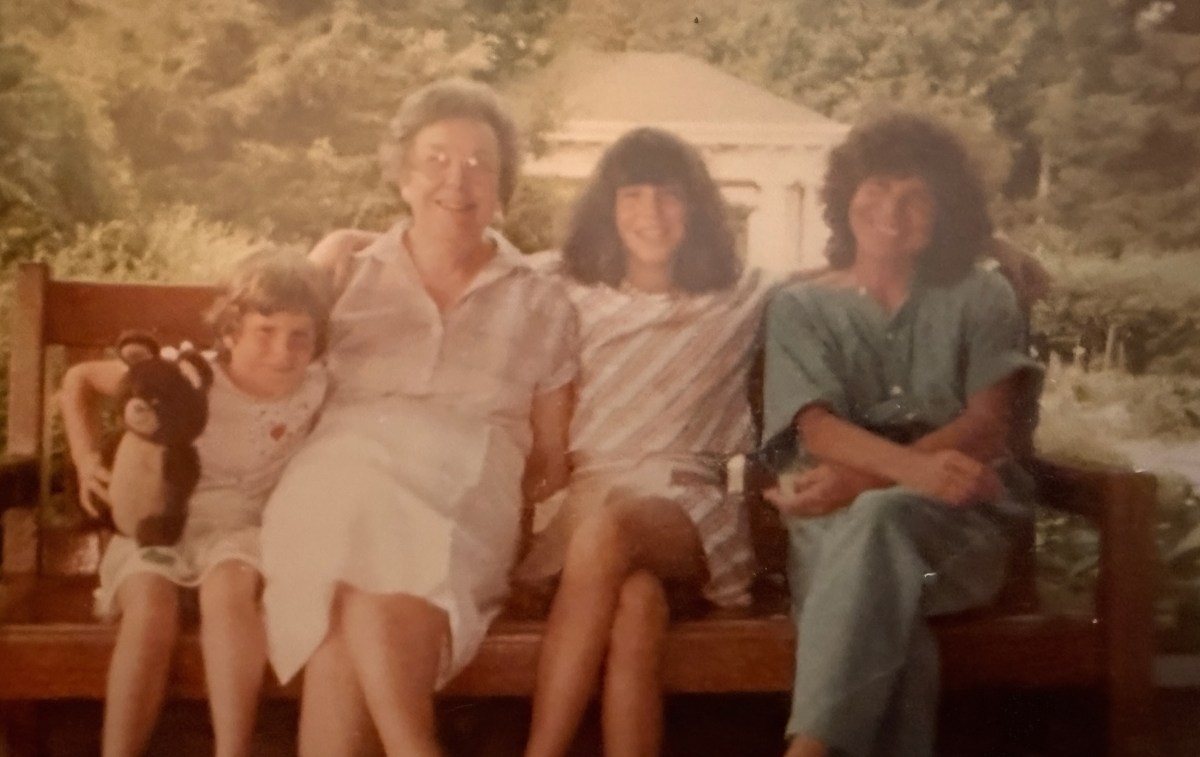
Anyway, back to my mother. “The time my sister joined the pro-lifers” was a well-worn classic among the many anecdotes I told my friends about my mother. I accumulated any number of amusing Joan McArdle moments, because she managed to be startlingly singular for a respectable real estate broker. For example, there was the time she stopped dead on a Manhattan sidewalk as we were headed out for dinner to celebrate my 21st birthday.
“My God!” she said. “You’re taller than me!”
“Mom, I’m 6’2”, and what’s more, I’ve been 6’2” since I was 11 years old. I probably outgrew you sometime in the sixth grade.”
“I’m not that short,” she said defensively.
“You’re 5’6”,” I said. (In reality, she was probably closer to 5’4”, but I hewed to the polite family fiction.)
“Well I know,” she said. “But I feel tall.”
That was my mother: a small dynamo who identified as a giant. Then two years ago my mother got sick and died, and I stopped telling that story. It no longer struck me as funny.
Few of us leave this life any easier than we came into it, and the death of a beloved parent is harrowing in a way that cannot really be described or explained. So I am not going to tell you about my mother’s death. All I will say is that her illness was brief, and not obviously fatal, and we expected her to get better until shortly before that horrible moment when I told the doctors to turn off the machines and make her comfortable.
Instead, I want to tell you about a conversation we had just a week before she died, and a few weeks after my 50th birthday. We were sitting in the bleak nursing home room where she was supposed to be recuperating in preparation for coming home.
At several points during her illness, my mother had told me she thought she was dying. I discounted these premonitions as the natural fears of someone who was pretty sick, but not fatally so, and tried to turn her mind to pleasant, ordinary things.
But my mother would not be turned when she was determined. She was warm and generous and good-humored, and sometimes her decisions were more passionate than wise, but underneath all that was a fierceness: Once she’d started something, she would see it through, even if it wrecked her.
As an 8-year-old child, she saved for weeks to buy some monstrous concoction called the “Pig’s Dinner” from the local ice cream shop, and since there was a prize for actually finishing it, finish it she did, even as each bite made her sicker and sicker. I have a million such stories in my collection of Joan McArdle anecdotes: the time she chased down a purse snatcher, threw him against the wall, and recovered her purse; the time she insisted on confronting a scary-looking tow lot owner who had three snarling pit bulls, over my frantic entreaties, because she did not believe he had been justified in towing her car. But the more telling story is probably the fact that my mother made my sister and me a hot, home-cooked meal every night, even while holding down a demanding full-time job, because she believed that family dinner was important.
But a week before she died in that nursing home, she had decided to tell me about her regrets, the kinds of regrets that families air on their deathbed. Many of them had to do with me, though none were really hers to regret—she couldn’t have known my third-grade class was bullying me, and it certainly wasn’t her fault that I nearly flunked out of both high school and college. I attempted to reassure her, and when that failed, to divert her, but my mother plowed on, through the failure of her marriage to my father, and the trouble she’d given her own parents.
“I could have done so much better.” Her voice was plaintive. “The wild child. The chaos mom. The unwed mother.”
Her own youthful misadventures I knew something about—let’s just say that the tendency to flunk out of school seems to be hereditary. I was also, obviously, aware that her marriage had gone awry; my parents essentially stopped speaking to each other when I was still in primary school, and finally divorced when I was 33.
I was nodding along, trying to look sympathetic and loving, and then … unwed mother? I blinked. She was looking at me with the look people give you when they want to say something and can’t find the words they need.
“You’re serious?” I said, inanely.
Suddenly, my mother looked terribly young and vulnerable. She told the story quietly, with a quaver in her voice: the high school boyfriend, a miserable freshman year in college, a motel near Albany, the boyfriend’s refusal to marry her … and finally, the home for unwed mothers in Buffalo where she’d waited out the pregnancy and given the baby up for adoption.
“He was the love of my life,” she said of that boyfriend, and the look on her face—well, she looked just as she must have looked when he’d abandoned her almost 60 years before, with every bit of love and innocence and bewildered hurt written on her face.
For the first time in my life, in thinking about that young man, I understood what “murderous rage” actually meant. In the brief, insane moment that followed, I thought about tracking down the 80-year-old man he’d become, and doing something violently illegal.
But my mother was still talking. “You know how your grandfather is.” (By which she meant that he was, like her, decent, honorable, and generous to a fault. ) “I couldn’t imagine that any man I loved would leave me like that.”
“What happened to the baby?” I asked, when I was finally able to quell my fantasies of inflicting grievous bodily harm on a geriatric patient.
“I don’t know,” she said. “All I know is that I named him David, and the nurses at the hospital said he was the most beautiful baby they’d ever seen.”
That night, when I was done crying, I downloaded the forms for the New York State Adoption Registry. Parents who gave their children up for adoption, and children who were adopted, can apply to the registry to meet each other. If both parties sign up, the registry helps them contact each other.
Because I didn’t know that my mother was going to die, I thought that I could give my mother her son like a gift. I was intrigued by the possibility of a brother, but if I am honest, I was most interested in finding my mother something to live for.
There’s a movie version of this story where that’s what happens, with a touching reunion around a hospital bed. What actually happened is that my mother died, and when I staggered home from the hospital, I found a letter waiting for me in our mailbox.
The New York State Adoption Registry said that my brother had contacted them at some point, wanting to be reunited with his birth family. But now he was deceased, they said, and because he could not renew his consent, the registry would not share his information.
Is it possible to grieve a man you never met? It is, and I did. I grieved my mother and my brother separately and together, her with agony, him with quiet sadness.
When the initial shock had faded, and I was able to think again, I saw that my brother had always been the missing piece to many puzzles.
It explained why my mother had almost had me in a cab—when she went into labor, the obstetrician told her she could take her time about getting to the hospital, since after all, first babies take forever to come. I learned that her secret had contributed to the failure of my parents’ marriage when she finally told him, though I suspect that it was probably already on the rocks by that point.
“He thought I wanted to hide it from him,” she told me, on that haunted afternoon in the nursing home. “But I just—” her voice broke. “I just couldn’t talk about it.”
The revelation made me wonder about something else, a funny bit of personal family lore: When I was a little kid, I was convinced that I had an older brother. I named him Tom, not David, but I believed in him intently. I suppose I don’t really think that memories of previous occupants can be transmitted through the womb, but there is something eerie about it. And it saddens me to think of how my mother must have felt, listening to her “oldest child” prattle about an absent brother.
And of course, my mother’s revelation helped me understand why she was so passionate about abortion rights. She used to tell us it was because a relative had had a dangerous illegal abortion. In hindsight, it must have been her own suffering that animated her. And now that I knew, I found myself revisiting the subject I’d long avoided.
There is a famous thought experiment about abortion, published by philosopher Judith Jarvis Thompson in 1971, when my brother was 7, and Roe v. Wade and I were both two years away from happening.
Suppose you wake up in a hospital and find yourself in bed with an unconscious man connected to you by a series of tubes. A doctor explains the man is a famous violinist with a kidney ailment, and you were kidnapped by his fans who hooked you together so that your kidneys could filter his blood as well as your own. While the doctor would of course never perform such an operation herself, now that your circulatory systems are entwined, she cannot ethically disconnect the violinist, since that would kill him. So you’ll just have to stay attached to him in that hospital bed for nine months, while his kidneys heal.
Do you have a right to detach yourself and get on with your life, Thompson asks? Her answer is that you do, at least in some cases. There are a number of critiques of both her analogy and her answer, most notably that it is analogous to forcible rape, not the voluntary sexual intercourse which accounts for most unwanted pregnancies, including my mother’s. But at least it sidesteps the endless, unwinnable arguments over when, exactly, an embryo becomes a person. Instead, it takes us to the heart of the problem: What do we do when one human being needs another’s body to survive?
We want there to be a clear, fair, and logical answer to that question. There isn’t, because biology is not fair. It isn’t fair that some animals need to eat other animals to survive, that black widow spiders eat the fathers of their children after they are done mating, or that female mammals gestate their children inside them, at significant personal cost. These things may be evolutionarily advantageous, and they may have side benefits like the delicious taste of meat or the overwhelming love between a mother and her child. You may even think these arrangements are the virtuous outgrowth of God’s law. But whatever they are, they are not fair, and no amount of scheming by philosophers or theologians can make them so.
However, “life’s unfair” is not a satisfying answer to us humans, who stubbornly think that things should be fair. So we obfuscate. Many people, as I did for years, throw their hands up in frustration and refuse to decide which of two supreme values ought to be sacrificed for the other: a woman’s bodily autonomy or a human life. Others simply discount one side of the equation.
Committed pro-choicers dismiss the fetus as valueless, a potential life only, in the same way that all the other babies who were never conceived because their potential parents didn’t happen to have sex at a particular moment. If you look at it this way, it is as ridiculous to demand that a woman carry the baby to term as it would be to demand that she have unprotected sex with various strangers in hopes of making a baby.
There are some obvious gaps in that reasoning, but then, there are also some notable gaps in standard pro-life arguments, most notably the tendency to downplay or elide the suffering of the mother. Certainly, pro-lifers acknowledge that a woman’s life changes when she has a baby, but they tend not to dwell on how giving a baby up for adoption can scar a woman like my mother, who clearly thought she’d have been better off having an abortion.
If she hadn’t been so shattered by her unplanned pregnancy, she might have met and married someone better suited to her than my father, had a happy marriage with a large crop of gloriously wanted kids. At the very least, she might have stitched things back together with my father rather than spending decades in a marriage that was irretrievably broken.
Of course, if she hadn’t had my brother, she also wouldn’t have had my sister and me. But she wouldn’t have missed us, in that happier alternative world. We would be just one of a billion potential things that didn’t happen in her life. And who can say that the children she didn’t have, in that world that never was, wouldn’t have been more wonderful and happy and valuable to humanity than one middling good columnist?
None of these are new arguments; if you’ve spent any time on abortion debates, you’ve gone around and around and around on them like the world’s worst fair ride. But it is one thing to think about these things in the abstract. It is another to hear the raw pain in your mother’s voice and understand that it has been there for your entire life—and also, that you could erase that pain if you could only go back to 1963 and give her a safe, legal abortion.
Who wouldn’t want to do that? Yet ironically, it was my brother who stopped me from becoming as passionately pro-choice as my mother was.
There’s another thought experiment I think about a lot when it comes to abortion. This one I made up myself, or at least I think I did, and ChatGPT seems to agree with me.
Imagine you meet a single mother struggling to raise a 2-year-old alone—her dreams of medical school crushed and unlikely to be fulfilled, her dating life filled with an endless series of men who back away from raising someone else’s child, her nights a frequent battle with loneliness and toddler tantrums. You see that she is breaking under the strain, and just as you are thinking how sad it is, someone hands you a button.
If you push that button, the toddler will be erased. The child will feel no pain, but will simply vanish, and no one, not even you, will remember that he ever existed. The woman will blink and find herself in med school, dating a charming and kind fellow student with great potential as a husband and father.
Some people would, I’m sure, but I imagine most people, and even most people who call themselves pro-choice, would have trouble looking into a child’s face and obliterating his existence. Sure, you may understand intellectually that removing him from the world opens up the way to other future children who will be just as cute and just as deserving of life. But something in us rebels at the idea of trading the child we can see for the ones we can only vaguely imagine.
The invisibility of the child is one of the essential features of abortion. It is not the only reason women get abortions, of course—pregnancy is extremely hard on the body, and having never been pregnant myself, I am not anxious to judge the reasons other women refuse its burdens. But it seems obvious that one reason women choose abortion is that it makes the pregnancy invisible to society, and the baby invisible to its mother.
I was surprised to learn that many women say they are having an abortion because they could never give their baby up for adoption. This seems like a confession that the life growing inside her is so precious to her that she could never bear to let go of it, which makes killing the child in the womb seem like a very strange solution. But then, abortion means she never truly knows the child she is giving up; she will never even see its corpse.
She is also spared the social stigma that I suspect might attach if she gave the baby up for adoption. We think we’re more tolerant now, because we no longer shame unwed mothers as brutally as they did when my mother was young. But how easy would it be, really, if a working woman carried the pregnancy to term, then allowed someone else to adopt it?
There would be, at minimum, months of incredibly awkward conversations in the office—“Do you know the baby’s sex yet?” “Have you chosen a name?” But I also think there would be something else, never mentioned but often thought: the suspicion that there must be something wrong with a woman who could give her baby away.
At least my mother could say she didn’t have a choice to put her baby up for adoption; even if people had known, no one would have judged her for giving up a child she could not have cared for decently with the jobs then available to a single mother. Today, we have choices, but one of those choices seems to be almost impossible. There are millions of unintended pregnancies every year, and about a million abortions, but only about 15-20,000 infant adoptions.
Abortion isn’t the same thing as not having been pregnant, which is what everyone would prefer. But it is surely much closer than a boy named David who has 10 fingers and toes, and your father’s eyes. And I understand why my mother believed she deserved the option.
But because she didn’t have that choice, I can see that the notion of invisibility is a sham. To my fury, my brother David remains technically invisible to me; he is as vague and formless as the wraiths of all the children whom my parents might have conceived, but didn’t. Yet he existed as firmly as I do. Like me, he gurgled and smiled and banged his head learning to walk, and like me, he probably climbed trees and learned to throw a baseball and read books and got bored in algebra class.
I may not know what he looked like, what he did with his life, or when or how he died. But I imagine that if I’d ever met him, I’d have recognized my own face in his. And while I do not know exactly when he contacted the adoption registry, I do know that he longed for our mother, as I do today.
When my mother told me what his existence had done to her, I felt ready to kill that feckless boyfriend, if it could have avenged her suffering in some small way. But now I ask myself: If someone gave me the button, would I unmake my missing brother for her sake?
As a Catholic, I have a theological answer to that, but that was a teaching I accepted on faith when I joined the church as an adult, not a visceral personal conviction. My brother made me confront the question in the personal and the particular. Would I save my mother, at his expense?
I’m sure I could not, if he were standing here before me. But now I’m also pretty sure I could not, even just knowing that for some number of years we breathed the same air, and listened to the same songs on the radio, and watched the same sitcoms, and very probably, smiled the same smile.
Because he lived, I grieve his death, along with hers. But because he lived, I cannot bring myself to grieve his birth.