With the current mess that the US is in, there has been plenty of talk of “what comes after” and how to think about the big structural changes needed to prevent another authoritarian from taking over and abusing all the levers of power for corruption and self-enrichment.
There are many different issues to address, but we should be thinking creatively about how to redesign our institutions to be more resilient to the abuses we’re witnessing.
One area ripe for creative rethinking is the federal judiciary, particularly the Supreme Court. Because right now, we have a system where individual judges matter way, way too much. Rather than the minor reforms and incremental changes some are suggesting, I think the solution is to go big. Really big. Expand the Supreme Court to at least 100 justices, with cases heard by randomized panels.
I’ll explain the details below, but the core philosophy is simple: no single Supreme Court Justice should ever matter that much.
President Trump has found a powerful but obscure bulwark in the appeals court judges he appointed during his first term. They have voted overwhelmingly in his favor when his administration’s actions have been challenged in court in his current term, a New York Times analysis of their 2025 records shows.
Time and again, appellate judges chosen by Mr. Trump in his first term reversed rulings made by district court judges in his second, clearing the way for his policies and gradually eroding a perception early last year that the legal system was thwarting his efforts to amass presidential power.
The actual figures are damning. Trump’s appellate appointees voted to allow his policies to take effect 133 times and voted against them only 12 times. That’s 92 percent of their votes in favor of the administration.
When Chief Justice John Roberts responded to Trump’s criticism of an “Obama judge” back in 2018, he insisted that “we do not have Obama judges or Trump judges, Bush judges or Clinton judges.”
The data suggests Roberts was either naive or lying.
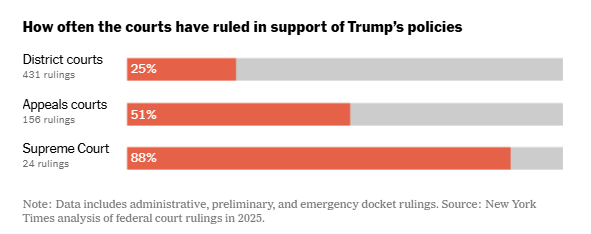
The Times analyzed every judicial ruling on Mr. Trump’s second-term agenda, from Jan. 20 to Dec. 31 of last year, or more than 500 orders issued across 900 cases. About half of rulings at the appellate level were in Mr. Trump’s favor — better than his performance with the district courts, though worse than his record at the Supreme Court, where the rulings on his agenda have almost all been on a preliminary basis in response to emergency applications.
And there it is. The higher you go up the judicial food chain, the better Trump does. District courts ruled in his favor 25% of the time. Appeals courts: 51%. The Supreme Court: 88%.
Now, some will argue this is the system working as designed—higher courts correcting overzealous lower court judges. And sure, that’s part of what appeals courts do. But the pattern here isn’t just about legal merit. It’s about how much individual judges matter, and how vulnerable the system is to ideological capture.
The uniformity of the judges’ votes is reason for serious concern, said Mark L. Wolf, a former federal judge nominated by President Ronald Reagan. Judge Wolf recently retired so he could speak more freely about what he has characterized as the threat that Mr. Trump posed to the rule of law.
“If you’re an impartial judge, the same party is not going to win every time,” he said. “Because the facts are different, the law is different, and so the result is often going to be different.”
This gets at the fundamental problem. When you have a small number of judges with lifetime appointments, whose ideological leanings are known quantities, those individual judges become enormously powerful. A single justice retiring or dying at the wrong time can reshape American law for a generation. That’s insane. No single person should have that kind of power over the constitutional rights of 330 million people.
And it gets worse. The Times found that three Trump appointees on the D.C. Circuit—Judges Gregory Katsas, Neomi Rao, and Justin Walker—accounted for more than half of all pro-Trump votes from Trump’s appellate appointees. Three judges. In one circuit. Exercising “outsized influence.”
Combined, Judges Gregory G. Katsas, Neomi Rao, and Justin R. Walker voted 75 times in favor of the administration — slightly more than half of the pro-Trump votes from Mr. Trump’s appointees logged by the Times analysis — and only three times against.
So what do we do about this?
The typical response from Democrats when they’re in power is to either accept the status quo or propose modest reforms that don’t actually address the structural problem. Republicans, meanwhile, have been playing the long game on judicial appointments for decades, understanding that packing the courts with ideologically aligned young judges is one of the most effective ways to entrench their policy preferences beyond electoral accountability.
We need to think bigger. Much bigger.
Here’s my proposal: Expand the Supreme Court to at least 100 justices, with cases heard by randomized panels of 9 justices. High-profile or particularly important cases could be reheard en banc by a larger panel or the entire court, similar to how it’s currently done in appeals courts.
Before you dismiss this as just another “court packing” scheme, let me explain why it’s fundamentally different from what FDR tried to do in 1937.
FDR’s plan was explicitly designed to shift the ideological balance of the court in his favor. He wanted to add up to six new justices precisely because the existing court kept striking down New Deal programs. The goal was partisan advantage, and everyone knew it. That’s why it failed—even FDR’s own party largely opposed it as a power grab.
What I’m proposing is the opposite. By expanding to at least 100 justices, you’re not packing the court in any ideological direction. You’re diluting the power of any individual justice—or any ideological bloc—to the point where it doesn’t matter nearly as much who gets appointed or when they retire or die. And unlike some reform proposals that would require a constitutional amendment, this one doesn’t. The Constitution doesn’t specify the size of the Supreme Court—Congress has changed it before, from as few as five justices to as many as ten.
Think about it this way: Right now, replacing one justice out of nine can shift the balance of the court from 5-4 one way to 5-4 the other way. That’s an enormous swing from a single personnel change. But if you have 100 justices, and cases are heard by randomized panels of 9, the ideological composition of any given panel becomes much more variable, and the overall composition of the court becomes much more stable over time.
No single president appointing one or two or even ten justices can fundamentally reshape the court. No single justice dying at an inopportune moment can throw constitutional law into chaos. The incentive for presidents to appoint ideological extremists diminishes because no individual justice will be important enough to matter that much.
This is the core principle: No single Supreme Court justice should ever be important enough to matter.
We shouldn’t care who any individual justice is. We shouldn’t have national freakouts when an 87-year-old justice refuses to retire. We shouldn’t have presidents salivating over the actuarial tables of aging justices. The system should be robust enough to absorb personnel changes without lurching wildly in one direction or another.
How would this work in practice? There are several possibilities.
One approach would be to elevate existing appeals court judges to the Supreme Court. This could happen all at once or gradually over time. Given that there are currently around 180 active appeals court judges, drawing from this pool wouldn’t be difficult from a numbers perspective.
Another approach would be a rotating system where appeals court judges serve temporary terms on the Supreme Court. This would actually align with how many other countries structure their highest courts and would create a more fluid relationship between the appellate and Supreme Court levels.
Either approach could be combined with term limits—say, 18 years—for Supreme Court justices. Term limits address a different but related problem: the arbitrary power that comes from lifetime appointments combined with advances in life expectancy. When the Constitution was written, justices served an average of about 15 years. Now they routinely serve 25, 30, or more. Term limits would make appointments more predictable and reduce the incentive for presidents to appoint the youngest possible ideologues who might serve for four decades.
There are additional benefits to this approach beyond diluting individual power.
First, the Supreme Court could actually hear more cases. The court has been steadily shrinking its docket for decades, from around 150 cases per year in the 1980s to around 60-70 today. With multiple panels operating simultaneously, the court could address far more legal questions, reducing the enormous backlog of important issues that never get resolved.
Second, it could help rationalize the federal circuit system. The Ninth Circuit, for example, is a behemoth that covers nine states plus Guam and the Northern Mariana Islands, with more than twice as many judges as the smallest circuits. With a reorganized Supreme Court drawing from an expanded pool of appellate judges, there would be an opportunity to realign the circuits into more sensible and equally-sized units.
Third, randomized panels would undermine the strategic timing that currently shapes which cases reach the court and when. Right now, advocacy groups wait for favorable court compositions before pushing major cases. The Dobbs decision that overturned Roe v. Wade didn’t happen by accident in 2022—anti-abortion activists had been deliberately holding back their most aggressive challenges for years, waiting until they knew they had a 6-3 anti-abortion majority locked in. With randomized panels drawn from 100 justices, that kind of strategic patience becomes pointless. You can’t game a court composition you can’t predict.
Now, there are legitimate questions and criticisms of this approach.
Some will argue that a 100-justice court would produce inconsistent rulings—different panels reaching different conclusions on similar issues. This is a real concern, but it’s manageable. En banc review could resolve circuit splits and ensure consistency on the most important questions. And frankly, we already have inconsistency—different circuit courts regularly reach contradictory conclusions that take years to resolve. Also the Supreme Court’s composition continually changes over time, and we still accept the results from different panels. No one sees a problem with relying on cases from half a century ago even though none of the Justices who made those rulings is even alive, let alone on the court, any more.
The most serious objection is political: any expansion would be seen as partisan court packing regardless of intent. This is true. Republicans would scream bloody murder if Democrats expanded the court by 91 justices, no matter how the new seats were filled. But Republicans are already screaming bloody murder about the courts whenever they don’t get their way. The question isn’t whether a reform will be controversial. The question is whether it will actually fix the problem.
The status quo isn’t neutral. A system where individual justices wield enormous power is a system that advantages whoever is best at the long game of judicial appointments. For the past several decades, that’s been Republicans.
Refusing to change a broken system because change might be controversial is just accepting permanent disadvantage while pretending to take the high road. Indeed, for anyone who (falsely) claims that this plan is “packing the court” (a la FDR), it’s the opposite. The Republicans and the Federalist Society spent decades plotting out things to get us where we are today, with a court that is “packed” in favor of their interests.
This is about unpacking the court.
The data from the Times analysis should alarm everyone who cares about an independent judiciary. When 92 percent of a president’s judicial appointees vote in his favor, that’s not impartial justice. That’s a rubber stamp. And when that pattern intensifies the higher you go in the judicial system, culminating in an 88% success rate at the Supreme Court, you have a system that’s been captured.
The solution isn’t to try to capture it for the other side. The solution is to build a system that’s resistant to capture in the first place.
Make the Supreme Court so large that no president can pack it. Make individual justices so interchangeable that none of them become celebrities or villains. Make the system boring. Make it work.
Because right now, we have a Supreme Court where everyone knows exactly who the swing vote is, where entire advocacy organizations are built around influencing specific justices, where presidential elections are decided partly on who might die in the next four years.
That’s not how a functional judicial system in a modern democracy should work. It’s time to unpack the court.