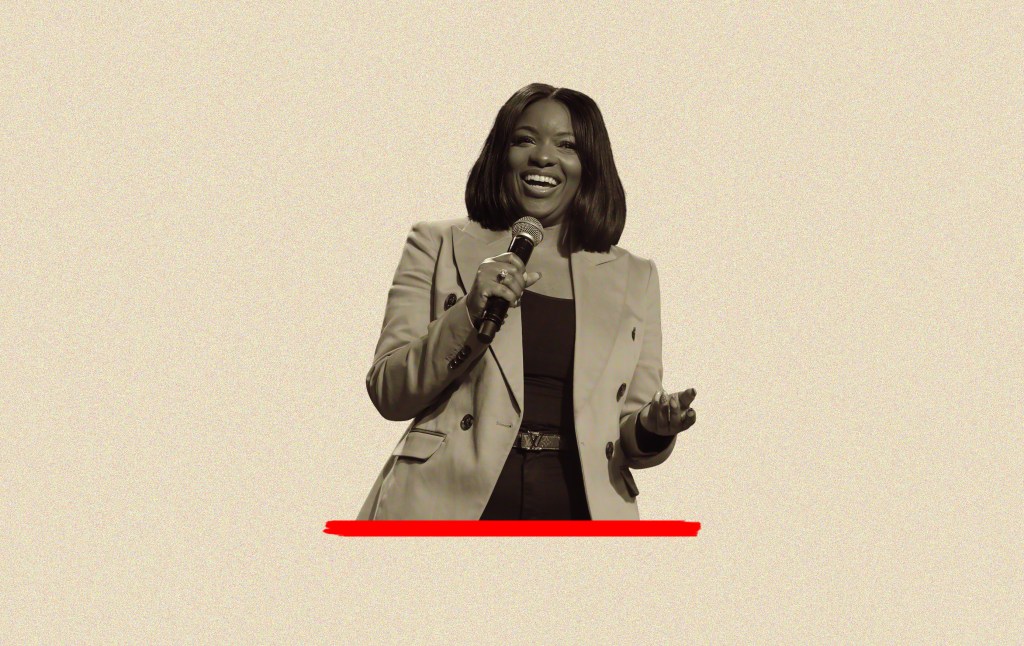
She’s a combative political performance artist distinguished chiefly by the relish with which she throws rhetorical punches at the opposition. There’s an audience for that on the left, as any MS NOW viewer might tell you, but if she were a Republican the president and his base would adore her. She’d be a top draw on the MAGA infotainment circuit and a mainstay in Fox News prime time. In a movement that celebrates boorishness as a virtue, few would be more celebrated than Crockett. She fights!
Alas, she’s a Democrat, which means she fights Republicans—and is now running for Senate in a state chock full of ‘em, enough so to have handed the president a nearly 14-point win in Texas last November. Her reputation as a fighter will probably carry her to victory in her party’s primary—and then to almost certain defeat in the general election.
In 2027, America might plausibly end up with Ken Paxton in the Senate, Republicans still in control of the upper chamber, and scores of postliberal stooges confirmed to the federal bench because Texas Democrats convinced themselves that the missing ingredient for turning the Alamo State blue is an abrasive resistance lib prone to playing identity politics.
Sure seems like a disaster in the making!
A bad fit.
The bullish argument for Crockett rests on two pillars. One is that she’s a “good communicator,” an important talent in the Trump era. The other is that she might turn out low-propensity voters, especially black voters, who normally skip midterm elections. The candidate herself mentioned that in her announcement speech, insisting that “when they tell us that Texas is red, they are lying. We are not. Reality is that most Texans don’t get out to vote.”
Start with the first. Is Crockett a good communicator or just a loud communicator? Which policies has she used her allegedly stellar communication skills to champion and make herself the face of?
The dirty little secret about her is that she isn’t a particularly dogmatic leftist. She admits to owning a “couple” of guns and says she’s licensed to carry. She’s also been softer on Israel than many in her party would prefer. Yet even political publications like Axios insist on referring to her as “progressive” (to the annoyance of actual progressives), possibly due to the stereotype that young nonwhite women in Congress like Alexandria Ocasio-Cortez reliably skew far-left.
It would help Crockett in a state as red as Texas to be known as someone who doesn’t fit that stereotype. Even in a Democratic primary, where she’ll face some progressive voters, her moderate streak would ease some of the electability concerns about her. So why, given her supposed talent as a communicator, hasn’t she done a better job of educating people about it?
Why didn’t she use her launch video to talk about it, or at least to position herself somehow on policy, instead of luxuriating in Trump’s contempt for her? She’s running to win more than just a Democratic primary, isn’t she?
The most one can say about her, I think, is that she could be a good communicator. Like Zohran Mamdani, she’s telegenic, charismatic, and shrewdly pivoting away from rhetorical bombthrowing toward affordability, affordability, and affordability. But unlike Mamdani, she’s not running for office in a city that Trump lost by 37 points. With every Democratic candidate in the country destined to campaign on affordability this fall, why would Texas liberals saddle themselves with a nominee who will muddle that message by having to defend her many bruising attacks on the party that a majority of her state supports?
As for the possibility that Crockett will turn out unlikely voters, specifically African American ones, I’m not sure why the same reasoning shouldn’t have applied to Kamala Harris’ campaign. In that case, Texans had a chance to hand a black woman a victory even more historic than Crockett winning a Senate seat would be. Yet Harris’ share of the black vote there in 2024 was no greater than Joe Biden’s in 2020. (In fact, it was slightly less.)
“Midterm elections are different from presidential elections,” you might reply. “Everyone turns out for the latter. Democrats need someone who can motivate them to turn out for the former.” Fair enough. Tell me, though: Which side is more likely to gain motivation by having Jasmine Crockett on the Senate ballot?
Is it Democrats, who have made huge gains against Republicans in elections all year and who pounded them again on Tuesday night in their fervor to turn back the Trumpist tide? Or is it Republicans, who are demoralized nationally and might be particularly disinterested in turning out in Texas if a sleaze like Paxton emerges from the Republican Senate primary—unless the Democratic alternative is someone they really, really dislike?
According to NOTUS, the institutional GOP has a firm opinion about that. A source told the publication that the National Republican Senatorial Committee has been quietly promoting the Crockett-for-Senate idea for months, first by including her name in a Democratic primary poll it conducted over the summer and then using various tactics to encourage left-wing voters to reach out to her and urge her to run. Eventually, other pollsters began offering her as an option in their own primary surveys, and her numbers were strong enough that she began to pay attention.
Essentially, the NRSC astroturfed her into the race.
When she finally took the plunge on Monday, top Republicans couldn’t contain their glee. Trump and Sen. John Cornyn, who’s battling Paxton for the party’s nomination in Texas, each called Crockett’s candidacy a “gift.” A Republican operative who spoke to the Texas Tribune compared it to Christmas morning. And no wonder: When Change Research surveyed Texans last month about potential Democratic Senate nominees, it found Crockett 8 points underwater in favorability among those who had heard of the candidates. Her opponent, state Rep. James Talarico, was 30 points net positive by comparison.
It gets worse. Already, before Republicans have run a single ad against her, 49 percent of Texans told the polling firm they “definitely” won’t vote for Crockett. For Talarico, that number was 40 percent. At 44 percent, even Paxton was less offensive to voters than she is.
Despite all that, Crockett seems intent on following a “base” strategy instead of a “persuasion” one, despite the fact that her base is, uh, very much not the majority in Texas. Instead of aiming to win over normie Republicans dissatisfied with Trump 2.0, it sounds like she’s going to try to rabble-rouse her way somehow to 100 percent Democratic turnout and hope that that’ll be enough. “I don’t know that we’ll necessarily convert all of Trump’s supporters. That’s not our goal,” she frankly admitted to CNN about a state which, I remind you again, broke for the president last fall by almost 14 points. “We don’t need to.”
I’ve got a bad feeling about this.
Things to come.
The first, easiest prediction about Crockett’s campaign is that it will raise a boatload of money. She’s a “fundraising juggernaut,” in the words of the Houston Chronicle, having raked in more cash for her reelection campaign than all but four members of the 435-member House. One of the perks of being a fighter is having lots of grassroots fans eager to fight with you vicariously by sending you money.
But now that Crockett is set to go national, likely emerging as her party’s nominee in a major state with implications for control of the Senate, the sky’s the limit. Recent election cycles have proved that there’s no bigger sucker in America than a resistance lib with disposable cash and a keen interest in a marquee race that his or her party is all but certain to lose. In 2020, for example, six Democratic Senate candidates hauled in an astounding $315 million combined as grassroots donors plowed money into trying to unseat hated red-state nemeses like Mitch McConnell and Lindsey Graham. And all six lost decisively.
Funds that might otherwise have been spent to tilt competitive but more obscure contests that would have padded Democrats’ congressional margins were instead sunk into money-pit longshots for idiotic emotional reasons. It’s likely to happen again next year in Texas.
Another easy prediction is that Republicans will try to make Crockett a national face of her party in the midterms. That role had been reserved for Mamdani, a central-casting villain for right-wing ad-makers given his socialist politics and Muslim faith, but the peace summit in the Oval Office last month has complicated the plan. The GOP will need more villains. Crockett is an irresistible one.
It’s not just that she’s likely to put her foot in her mouth on the trail with more nasty ad libs in the “hot wheels” vein. It’s that she seems poised to make identity a subplot in her campaign, no doubt in the belief that it’ll motivate some of those low-propensity voters she’s hoping will turn out for her. “If you believe women should be in all spaces, then I ask you to stand with me,” she said at one point in her announcement speech. In her CNN interview, she reminded viewers that her home state is 61 percent nonwhite before calling on her party “to start talking to the vast majority of Texans.”
Identity could become a live issue in her primary against Talarico. On Monday, she deflected concerns about her electability by warning supporters not to listen to those who say a black woman can’t win in Texas. But what if party elders begin lining up behind her opponent, not because he’s a white man but because he hasn’t gone out of his way to irritate the state’s Republican majority? Will she and/or her voters conclude that they penalized her for her race or sex and accuse them of prejudice? If so, will those voters turn out for Talarico in the general election?
We might end up with Harris redux here, with prominent liberals feeling obliged to bite their tongues about a candidate’s weakness lest they risk antagonizing their black and women voters by insisting that the party can do better. The last thing Democrats want this fall is an identity-politics distraction—the “all affordability, all the time” message is partly designed to rebrand the left by pivoting away from “wokeness”—but the dynamics of a Crockett-Talarico primary could make that unavoidable. And could hand Republicans some prime culture-war material.
But let’s say Crockett wins the primary. What’s likely to follow from that, apart from her own defeat next fall?
One possibility is a wipeout down ballot in Texas. Maybe not: Grassroots Democrats are angry enough at Trump, and swing voters are angry enough about the cost of living that the worst-case scenario, one would think, is them turning out en masse and splitting their tickets. But if polling shows Crockett losing badly, it’s anyone’s guess how many leftists might skip Election Day in the belief that there’s no point showing up. Or how many congressional Democrats might be punished by swing voters for their associations with Crockett.
A looming Crockett victory in the Democratic primary could also influence what Republicans do in their own Senate nomination contest. If the comparatively stronger Talarico looks poised to win, undecideds on the right might feel obliged to stick with the safe incumbent Cornyn rather than roll the dice on the scummy fighter Paxton. But if Crockett is trouncing Talarico in polling, Paxton suddenly seems less risky. Her candidacy could plausibly lead to a Senate in 2027 that’s more MAGA than it otherwise would have been.
In fact, that’s true even if the GOP does end up nominating Cornyn. Democrats have a puncher’s chance of retaking the Senate next November, but if they flip Maine, North Carolina, and Alaska, they’ll still need a fourth pick-up somewhere to reclaim a majority. Texas is the left’s white whale, forever supposedly on the verge of turning blue and forever failing to do so, yet the sort of shift we’ve seen in special elections this year makes an upset there conceivable—unless Democrats functionally forfeit by nominating Crockett.
A Cornyn victory over her in the general election could be the one that ensures a 50th seat for Republicans in the Senate, preserving their majority and ensuring that the next crop of unimaginably terrible Trump nominees is rubber-stamped just like the first one was.
There are really only two things I can think to say in favor of her candidacy.
One is that Talarico is no prize either. He’s a heck of a lot shrewder than Crockett about seeking common ground with his state’s right-wing majority, quoting scripture frequently to remind voters that he’s a Presbyterian seminarian. But he’s also been known to say things like “God is non-binary” and to assert that there are six sexes. You don’t need to imagine how that will play in a general election.
How it is that Texas Democrats can’t find a centrist normie Hispanic candidate—who wasn’t under federal indictment for bribery until a few days ago, I mean—to run statewide instead of any of these chumps, I don’t know.
The other is that watching Crockett lose Texas might finally, finally sober up liberals about not dumping money into electoral sinkholes just because they despise the Republican nominee there or feel tingly about his or her pugnacious Democratic opponent. And it might teach the party a lesson that dopey Tea Partiers had to learn again and again in the early days of GOP populism and still haven’t quite mastered to this day. Namely, don’t nominate performance artists for important offices.
Granted, Congress has become a natural place for performance artists now that it’s farted away most of its power, but the first step to changing that is to penalize candidates who view elected office largely in terms of opportunities to go viral. We already have a political performance artist in the White House. That’s quite enough.