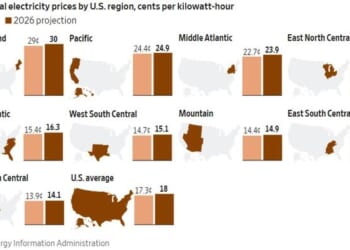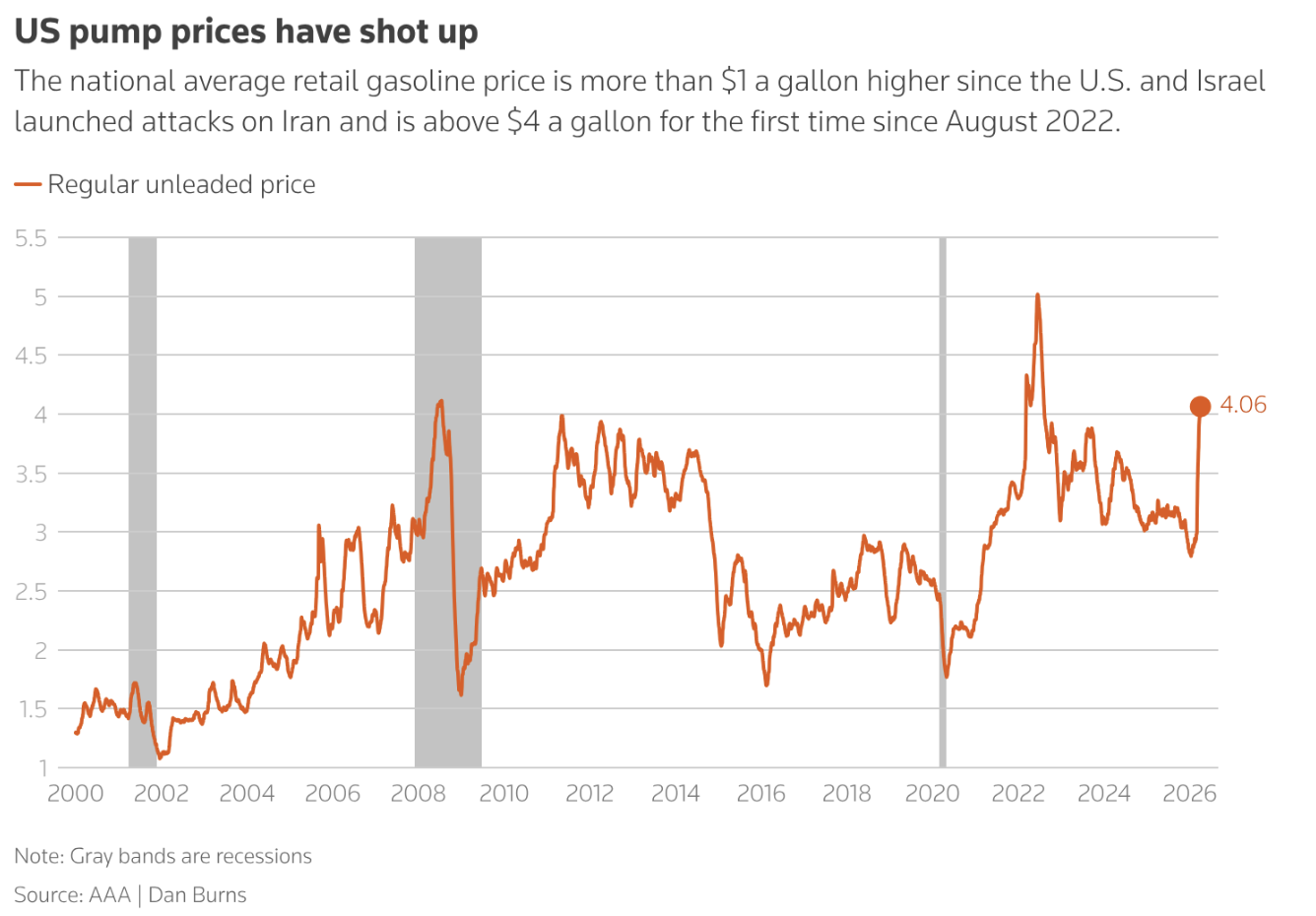
The U.S. Energy Information Administration (EIA) raised its outlook for oil and other fuel prices in the wake of the conflict in Iran. It now projects Brent crude oil will average about $79 a barrel in 2026, up 36% from a prior forecast of $58, and that U.S. retail gasoline will average $3.34 a gallon, up almost 15% from the previous estimate. Oil prices have risen as petroleum shipments through the Strait of Hormuz have fallen and some Middle East oil production has been shut in. For 2027, global oil prices fall back down to $64 a barrel in the EIA’s forecast, and U.S. gasoline prices fall to $3.18 a gallon as the geopolitical effects of the conflict in Iran ease. Reuters reports that U.S. oil futures averaged $68.10 a barrel so far this year, but are expected to average $85.25 for the remainder of 2026 and $71.35 in 2027, compared to an average of about $64.70 a barrel in 2025.
On March 17, the national average for regular gasoline was $3.79 per gallon, up from $3.54 the previous week and $2.92 a month prior. Prices are also higher than a year ago, when they were at $3.08 a gallon. According to AAA, they inched higher on March 18 to $3.84, up $0.85 from February 28 and the start of hostilities.
Since the conflict began on February 28, President Trump has reviewed a range of options to ease price pressure on consumers, including temporarily waiving certain sanctions on Russian energy exports to bring additional oil to the market, joining allied nations in a coordinated release of 400 million barrels of strategic petroleum reserves, providing backup insurance for tankers transiting the Strait of Hormuz, and reopening an offshore oil production facility off the coast of Santa Barbara, California. The Trump administration also issued a temporary waiver allowing India to purchase certain Russian oil cargoes to help offset the loss of its Middle East supply. The U.S. will release 172 million barrels from its Strategic Petroleum Reserve over the next two months to help moderate price increases, and some allies, such as Japan, have already begun releasing their reserves.
President Trump is also considering a waiver of the Jones Act, a 100-year-old law that requires goods moved between U.S. ports to be carried by U.S. ships, manned by U.S. crews. There are only 55 oil tankers in the U.S. fleet compared to 7,500 in the global fleet. Waiving the Jones Act would have reduced average East Coast gasoline, diesel, and jet fuel prices by 63 cents, 82 cents, and 80 cents per barrel, respectively, from 2018 to 2019, according to a working paper from the National Bureau of Economic Research from December 2023.
Democrats To Announce Their Plans for Energy Affordability
In light of the crisis with Iran, Democrats in the Senate, led by Senator Chuck Schumer, believe they have the answer, which is grounded in a message of advancing renewable energy, particularly wind and solar power, through tax credits. Democrats in the House introduced the “Energy Bills Relief Act” to reinstate their preferred energy tax incentives and encourage permits for wind and solar projects on public land, resurrecting parts of Biden’s energy agenda. One need only look at California to see how well Democratic energy policies have affected consumers.
Gasoline prices there are currently more than $1.70 higher than the national average due to the state’s onerous laws and regulations on the oil and refining industries. California’s combined taxes add about $1.00 per gallon, with $0.18 from a federal gasoline tax, $0.72 from a state gasoline tax, $0.10 from a sales tax, and $0.02 from a storage tank fee. California also imposes several “hidden taxes” that directly affect the price of gas. These hidden taxes take the form of environmental compliance costs, which add an estimated $0.54 per gallon from California’s Low Carbon Fuel Standard and the state’s Cap-and-Invest Program, formerly called Cap-and-Trade.
California also has one of the highest electricity prices in the country. As of October 2025, it ranked second, with average residential prices of 33.6 cents per kilowatt-hour, 87% higher than the national average of 17.24 cents per kilowatt-hour. In 2024, renewable resources, including hydroelectric power and small-scale solar power, supplied 57% of California’s in-state electricity generation. California has a renewable portfolio standard that requires 60% renewable energy in the generation sector by 2030 and 100% “clean” energy by 2045.
California is not alone. Other blue states have above-average electricity prices. Through a good portion of 2025, 86% of states with above-average electricity prices were blue, while 80% of the lowest-priced states were red. This pattern holds throughout the rest of the year, with blue states consistently paying 30-40% more, on average, for electricity than red states. The higher electricity prices are due to policies promoting “clean” energy in those states.
The same is true for gasoline prices. Red states tend to have the lowest gasoline prices in the country, as many are oil producers or close to major oil production and refining centers, allowing them to keep average gasoline prices within the state below the national average. Blue states tend to have the highest average gasoline prices, in part due to state policies that add hidden fees to the price of gasoline, such as those explained above for California.
Analysis
The EIA is unfortunately expecting oil and gasoline prices to stay elevated for much of this year. Although the increases are due to the Iran war, congressional Democrats don’t want to let a crisis go to waste, using the war as an opportunity to pursue the same policy of subsidies that has failed in the past. One only has to look at gasoline and electricity prices in blue states versus red states to see that renewable energy subsidies and mandates raise energy prices. The United States has been affected less than other nations because of our strong energy production profile, which has made the country the world’s largest producer of oil and gas.
For inquiries, please contact [email protected].