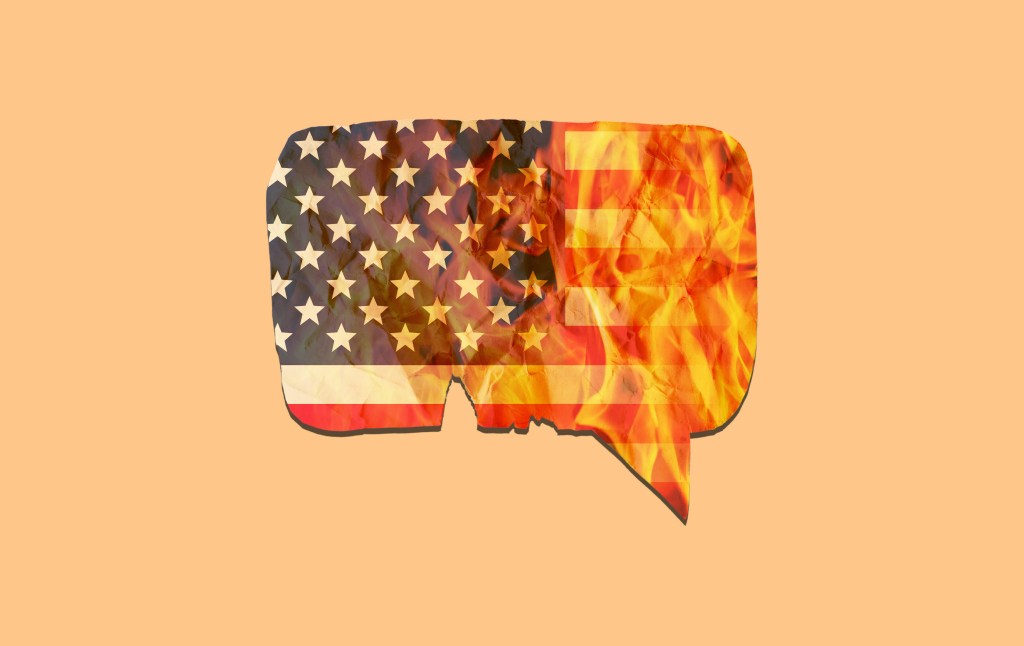
My office is full of the things that are dear to me—well, not those things themselves, but items representing them. An icon of Our Lady holding the Child Jesus, setting my Lord before me, hangs on my wall. My diplomas, holding in a few words the weight of eight years of my life, rest in sight of my webcam. Photos of my wife and me, preserving the smiles of our early love, are tacked to the bulletin board. And, draped across another wall, is an American flag, bearing the same colors and patterns of the one that sailors in dress whites folded across my grandfather’s casket.
Desecration of any of these would hurt my heart, because they represent things dear to it. Someone who spat on a crucifix or tore up a picture of my alma mater’s seal would be committing a symbolic act of rejection and defiance against things near to my soul. It would distress me to see such an act or even to learn about it. But I cannot conceive of calling the police on someone who did, because the freedom that the flag in particular represents is even more important to me than its stitches and thread. Ultimately, a prohibition on flag-burning would undermine the banner’s very meaning.
To be sure, a message sent through desecration often lands hard. Enact it upon a symbol representing what is near and dear to many people and it will stoke great rage. In many countries around the world, including several that are culturally similar to the United States, that’s all the justification the law needs to act. But America, with its robust constitutional protections for speech of all varieties, stands apart. And it should continue to do so, even when its own symbols are under attack.
“America, with its robust constitutional protections for speech of all varieties, stands apart. And it should continue to do so, even when its own symbols are under attack.”
Matthew Cavedon
“Flag burning goes beyond speech merely critical of the government, which is and ought to be protected. It is speech targeted at, and actively hostile to, the system of liberties that makes it possible.”
Charles Fain Lehman
A decade ago, after the terrorist massacre of French satirists for depicting Muhammad unleashed a counterwave of support for free speech, commentator Pascal-Emmanuel Gobry mused about how much had changed in just a short span of history:
Right after the attack, André Cardinal Vingt-Trois, archbishop of Paris, sent a message of dismay and support for Charlie Hebdo’s right to mock his faith. A century ago, the cardinal’s predecessor would undoubtedly have thought that Charlie Hebdo should be shut down as a measure of public safety. And a few centuries before that, his predecessor might have put [its cartoonists] on the rack.
These centuries of war and civil strife—and sometimes, accompanying reminders of the good that can come from rethinking the previously unquestionable—have taught many of us the value of talking and letting talk. But in too many parts of the West, these lessons of history have gone unlearned. When Iraqi refugee Salwan Momika burned a Quran in 2023, Swedish authorities indicted him for incitement. Momika’s case was dismissed only after others reacted still more heatedly—by shooting him dead in a Stockholm suburb.
Religion is not the only matter of the soul that some countries protect from hostile expressions. Sensitive cultural issues have also brought about government interventions. This autumn, five British police officers arrested comedian Graham Linehan at Heathrow Airport for incitement based on a social media post about gender identity: “If a trans-identified male is in a female-only space, he is committing a violent, abusive act. Make a scene, call the cops and if all else fails, punch him in the balls.”
Matters of the heart have a way of becoming matters for criminal codes. At least, private matters such as religion, gender, and race do. As for political issues, though, Western countries have shown more reluctance to limit speech out of respect for robust debate. Those protections apply even when that debate is conducted tastelessly, with dubious logical value, and in a way that deeply offends much of the citizenry.
This is not the case everywhere. Thai law provides: “The King shall be enthroned in a position of revered worship and shall not be violated. No person shall expose the King to any sort of accusation or action.” Hence, one royal subject faced up to 15 years in prison for sharing Facebook images of the king’s dog.
That’s not the way things work in democracies. We have hopefully learned some humility from seeing the good that can come from even shocking provocations about religion, race, national identity, history, sex, and so on. The Sex Pistols released “God Save the Queen” in 1977, and infuriated much of the English public without fearing the bobby’s baton. James Baldwin accused white America of “castration” and “infanticide” decades ago, and in doing so contributed to a racial reckoning that continues to this day.
If anything, Americans are more willing to (begrudgingly) tolerate insults than are Europeans. Consider the reactions to the September assassination of conservative activist Charlie Kirk. Abhorrent celebrations of this murder proliferated on social media, to the disgust of many. And at first, Attorney General Pam Bondi vowed to root out “hate speech” using the full power of her Department of Justice.
Then, though, many of the very same hearts that were most wounded stirred in defense of American freedom. “Our Attorney General is apparently a moron,” wrote conservative commentator Erick Erickson. “There is no law against saying hateful things, and there shouldn’t be,” pundit Matt Walsh said of Bondi’s threats, before urging the president to fire her for suggesting otherwise. A year before his death, Kirk himself declared: “Hate speech does not exist legally in America. There’s ugly speech. There’s gross speech. There’s evil speech. And ALL of it is protected by the First Amendment. Keep America free.”
Americans are not pure moral relativists. It is not as though Erickson, Walsh, and Kirk felt nothing from the words and gestures impugning things they hold dear, or that they believed good citizenship is compatible with rejoicing over a politically motivated shooting.
Rather, they understood the truth the Founders recognized: Once the government gets into the business of deciding what speech is sufficiently patriotic to be allowed and what is not, the law is no longer the roof under which all of us can safely take shelter from each other’s sense of outrage, nor the highway along which hard ideas can speed as they try to change minds. It is corrupted into a weapon that those with the power can wield to silence those without it.
After all, Americans are far from agreement on our own country’s values. Some of us find it hard to imagine a greater national blasphemy than slandering immigrants as “killers, leeches, and entitlement junkies” who “slaughter our heroes, suck dry our hard-earned tax dollars, or snatch the benefits owed to AMERICANS.” Others, apparently, get to serve as the secretary of Homeland Security. Some of us see it as the moral equivalent of burning an American flag to tell a Vietnam War POW, “I like people who weren’t captured”—while others of us are evidently unashamed to ride that line into the White House.
We are a people of conflicting convictions. For the sake of civil peace and the political liberty of the country, and even the possibility that today’s unbearable insult might point the way to tomorrow’s new wisdom, we debate them in conversations and on Election Day, not by asking judges which ones pass far enough beyond tolerability to justify issuing arrest warrants.
This is why I can’t abide calls to ban the burning of the American flag—not because the flag doesn’t matter, but because we are a people who must live with harsh and even brutal differences. In America, you can raise a middle finger to a cross or rip up a Quran. You can say white men are racists and rapists, and you can use the wrong pronouns. You can slander veterans or adorn your truck cabin window with a “Let’s Go Brandon” sticker.
I hate much of that speech. But some of it may someday prove to have been a useful thumb in our collective eye. And I certainly cannot fathom the ridiculousness of banning flag-burning alone while continuing to allow all the rest of it. I am still more loath to imagine us surrendering our reckless and not-infrequently-ugly freedom to suffocate under the Swedish or British or Thai alternative.
The flag deserves our reverence. So does the freedom to disrespect it.