Editor’s Note: This is the first entry in a new Dispatch series entitled “Where I’m From.” Every Saturday, a writer will share a meditation on his or her hometown—a bustling metropolis, distant desert outpost, quiet suburb, or somewhere in between—and what makes it unique. The goal? Highlight voices—and good writing—from every corner of these United States.
Arizona is Mars. Specifically, it’s the Mars from Ray Bradbury’s short stories. It’s got canals, weird plant life, ancient and mysterious abandoned cities, and at times the same bittersweet, nostalgic optimism that any reader of The Martian Chronicles would immediately recognize. In real life, Bradbury was inspired by Venice, California. But anyone who grew up in Los Angeles County and moved to Phoenix, as I did, can testify that the Valley of the Sun has Venice beat when it comes to otherworldly magic.
Maybe it’s the feeling of the frontier. Arizona is self-conscious about its westernness. Pretty much any cowboy film will turn out to have been made here, perhaps at Old Tucson Studios, Monument Valley, or Sedona. We’re the site of the world’s oldest rodeo and the O.K. Corral. And whereas California long ago outgrew whatever Western origins it might have boasted, the Grand Canyon State still feels like a new land. Indeed, it’s the mental image of the exotic West that most people around the world carry in their heads. That includes Korea in the 1950s (where Myeong Guk-hwan had a hit with the song “Arizona Cowboy”), the former Soviet Union in the 1970s (where Jarmila Vesela’s “Arizona” expressed the Czechs’ vision of the West), or today’s France (as in Benjamin Biolay’s “L’Arizona”). When people think of the American Southwest, they’re thinking of this place.
Obviously today’s Phoenix—the fifth-largest city in the United States—is no frontier outpost. But in some ways, it retains the qualities of a new community. In just the past 20 years, its population has increased by some 40 percent. And immigrants from other states—be they Midwesterners fleeing the snow or Californians fleeing the politics—have brought with them new cultural experiences and economic opportunities. For example, we’re the only city outside the Great Lakes states where you can find Lou Malnati’s pizza.
Actually, our economy has been growing for years, attracting businesses and employment in impressive numbers. One major reason is our low tax rates. In 2021, my Goldwater Institute colleagues helped pass a statewide flat tax, and a year later, defeated efforts to impose a massive (and unconstitutional) tax increase on the state. By letting people keep more of the money they earn, Arizona has chosen to encourage the entrepreneurship and hard work that certain neighboring states prefer to punish.
Arizona has also led the way in legal reforms that make it easier for people to move here for work and to start new businesses. These include the Right to Earn a Living Act, the Universal Licensing Law, and the Permit Freedom Act. The state also passed pioneering legislation to protect people’s right to rent out their homes on Airbnb or VRBO, the Property Ownership Fairness Act—the nation’s most powerful protection against eminent domain—and we’re the nation’s leader in school choice, with our Empowerment Scholarship Account program giving hundreds of thousands of families the tools they need to escape the one-size-fits-all government system.
But while all these things make for strong economic growth, the state also has a youthful spirit that goes beyond these basics. We were the last of the continental United States—admitted to the union in 1912—and our young age is reflected in our legal and cultural institutions. We’ve always been overwhelmingly an immigrant state—only two of the authors of our state constitution were born here, for example (five were from other countries), and still today, more than 60 percent of Arizonans were born elsewhere.
Arizonans also tend to be unusually independent. More than a third refuse to join a political party, for example—a number that rivals or exceeds the number registering as either Republican or Democrat. Our foremost political figure, Barry Goldwater, was notoriously individualistic, willing to break with his party when he thought it was failing to defend freedom. But individualism also powers our culture; consider the work of our greatest artists, Maynard Dixon, Ed Mell, Waylon Jennings, Alice Cooper, and that individualist par excellence, Frank Lloyd Wright.
These factors combine to make a place whose people are more excited by opportunity than fearful of change. To me, that’s best symbolized by one especially Bradburian aspect of life here: self-driving vehicles. Phoenix is now America’s largest market for autonomous cars, with Waymos now offering about 10,000 robo-rides per week—not to mention robots that will deliver your DoorDash order. Nothing says The Future like self-driving cars—yet they’ve become such a common feature of life here that one hardly notices them anymore. Self-driving cars hold the potential to make driving—which every year kills about 300 Phoenicians—as safe as flying.
Out there, one gets a real sense of the vastness and virginity of our landscape.
Admittedly, Bradbury himself would probably have had mixed emotions about these things. He was a bit of a Luddite, fearful that machines tend to alienate us from each other and from nature. Of course it’s true that technology brings both blessings and curses; or as Bradbury put it, “each time we … extrude into three-dimensional form some new electronic or mechanical technology, we birth at the same time the Beast of Iniquity and the Angel of Mercy.” As Phoenix grows, it too must strike a balance between change and stability.
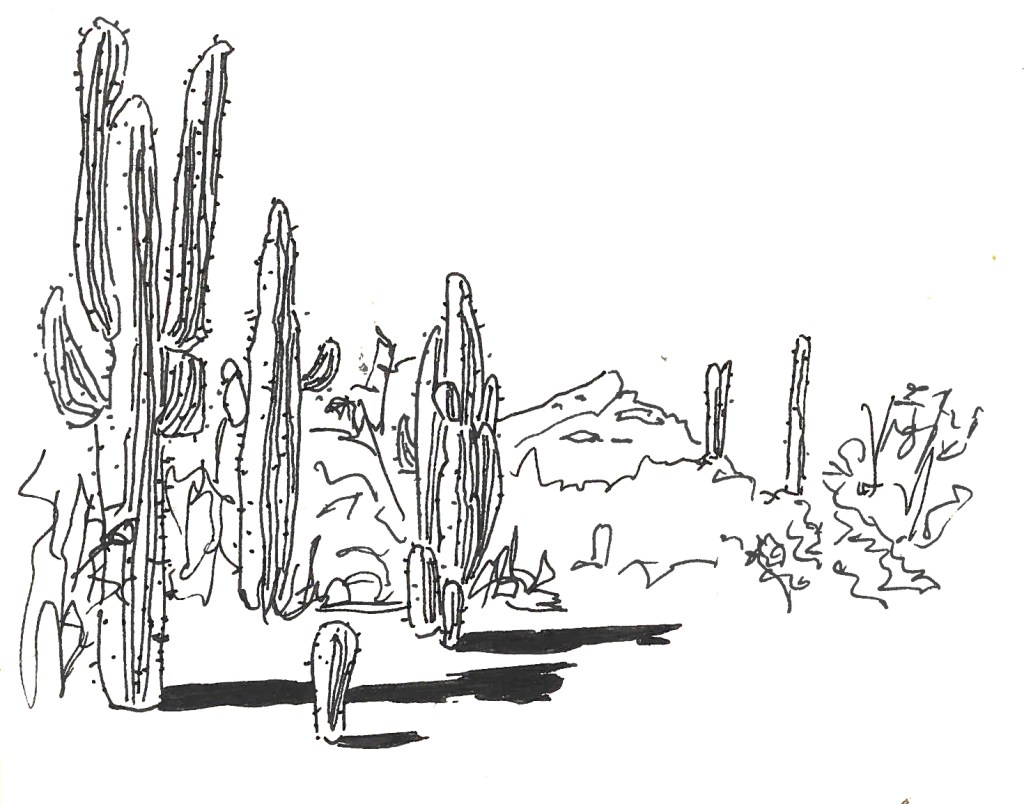
But that’s something we seem unusually well-suited to do. Our desert setting is a constant and inescapable reminder of changeless things, and its effect on the residents’ psyche is quite genuine. Southern Californians strive to conceal the fact that they live in a desert, but we embrace it; our yards, for example, typically feature saguaro, ocotillo, and palo verde (which every April blankets the streets in thick banks of golden flowers) rather than imported plants and unrealistic grass lawns.
And then there’s our “outback.” Southern Arizona encompasses some 30,000 square miles of desert—three times the size of Massachusetts—and on this land between 3 and 15 inches of rain falls each year. Beyond the stark boundaries of the Valley of the Sun lies a realm of rattlesnakes and boulders, interrupted now and then by haunting relics of human habitation like Tuzigoot—whose residents abandoned their village six or seven centuries ago for reasons nobody knows—or the well-named “town” of Nothing, which consists of the ruins of a gas station and a road sign bearing that word. Out there, one gets a real sense of the vastness and virginity of our landscape.
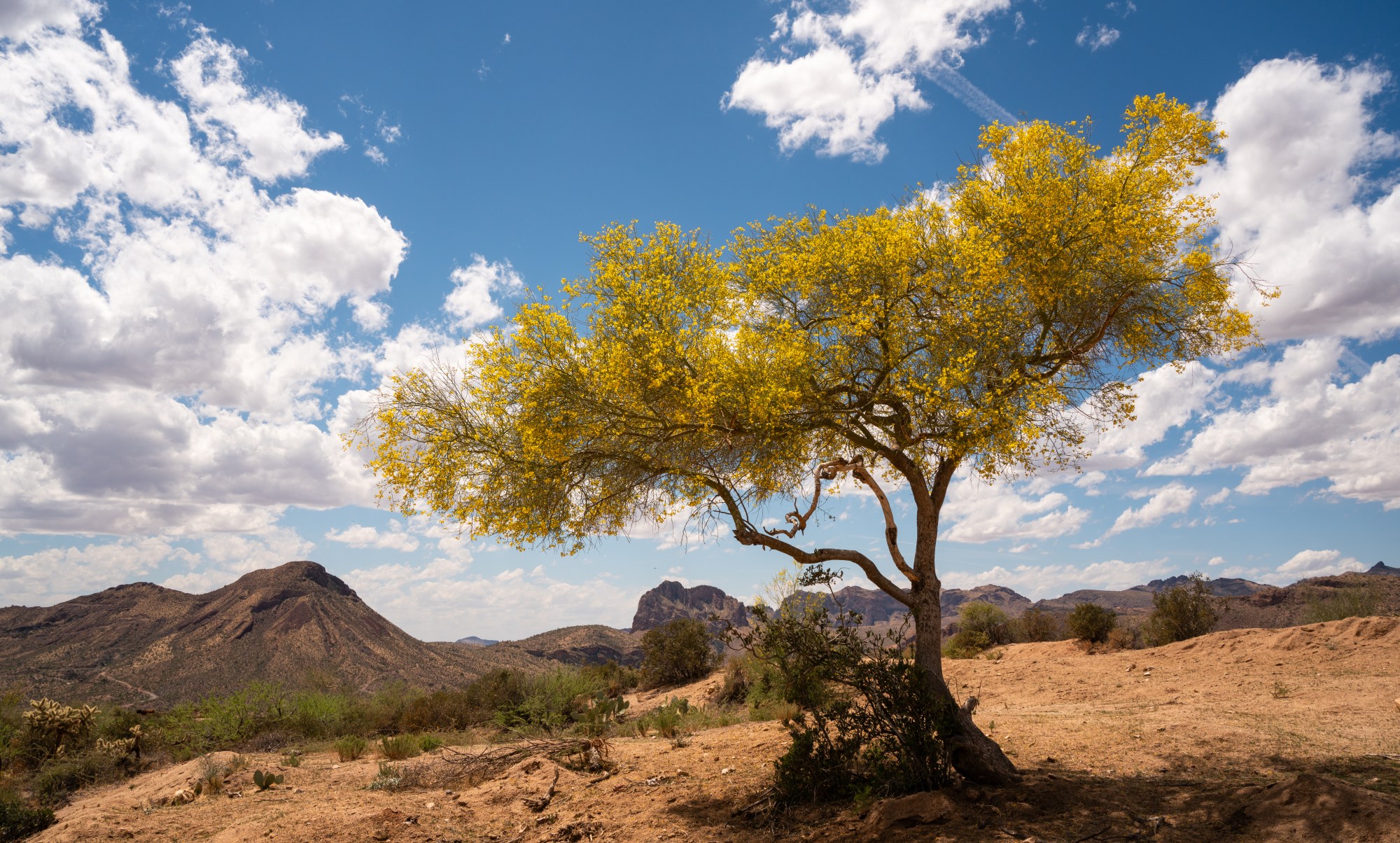
That desert isn’t barren, but it certainly is austere, and the breathtaking heat of Phoenix’s summers, its incredible dryness—which makes for crystalline nighttime skies—and its proximity to lands that to this day may have never been trod upon by a human foot, all keep the place refreshingly unfamiliar. I think it keeps Phoenicians conscious, too, of both the shortness of human life and its immense possibilities. We don’t have four centuries of pilgrim ancestors to make the place feel “lived in.” But we also don’t have the amnesia that causes Californians to forget that there was a time before TV.
One thing Bradbury understood, and captured well in his Mars stories, is how settling a frontier transforms both the land and the people. They eventually blend together, making both new. It’s a feeling one can still experience in Phoenix.
Aptly enough, the final chapter of The Martian Chronicles is set in 2026. It features an Earth family—Dad, Mom, and sons Robert, Mike, and Timothy—who visit Mars on a fishing trip, although the boys are more interested in maybe seeing an actual Martian. Boating up a canal, the family finds an abandoned Martian city. “Here we are,” says Dad, jumping out of the boat. “This is where we live from now on!” That’s when he reveals his true plans: He pulls out a remote detonator and blows up the family’s rocket. Stunned, the boys try to comprehend what that means while their father starts burning all his useless Earth paperwork:
Timothy looked at the last thing that Dad tossed in the fire. It was a map of the World, and it wrinkled and distorted itself hotly and went—flimpf—and was gone like a warm, black butterfly. Timothy turned away. “Now I’m going to show you the Martians,” said Dad.
He walks them over to the canal and points out their reflections in the water. “The Martians were there,” writes Bradbury. “Timothy began to shiver.”