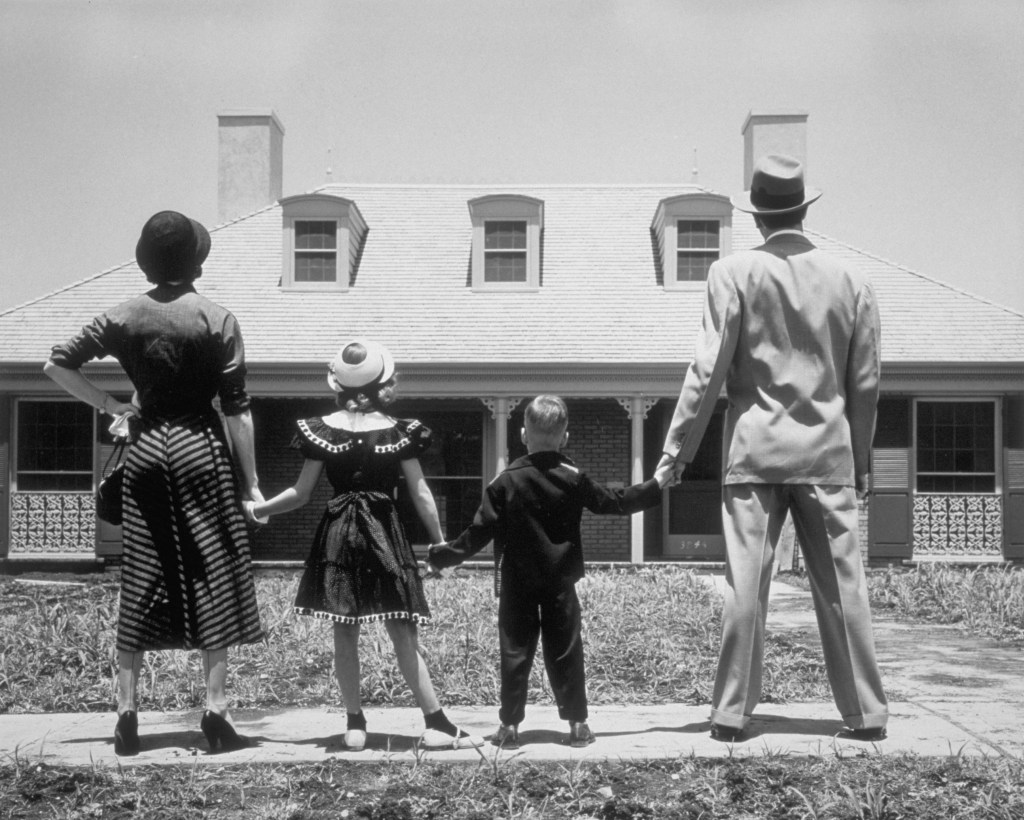
The 20th century changed much of the American way of life, but the largest change came in Americans’ personal security, their and their families’ safety from life’s hazards. At the start of the century, debilitating illness, disabling accidents, economic failures, and interpersonal violence frequently derailed Americans’ life trajectories; a century later typical Americans could reasonably expect long lives with few shocks.
While insecurity leads to hedging, caution, and fatalism, security brings greater predictability and confidence in the future. Steps in the life course—graduation, then job, then marriage, then two or three children, etc.—became more regular and more common. Deviations became choices rather than twists of fate, for example moving for new opportunities rather than being forced to move by bad fortune. Security makes planning for the future sensible because we expect ourselves and our children to live long and well enough to fulfill those plans. Greater security is one reason the American birth rate dropped so rapidly in the last century and a half (the Baby Boom notwithstanding). When people can expect their children to survive, they have fewer of them and instead invest more in each of them. With a secure future, people take more risks—and investments bear fruit.
But now, in the 21st century, that achieved security has been increasingly threatened.
The Great Mississippi Flood of 1927 took about 500 lives and cost at least $4 billion in today’s dollars. While the federal government helped save lives and provided tents, it covered only 3 percent of financial losses; recovery was largely left to charity and the victims. In 1993, similar floods took only about 40 lives thanks to water management and the feds covered about half of $14 billion in losses. In 2004, Harvard Business School professor David Moss used this contrast as a telling example of how government in the 20th century had made Americans more secure. But there was yet another turn. In 2017, Hurricane Harvey took 107 American lives and cost about $160 billion—and the federal government covered less than 10 percent of the losses. These cases suggest that progress toward safeguarding Americans may be unraveling.
Changes in life expectancy tell the story most starkly: A person born in 1900 would have been expected to live to age 47; a person born in 2000 to age 77. Most families circa 1900 had grieved the death of at least one child, but by 1970 fewer than 5 percent of families had. Survival odds improved for older Americans, too.
Average lifetimes tell only part of the security story. Critically, variation in life expectancy—and thus the risks of an unusually early death—narrowed. Death rates used to fluctuate significantly from year to year but then leveled out (until COVID); Americans gained more certainty about when to expect death. By the end of the century most Americans could foresee and experienced lifespans of 75 to 95 years. Less variability meant that modern Americans shared a more predictable life course.
Twentieth-century Americans became more secure in other ways, too—for example, look to serious illness. Smallpox essentially disappeared by 1950. Epidemics like cholera and typhoid periodically ravaged 19th-century American towns and cities; by the early 20th century they were becoming rare. Americans became more secure from physical violence, too: 19th-century levels of everyday violence—frequent, usually drunken brawling; gang wars (often between volunteer fire crews); wife-beating—were already abating around 1900, and these dangers further dissipated over the next century. Historians can track violence most reliably in homicide rates, and the best estimate is that they dropped substantially from the 1800s, hitting a low in the 1950s. (Homicides then rose in the 1960s to the 1990s, dropped back down, spiked around COVID, and have now again descended to 1950s-like levels—historically low.)
Economic security greatly increased as sharp and painful business cycles subsided. The Panic of 1893, for example, sent millions of “floaters” tramping the country hunting jobs. Even in normal years, factories in some industries shut for months at a time, leaving workers seasonally with no income. Economic historian Alexander Keyssar has pointed out that it “was not merely poverty but insecurity … that led workers to send their children into the labor force, to take in boarders, to move from one place to another. …The structures of life in the working class were molded by the recurrent task of adjusting to unemployment.” Farm life was no less precarious. For generations, Americans had fled farms to escape devastating weather, exhausted soil, and roller-coaster markets, among other things. For example, two-thirds of western homesteaders failed, leaving them to become farm hands, move further west, or seek jobs in cities.
How did Americans gain this security? The answer might be best typified by the federal government’s reaction to the 20th century’s greatest loss of security, the Great Depression. The New Deal’s response, David Kennedy emphasized in his Pulitzer Prize-winning history Freedom from Fear, was to strengthen governmental institutions like the Federal Reserve (a product of the 1907 Panic) and to build new ones like job corps and programs to insure farmers against crop losses —which helped give Americans a sense of economic security.
The successes of these moves (and despite the less-than-rosy view of the New Deal by many conservatives, they were successes) can be seen in the sharp decline in Americans hedging their bets. For example, boarding virtually disappeared, and multigenerational households became less common as both young adults and the elderly could afford their own homes. Fewer random shocks, like the early death of a parent or the failure of a farm, allowed more Americans to make and carry out plans. Ironically, but understandably, as individuals gained greater control of their lives, they increasingly chose similar paths through life: school, job (at least for men), marriage, children, retirement, and an anticipated death.
Modern industry also brought widespread affluence. Average households roughly tripled their buying power, allowing families to buy far more than necessities—which shrank from 80 to 50 percent of spending. Bountiful food production and distribution—thanks to technologies like mechanical harvesters (mid 1800s), refrigerator train cars (circa 1880), and supermarkets (1916)—cratered the cost of food. In 1901, an hour of factory work could buy a dozen eggs or 1.5 pounds of bacon; in 1996, a factory hour could buy 10 dozen eggs or five pounds of bacon.
Industrialization moved millions from farming, a difficult, dangerous, and highly uncertain occupation, into blue- and white-collar work. Farmers were about a third of the workforce in 1900 but nearly none of it by 2000. And new industries reduced risk. Life insurance, for example, developed out of 19th-century beneficial societies into a commonplace. In 1900, commercial underwriters wrote only one modest life insurance policy for every five Americans; in 2000 they wrote one for each American and they were worth in constant dollars 25 times as much.
Alongside industry’s modernization was an American government that built up security directly and indirectly. Many programs protected average Americans against the consequences of misfortune: disability insurance, worker’s injury compensation, unemployment insurance, supplemental security income, Medicare and Medicaid, and so on. Franklin Roosevelt declared: “We can never insure one hundred percent of the population against one hundred percent of the hazards and vicissitudes of life, but we have tried to frame a law [Social Security] which will give some measure of protection.” General disaster relief programs attached to FEMA backstop all Americans, but particular groups are also protected by, for example, 20th-century innovations including Price Loss Coverage, the Federal Black Lung Program, and Fishery Resource Disaster Assistance for farmers, miners, and fishermen respectively. The government also directly supports many Americans’ living standards, not just through Social Security, but also through the homeowner mortgage tax deduction, food stamps, tax credits for children, and the Earned Income Tax Credit for low-income workers. Harvard’s David Moss said it best in his book When All Else Fails: The government, he wrote, became America’s ultimate risk manager.
But government security doesn’t end with providing a “safety net.” Indeed, everything from speed limits, police, courts, and contract laws to weather reports, food and drug monitoring, highway engineering standards, and housing codes establish security for normal life. We start the day with confidence that the drive to work will be routine, our midday lunch won’t sicken us, the kids will be at school, and we will get paid for the workday. At a broader level, modern government by the late 20th century avoided or mitigated major shocks, notably of war at home and of major economic downturns. The 9/11 attack was a colossal security collapse, but the relative homeland peace of today sharply contrasts with the 19th-century experience—the War of 1812, the Civil War, postwar racial violence, anti-immigrant riots, chronic “Indian wars.” If you can come home safely from work, enjoy dinner, and settle in for some TV, you’re likely a beneficiary of the modern American security apparatus.
But that apparatus seems to be crumbling.
Start again with life expectancy. Death rates have recently surged for middle-aged whites, mainly because of opioid addiction and obesity. A 2007 study reported that the “probability of a 15-year-old U.S. female dying within 35 years was double the average for 16 peer high-income countries.” Americans suffered unusually high death rates from COVID. Twentieth-century Americans converged toward a common expected lifespan, but 21st-century Americans’ lifespans are diverging.
Similarly, Americans’ health keeps falling behind that of comparable foreigners. For example, diabetes has increased in the U.S. while leveling off in other well-off nations. After World War II, Americans were the tallest westerners; no more. We have experienced, one review finds, “a significant and unique decline in physical stature among individuals [even the native-born] … who grew up between circa 1980–2023.” (Height is a reliable marker of health across populations.)
What’s happening to job security and income has been much debated. Risks and fears of losing a job apparently haven’t risen, but the frequency of particularly bad outcomes, such as repeated or long-term unemployment, has risen, especially for men. This danger coincides with continuing declines in the purchasing power of the federal minimum wage (by about half since 1970), in job benefits, and in how much unemployment insurance pays. To top it all off, the specter of AI looms over future job prospects.
Economic security generally, especially for the less affluent, has eroded. The risk of falling into serious poverty—by not being able to recover financially from disability, divorce, or natural disaster—grew in the last three decades of the 20th century. In the current century, children with low-income parents have become more likely to fall down the income ladder as grown-ups than to move up significantly. Americans at all levels have taken on greater debt, especially those near the bottom. All this means that, even if the risk of running into bad luck has not risen, the toll bad luck takes has.
Evidence of this new insecurity can be seen in who lives with whom. For much of the 20th century, improving fortunes allowed many more young adults to move out of their parents’ homes. Since about 1970, that trend has largely reversed, probably because of a sharp slow-down in earnings. Now young adults are about as likely to live with their parents as they did in 1940, financial need being the major reason. And house-sharing among non-relatives—boarding in a sense—is re-emerging.
Polls showed that toward the end of the last century Americans increasingly expressed confidence that children would do better than their parents, but that faith has gradually eroded. (Similarly, the proportion of Americans who claim to have done better than their own parents rose until about 2000 and has declined since.)
This greater insecurity coincides with growing irregularity and variability—what one researcher called rising “turbulence”—in Americans’ life course. Since the 1970s, fewer Americans have married and those who have done so have married at more disparate ages. Similarly, while Americans had increasingly concentrated their retirements around age 65, in the last generation, they, especially men, have retired at more varied ages. Such increased variability suggests that we are seeing a higher proportion of Americans stepping off or falling off the typical life track—for example, delaying marriage to the point that it never happens. Increased variability also makes it harder to use the experience of others to look and plan ahead for oneself with confidence.
And now, Trump 2.0. With the possible exception of the administration’s crime-fighting (although its moves on crime are more performative than real), the administration’s actions have increased insecurity for most Americans. Obviously, holes are being torn in safety net programs such as SNAP, Medicaid, and Obamacare. Beyond that, attacks on government and regulation are increasing risks regarding, for example, weather damage, traffic fatalities, food poisoning, workplace injuries, and environmental toxins. We all know about the anti-vaxx campaign by Robert F. Kennedy Jr., the Hepatitis B arm of which doctor and Republican Sen. Bill Cassidy said “makes Americans sicker.” Risks to the economy posed by more lax regulation, like that which precipitated the Great Recession, are increasing with the disabling of oversight agencies and the indulgence of high flyers. And as a fitting capstone, there is the gutting of FEMA.
Some believe that individuals should absorb life’s uncertainties, that we should not “socialize” risks and certainly should not rely on a “nanny state.” Keeping people insecure, some argue, spurs hard work and innovation. But research across the social sciences tends to show that insecurity—particularly, but not only, economic uncertainty—promotes short-term thinking rather than long-term planning. Insecure people are likelier to play it safe than to gamble; secure people can more confidently strike out in new directions. (Although successful entrepreneurs, like the Silicon Valley “tech bros,” are often celebrated as embracers of risk, many had, unlike average Americans, the Bank of Mom and Dad to provide a safety net for their leaps into the unknown.) The price of a high-risk society would also include simply more misfortune—impoverishment, illness, idleness—for fate’s victims.
Or, some might argue that the private sector could protect Americans against risk as well or better than government—with, say, company pensions instead of Social Security, health savings accounts instead of Medicare, market discipline instead of government regulation. But history casts doubt on that claim. The U.S., for all its 20th-century innovations, still relies more on market solutions than other Western nations do and our inferior outcomes suggest that our approach is wanting. Further, the incentives are off. Companies need to make profits and U.S. companies have been particularly good at resisting efforts to internalize their negative externalities, such as pollution and worker illness.
Most Americans, surveys show, support maintaining and even expanding the government’s role as the ultimate risk manager. For example, two-thirds say “that the federal government has a responsibility to make sure all Americans have health care coverage”; 80 percent say that “Social Security benefits shouldn’t be reduced in any way”; and majorities say they want more government regulation of many industries. Government taking on more risk management combined with the prosperity engine of the American economy brought greater calm, confidence, and success to Americans in the last century. Are we capable of holding on to that achievement?