For years, Washington pundits bemoaned Western diplomats’ shortcomings with their counterparts from the Islamic Republic. Iranian negotiators would routinely blindside them, buying time for their nuclear program. They sowed discord among adversaries. They deployed plausible deniability. They played arsonists while winning praises as firefighters. They were masters of tridimensional chess, bamboozling their interlocutors with drawn-out games they routinely won hands down.
Yet, since October 7, 2023, when Hamas launched Operation Al-Aqsa Flood, massacring more than 1,200 Israelis and taking 250 hostages back to Gaza, the ayatollahs and their proxies keep losing their kings and queens in a series of unforced errors that reveal monumental misjudgment. Worse, as President Donald J. Trump and Israeli Prime Minister Benjamin Netanyahu make their queen’s gambit, Iran has already foolishly squandered many of its pawns—its fearsome regional proxies—that it patiently built up for decades to serve as its nuclear program’s and the regime’s very first line of defense in case of direct conflict with Israel and the United States.
Tehran lavishly invested in a robust buildup of terrorist organizations that shared common enemies, embraced its ideological worldview, and advanced its imperial ambitions. For a time, it seemed as if its proxies and their successes would make Iran’s regional power grab unstoppable. By the eve of October 7, Israel was encircled. Hezbollah ruled over South Lebanon, amassing an awesome missile arsenal and a fierce, battle-hardened militia, while blackmailing that country’s government into subservience. Bashar al-Assad’s truncated fiefdom, Syria, depended on Iranian military might and largesse to stay in power and in return gave Iranian forces unfettered access to its southern border, whence they could threaten Israel. In Iraq, Iran’s influence over the political system and its bankrolling and training of local Shiite militias guaranteed a land bridge to feed Iran’s allies with weapons and funding. At the far end of the Arabian Peninsula, the Houthis gave Iran the ability to permanently pester Tehran’s archrivals, the Sunni powers of the Gulf, while casting a spell over the Bab El Mandeb gate—together with the Strait of Hormuz, one of the most sensitive waterways in the world for energy supplies and global maritime commerce.
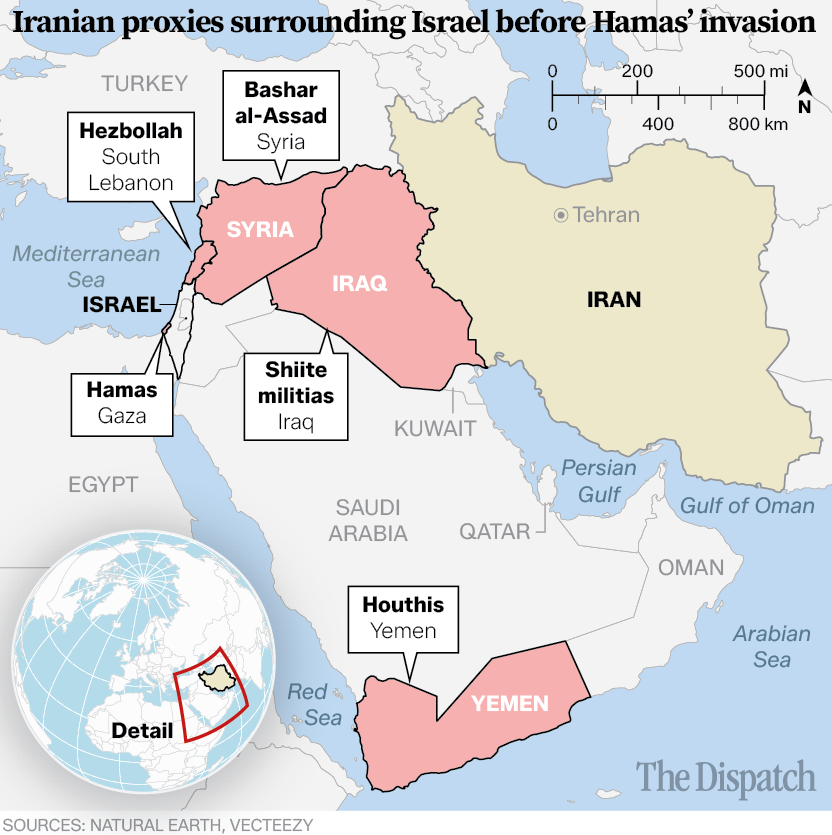
All told, this was a formidable force, a veritable deterrent that could mount fierce resistance against anyone who dared to threaten the king and queen of Iran’s chessboard. Over the years, Iran’s pawns did occasionally sustain fire, but never took a severe enough beating that they were lost. Confrontations typically ended in drawn-out contests that left them standing and, thanks to Iranian solicitude, able to resume their roles. This strategy could have paid off handsomely on October 7, 2023, had every proxy simultaneously opened fire against Israel once Hamas broke through the Israel-Gaza border. Instead, the proxies hesitated. Left in the dark about the timing of Hamas’ invasion, they belatedly started shooting at Israel—Hezbollah’s opening salvo came the next day—and even then, they never went all in. From Tehran’s standpoint, this was a fateful mistake. The proxies were a nuisance but never overwhelmed Israel when the Jewish state was vulnerable and still reeling from the horror of October 7. What it did, however, was to change Israel’s calculus. Jerusalem’s prior restraint vanished, leading to increasingly daring and brazen responses that left Iran’s proxies more bamboozled than the Western diplomats Tehran supposedly took for endless, joyless rides for years.
Israel’s relentless campaign against Hezbollah took out hundreds of mid- and high-ranking operatives between October 2023 and July 2024. Its air force also went after Syrian air defenses, senior Iranian Revolutionary Guard officials in Damascus, Hamas and Houthi leaders and military infrastructure—slowly and methodically crippling Iran’s proxy line of defense. Iran, too, was hit when it tried to retaliate twice in 2024, showing that Israel had both superior intelligence and the ability to reach escalation dominance against the Islamic Republic and its extensions.
The signs of Iran’s weakening hand were on the wall. On July 30, 2024, Israel eliminated Fuad Shukr, a top Hezbollah military official, in a Lebanon strike. The next day, it killed Ismail Haniyeh, Hamas’ political leader, in Tehran. Yet it wasn’t until September 2024 that it became obvious that Iran’s proxies had brought a spoon to a knife fight. Israel’s devastating pager attack on September 17, followed by the elimination of Hezbollah’s top leadership a few days later, was the opening salvo of a two-month campaign that left Hezbollah in tatters, with Tehran and its proxies unable to come to their rescue. Israel did not just focus on Lebanon. It systematically demolished Iran’s second defensive ring in Syria too, crippling Assad’s regime to the point where, in early December, it simply collapsed.
In one fell swoop, Iran lost Syria and its ability to prop up a battered and bruised Hezbollah in Lebanon. The regime could no longer easily replenish its proxy’s stockpile at the same time Hezbollah’s political clout in Beirut was eroding dramatically. The terms of the January 2025 ceasefire allowed Israel to continue its drip-drip campaign of targeted eliminations of Hezbollah operatives. And when, in June 2025, the IDF—and later the U.S.—launched a dramatic air campaign to strike Iran’s nuclear program and its senior leadership, Hezbollah sat out the fight it was created to spearhead.
With its proxies decimated, its air defenses crumbled, and much of its nuclear program buried under collapsed concrete, Iran’s regime could have licked its wounds and sought to patiently reenergize its web of regional assets while rebuilding its defenses at home. It might have learned a thing or two about how Israel almost immediately gained air supremacy over Iranian skies during the 12-Day War. It might have sought to patiently stake out the deep web of enemy intelligence inside Iran that successfully penetrated the regime all the way to its scientists’ bedrooms. Instead, Iranian leaders seemingly chose to simply believe their own narrative: The Israelis begged for a ceasefire at the end of the June 2025 war; the Americans have no staying power; the world is rallying behind the resistance; Trump is a bluffing buffoon whose mediators can be bamboozled like their predecessors. And when ordinary Iranians rose to challenge the regime, the regime thought it could slaughter tens of thousands with impunity, even as an armada the likes of which no one had seen since the 2003 U.S. invasion of Iraq was gathering at its doorstep.
When U.S. and Israeli air forces targeted the compound of Iran’s supreme leader on February 28, the regime and its proxies were still far from having recovered their strength. Yet the regime could still play some cards. It could seek to sow discord among U.S. regional allies that were ambivalent about war and regime change in Tehran. It could exploit the nearly universal unease America’s historic allies had with President Trump’s style of diplomacy by trying to create an obstacle course. It could play victim and ride out the storm. Instead, blinded by rage, the regime started shooting at everyone in sight. It unleashed its Iraqi Shiite militias, whose goons had just been deployed to Iran to help the regime drown protests in blood, to attack U.S. targets. By the third day of the war, it let loose Hezbollah, at its peak weakness. By the fourth day, even the usually shy European Union was openly supporting regime change in Tehran.
Days before the war began, Israel sent a message to Hezbollah’s leadership: Sit this one out. It did not. With most of their pawns down, the Iranians sent their queen charging forward, vulnerable and exposed. The king and his court, meanwhile, lay dead under the rubble of his own compound. The Israeli air force conducted a daring raid, flying thousands of miles across unfriendly terrain in broad daylight. Only arrogance and a misreading of the map could have left Khamenei so exposed.
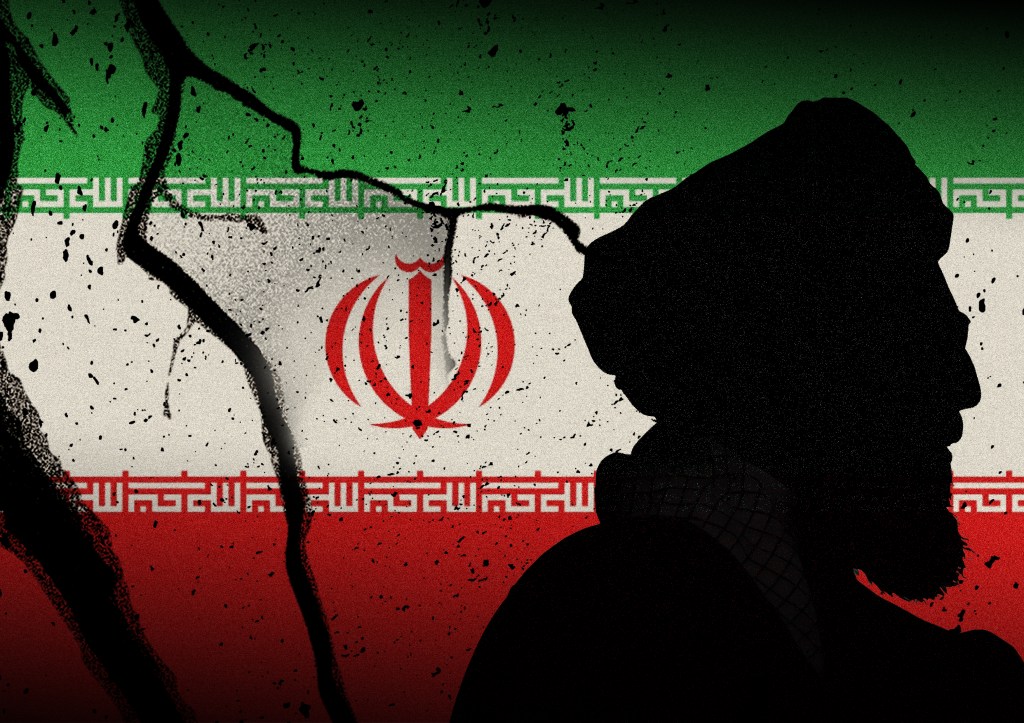
Iran and its proxies are down but not out. They can still hit and hurt. They are targeting civilians across the region, and they are temporarily disrupting maritime traffic and global energy supply chains. They can resort to terrorism. The more they do, the more bridges they burn, while the methodic destruction of their regional terror network and their domestic repressive apparatus continues. Their conduct for the past two years speaks of a monumental misjudgment. Say what you wish of the Islamic regime’s proverbial shrewdness. Tridimensional chess masters, they are not.