Most people would be astonished to learn how much of the “money in politics” that they love to hate lives, at least nominally, outside of politics. Everyone knows about Super PACs and “dark money” groups, but for years now tax-exempt 501(c)(3) charitable organizations have been one of the biggest centers of political power and money in the country. Not through public policy think tanks or civil rights litigation groups like the Heritage Foundation or the ACLU, but through a rapidly growing industry of “nonpartisan” voter registration and get-out-the-vote groups that abuse a combination of loopholes and lax enforcement to leave the policy consulting sidelines behind and get their hands dirty in the world of winning elections.
Recently released batches of tax forms show that this tax-exempt vote machine grew bigger than ever in 2024. Our research, based on a selection of more than 80 of the largest 501(c)(3) voter registration and get-out-the-vote groups, shows that these industry leaders consumed around $638 million in total expenses during 2024. Adjusted for inflation that’s a ten percent increase from 2020, meaning that nonprofit electioneering became an even larger force in American politics during the last election, even as traditional PAC spending experienced a modest decline.
The growth of this tax-exempt vote machine is bad for the charitable sector, bad for American politics, and dangerous to election integrity. It is well past time for the relevant authorities to give the get-out-the-vote industry a closer look.
The history of the vote machine
The best explanation of the tax-exempt vote machine comes from the leaked emails of John Podesta. One email, sent to Podesta in 2015 by the president of Swiss billionaire Hansjorg Wyss’s private foundation, contains an extremely detailed plan for using 501(c)(3)s to fund and execute a $100 million plot to register millions of voters.
But not all voters. In callously presented tables, the plan sums up “total non-white” votes that might be generated in eight key swing states, while still-visible edits show entire paragraphs about beating Republicans and “reshaping the electorate” being removed and nonpartisan language about “voter participation” being added only as an afterthought. In other words, the plan was to direct 501(c)(3) voter registration at only demographics whose voting tendencies just so happen to benefit the Democratic party for the specific purpose of winning elections. It was an obvious scheme, but the IRS has allowed left-leaning organizations to abuse this loophole freely because they pay lip service to nonpartisanship with fig-leaf words like “voter participation” and “civic engagement.”
This plan, as the Capital Research Center was the first to expose, later became the Everybody Votes Campaign, the largest and most partisan voter registration scheme in American history, and it played a pivotal role in helping President Biden win the 2020 election. A leaked memo from Democratic Super PAC Mind the Gap called groups such as the Everybody Votes Campaign and the Voter Participation Center “4 to 10 times more cost effective than the next best alternative” at “netting additional democratic votes” and Democratic mega donors lined up to fund them. Some donors, including the San Francisco Foundation, the Black Dog Private Foundation, and the David E. Reese Family Foundation were even foolhardy enough to write out the name of the Super PAC in the description of their charitable grantmaking, and without receiving so much as a second look from the IRS.
All by April
The tax-exempt vote machine was riding high on its 2020 successes as 2024 approached. Off-cycle budgets remained high, much higher than in the past, since donors had learned that “registering in the off year is just as — or even more — effective than registering during the on year” because it kept the vote machine running smoothly. With election season approaching, Mind the Gap once again advised its donors that 501(c)(3) voter registration would be the key to a Democratic victory in 2024, while some two dozen new organizations had been added to the industry’s ranks since 2020.
Another initiative, All by April, was launched by Pierre Omidyar’s Democracy Fund specifically to urge donors to distribute their “election-related grants” to 501(c)(3) groups early, by April of 2024, giving the vote machine plenty of time and money to get back into full gear before November. 174 donors signed the pledge, making a combined “$79 million in new 501(c)(3) grants for election-related work and moving up $61 million in scheduled grant payments so that grantees would have access to funds earlier in the year.” In total the campaign estimates it mobilized $155 million, getting generous funding to many electioneering 501(c)(3)s earlier than ever before. All by April even conducted a detailed survey to verify it.
Things were looking very good.
A fly in the “nonpartisan” ointment
Then, just as the All by April money arrived, Democratic strategists and donors foresaw a problem: “nonpartisan” voter registration might not be partisan enough. The whisperings and worries coalesced in January, when Aaron Strauss, a prominent left-leaning data expert, sent an urgent memo to numerous Democratic megadonors urging them to pull the plug on voter 501(c)(3) voter registration immediately because demographic trends had shifted and the “nonpartisan” voter registration groups might now actually be helping Republicans.
The memo caused quite a ruckus.
Writing about the memo in April the Washington Post reported that Strauss and other Democrats were concerned that nonpartisan voter registration groups wouldn’t be able to “avoid signing up likely Republicans” in 2024. The main reason for this concern was “a marked shift among the roughly 1 in 5 citizens of voting age who are unregistered toward Republicans,” and several polls “ [showing] Biden polling below 2020 levels among Black and Latino voters.” Suddenly, the façade of altruistic concern for the voices of “underrepresented communities” and “civic participation” had dropped. “Indeed, if we were to blindly register nonvoters and get them on the rolls, we would be distinctly aiding Trump’s quest for a personal dictatorship,” Strauss wrote. The memo also admits that the Democratic Party and its donors have outsourced its voter mobilization work to the nonprofit sector, saying, “For too long, many funders have relegated the work of mobilizing base constituencies, especially voters of color and young people, to nonpartisan programs.”
Leaders within the vote machine were not pleased. Maria Teresa Kumar, president CEO of Voto Latino, told the Washington Post that “Strauss was overestimating the amount that young voters and voters of color are shifting to the right,” and that she was afraid that the memo would “create a disinvestment” in her organization’s work.
As it turns out, she had no reason to be worried.
By the numbers
The 2024 batch of IRS Form 990s shows that Aaron Strauss’s memo was probably ignored, and that groups like the Mind the Gap and All by April were very successful at directing more money into the tax-exempt vote machine.
Using a service called Impala, which aggregates nonprofit financial data for research and fundraising purposes, our researchers gathered financial information for 83 of the leading voter registration and get-out-the-vote groups in 2024. Groups were selected judiciously to avoid counting large organizations for whom voter registration and mobilization was only a small part of their overall work. Only 501(c)(3) organizations were included, 501(c)(4)s were not, and for each group total revenues and expenses from both 2020 and 2024 were recorded (when applicable) in order to estimate the rough size of the nonprofit voter registration and mobilization industry. Totals were automatically rounded by Impala to the nearest 100,000 or the nearest 100 if the value was below 1 million.
A digital copy of the data can be found here.
The results showed very impressive growth:
- In 2020 the groups raised $541.7 million and spent $491.5 million.
- In 2024 the groups raised $633.3 million and spent $638.7 million.
Using expenses as the measuring stick to avoid counting organizations receiving large multi-year endowments, the sample of 501(c)(3)s saw a 30% increase in spending from one election cycle to the next. Additionally, our research found that 23 of the top voter registration groups in 2024 didn’t even exist in 2020, while no strictly voter registration and mobilization organizations could be identified that existed in 2020 but not in 2024.
Now, some concessions and explanations must be made regarding this data.
First, there is a non-negligible amount of double-counting in the totals since many of the organizations made large grants to one or more of the other organizations on the list, so the total size of the industry is at least slightly inflated by those grants. For the purposes of comparing the year over year size of the industry, though, this double counting does not create as much of a problem since relative size, not total size is important.
Second, there was a staggering amount of inflation between 2020 and 2024, 20 percent by most estimates, so the real growth in expenses from 2020 to 2024 is about 10 percent, still sizeable, but not as impressive as the 30 percent nominal growth. Ten percent growth is still a remarkable feat though, since, according to Open Secrets, inflation adjusted total spending on elections through traditional PACs in 2024 was about twenty percent less than 2020. At a time when the total money being spent on politics was decreasing dramatically (relative to the last presidential election cycle) the voter registration industry actually seems to have surged.
The Everybody Votes campaign
So, with their funding unhindered by concerns that they would not be partisan enough, what did the left’s voter registration groups do with all that money in 2024?
One of the biggest players in the industry, as mentioned earlier, is the Everybody Votes Campaign (EVC), which serves as the name for three organizations; the Voter Registration Project, the Voter Registration Project Education Fund, and Register America, which is a 501(c)(4) not included in the data above. They once again received the endorsement of Mind the Gap in 2024 and raised a combined total of just over $75 million, substantially more than the $50 million raised in 2020, sending almost all of it out to other left-leaning nonprofits and for-profit canvassing firms. These grantees and canvassing firms landed them in a world of scandal.
For example, in 2024 the Voter Registration Project’s 990 shows it paid a canvassing firm called Field+Media Corps $4.6 million for “voter registration support” in 2024. In October 2025, seven employees of Field+Media Corps were charged by Pennsylvania Attorney General Dave Sunday with numerous crimes, including forgery and tampering with public records related to their work on behalf of the EVC after thousands of fraudulent voter registration forms were submitted in bulk in multiple important swing districts just before the 2024 election. Clearly, the $9.1 million that the Voter Registration Project paid for voter registration “quality control services” to another canvassing firm called The Outreach Team was not well spent.
One of the EVC’s grantees, New Georgia Project was also fined $300,000 for illegal partisan activity by the Georgia ethics commission in January 2025 and was ultimately permanently dissolved. Another grantee, the Voter Formation Project, reported record high revenues and 50,000 voter registrations after spending million on digital ads in 2024, but the group was also suddenly closed in 2025 with no explanation given.
While the EVC is probably the biggest source of money in the vote machine, the Voter Participation Center and State Voices are responsible for a huge portion of the ground work.
Voter Participation Center
The Voter Participation Center (VPC), for its part, did not have a good year compared to 2020. VPC’s yearly expenses were just $66.5 million, far less than $100.3 million it spent in 2020 and revenues were similarly disappointing. The VPC made an ambitious use of its diminished budget, though, and found its way into the center of an impressive number of scandals and controversies
In March the VPC’s misleading mailers caused so much confusion that the Mississippi and Alabama secretaries of state each had to issue statements clarifying that they were not official government communications.
In September VPC was caught filtering its digital voter registration ads so that they wouldn’t be shown to people interested in things like NASCAR, Duck Dynasty, or Golf. This scandal resulted in a demand from Congresswoman Claudia Tenney (R-NY) that the IRS investigate the VPC’s tax status compliance.
In October the VPC’s misleading mailers again caused so much confusion in Mississippi that the Secretary of State issued a statement.
In November the VPC was sent a cease and desist by the Attorney General of Maryland over intimidating mailers that they sent threatening to tell the recipient’s neighbors if the recipient didn’t vote that year.
The VPC also continued its controversial relationship with a consulting firm called the “Pivot Group,” paying the firm nearly $15 million for mailing services despite the fact that the Pivot Group has long described itself as “committed to electing Democrats up and down the ballot.”
State Voices
State Voices, is probably the leading organizing and training hub for the left’s vast network of smaller get-out-the-vote groups. They provide technical training, data tools, and other assistance through their “state tables” which often work with and fund a dozen or more local groups.
State Voices raised nearly $20 million in 2024 and spent nearly $25 million, a significant decrease from 2020. But that shrinkage might be partially explained by “state tables” within the State Voices network spinning-off and obtaining independent tax status, meaning their revenues and expenses would no longer appear on the State Voices books. Despite diminished revenues and expenses, State Voices still reported that its network made more than 179 million voter contacts and registered 840,000 voters during 2024. In 2020 the group reported only 124 million voter contacts but 2.1 million voter registrations, so voter registration numbers were cut dramatically while voter contact numbers improved. Perhaps Aaron Strauss’s memo did make an impact?
State Voices is an extremely useful organization for understanding the scale and activity of the tax-exempt vote machine because they train and fund so many organizations across so many states that are below them in the food chain. In their 2024 annual report State Voices provided a map of their voter contact numbers broken down state-by-state. Looking at the states highlighted with red stars, indicating where the most voter contacts were performed, a clear pattern emerges:
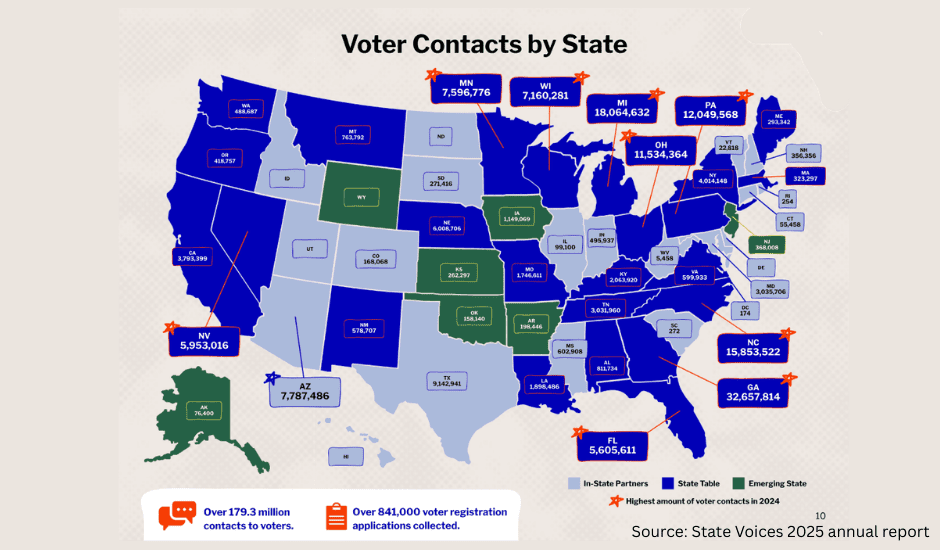
Wisconsin, Michigan, Pennsylvania, Ohio, Georgia, North Carolina, Arizona and Nevada is a near perfect list of the most important swing states in 2024. Additionally, in Nebraska, where both a paid family leave ballot measure and at least one electoral college swing vote hung in the balance, State Voices reported a staggering 6 million voter contacts, which is more than three contacts per resident and six contacts for every person that voted in the 2024. In Georgia, perhaps the most hotly contested swing state, the network’s 32.6 million contacts were likewise equivalent to roughly three per resident and six per voter.
Enough is enough
These numbers are staggering and show that the tax exempt voter registration and get-out-the-vote industry grew even larger in 2024 while most political spending shrank. Clearly, large left-leaning donors are growing more fond of, and comfortable with using the tax-exempt sector to do the dirty work of their partisan political allies. This is bad for several reasons.
First, it means that the charitable sector is becoming increasingly politicized and straying away from its purpose. Second, it gives foreign bad actors an easy method to manipulate our elections because, unlike PACs, 501(c)(3) organizations are allowed to accept unlimited funding from foreign sources. And third, it encourages tribal identity politics and encourages politicians to create division between demographics by specifically pandering to one or the other in order to keep abusing the register-by-demographic loophole that the IRS has benevolently neglected to close with even the slightest enforcement action.
There are several possible solutions. Any amount of IRS enforcement, a congressional hearing or investigation, or even a simple piece of legislation that amends the tax code so that voter registration and get-out-the-vote work are no longer tax deductible would all be huge steps in the right direction. It’s time to stop this partisan vote machine pretending to be a charity.