On the morning of November 14, 1960, 6-year-old Ruby Bridges walked toward the doors of her new school in New Orleans wearing a neatly pressed dress and carrying her school supplies, surrounded by four federal marshals as she climbed the steps. Ruby was the first black student to attend the formerly all-white William Frantz Elementary School after the Supreme Court’s historic decision in Brown v. Board of Education.
Brown famously ruled that separate schools for students based on race violated the 14th Amendment’s Equal Protection Clause. But it had not been an immediate panacea to racial segregation. The decision had been issued six years earlier, a few months before Ruby was born. Only now, under significant federal pressure, were many Southern schools finally allowing black students in. And they were still coming up with new ways to resist. Louisiana, for instance, instituted an entrance exam designed to keep its schools all-white. Of the 137 black first graders who applied for transfers to white schools in New Orleans, only six were accepted—and only four ultimately agreed to attend. Ruby alone was sent to William Frantz.
Behind her and the marshals, a crowd had gathered. Some shouted slurs. Others held signs. One woman held up a black doll in a wooden coffin.
Brown v. Board of Education is often portrayed as the triumphant moment when America finally fulfilled the Declaration of Independence’s promise that all men are created equal. And it was a landmark moment in constitutional law. But Ruby’s walk up those steps reveals that announcing a constitutional principle is sometimes easier than living up to it.
A promise deferred.
The Declaration’s statement that “all men are created equal” is at once one of the most important pieces of American political thought and one of the most uncomfortable, because it was accompanied, for decades, by slavery and the legal subjugation of black Americans. Historian Joseph Ellis has called this aspect of the Founding “The Great Contradiction.”
But from the start, there were passionate defenders of the idea that equality belonged to all people. And though they did not succeed in banning slavery through the Constitution, the Framers were successful in at least excluding any validation of slavery as a property right. That deliberate move opened the door to antislavery politics and emboldened politicians, lawyers, and agitators to argue that at the very least, the federal government had no power to support slavery. At best, the Constitution, seen through the Declaration’s lens, was an affirmatively anti-slavery document.
Eventually the country would go to war over this contradiction, and the 13th, 14th, and 15th Amendments—the Reconstruction Amendments—translated the Union’s victory into constitutional law. But once again, that guarantee was short-lived. In 1873, the Supreme Court gutted the 14th Amendment’s Privileges or Immunities Clause in its very first major interpretation of that provision. In The Slaughter-House Cases, a narrow majority held that the clause protected only a thin set of rights deriving from national citizenship, leaving the vast landscape of civil rights to the mercy of the states. The decision drew a contemptuous dissent from Justice Stephen Field, who called the majority’s reading an effective nullity that rendered the 14th Amendment “a vain and idle enactment” that “accomplished nothing.”
Then, in 1896, came Plessy v. Ferguson. The court similarly weakened the Equal Protection Clause, upholding racial segregation in an 8-to-1 vote. It declared that “separate but equal” facilities were constitutional, allowing states across the South to construct a rigid system of racial separation—one that extended to schools, transportation, housing, and nearly every aspect of public life. The lone dissenter, Justice John Marshall Harlan, predicted that the decision would “prove to be quite as pernicious” as Dred Scott, the most infamous ruling in the court’s history.
The theory of Plessy was that segregation was permissible so long as facilities were formally equal. The reality, of course, was that black facilities were systematically underfunded, overcrowded, and stripped of resources. Even “separate but equal” turned out to be a legal fiction that southern states never intended to honor.
The march to Brown.
It fell to civil rights attorneys to expose that fiction—and then to destroy it.
The campaign was conceived in the 1930s by Charles Hamilton Houston, then dean of Howard University Law School. Houston traveled through the South with his student, future Supreme Court Justice Thurgood Marshall, documenting in stark detail the inequalities of black educational facilities. From that investigation, Houston and Marshall developed a two-pronged legal strategy. First, they would demonstrate that black schools were not, in fact, equal to white ones, and second, they’d insist on equality, knowing that states could never afford or muster the political willpower to actually duplicate the quality of their facilities.
The strategy bore early fruit in graduate and professional schools, where the inequalities were hardest to deny. In Missouri ex rel. Gaines v. Canada, the court held that Missouri had to either open its only law school to black students or build a genuinely equal one. And in Sweatt v. Painter, the University of Texas Law School was required to admit a black applicant because the hastily erected black law school, which was housed in a downtown basement, was not remotely equal. A few years later, five consolidated lawsuits involving segregated elementary schools across the country would make their way to the Supreme Court.
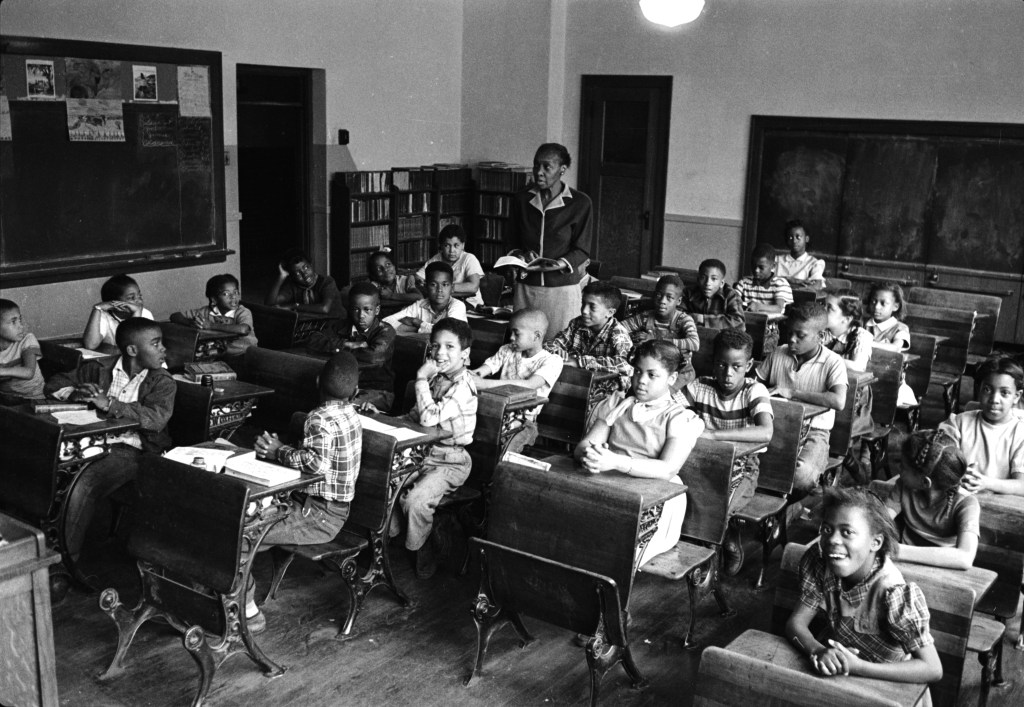
The case involved Linda Brown, a young girl in Topeka, Kansas, who had to walk through a dangerous railroad yard to reach a bus to her school even though a white school was located much closer to her home. What made the Topeka case legally significant was the fact that the black and white schools there were relatively similar in physical quality. This forced courts to take “separate but equal” head on. The NAACP’s lawsuit, headed by Marshall, argued that the Equal Protection Clause was fundamentally incompatible with a system designed to mark black citizens as inferior. The government defendants, for their part, relied largely on precedent, historical ambiguity about the 14th Amendment’s original intent with respect to schools, and judicial restraint—urging the court to defer to state legislatures on questions of education.
On May 17, 1954, Chief Justice Earl Warren read the opinion of the court aloud, departing from his written opinion in a few ways (most notably, by emphasizing the fact that it was unanimous, as he had scribbled in the margins of his reading copy). “We conclude that in the field of public education the doctrine of ‘separate but equal’ has no place,” he wrote. “Separate educational facilities are inherently unequal.” The announcement made international headlines, and the chief had written it in plain language so that it could be widely read. In that moment, the court appeared to vindicate the Reconstruction Amendments and the Declaration’s promise of equality. Racial classifications in education were finished. At least for now.
The return.
The question after Brown was what equality requires once formal segregation is gone. Decades later, after school integration had drastically increased, some began advocating for a return to racial classifications in public schools, this time for the alleged benefit of racial minorities. Defenders of racial preferences argued that even absent any history of state-sponsored discrimination, schools should take race into account to ensure equality of outcomes for racial groups. This flipped Brown’s idea of equality on its head. Rather than offering an individual right to equality before the law, this notion of equality required unequal treatment based on race in order to achieve equality of outcomes for racial groups.
That brought the issue of racial classifications in public schools back to the courts. In 1978, in Regents of the University of California v. Bakke, the court struck down a rigid racial quota system at a medical school but allowed limited consideration of race as one factor among many in college admissions. Even though it was joined by no other justice, Justice Lewis Powell’s solo opinion opened the door back up to racial preferences in education. And in Grutter v. Bollinger in 2003, the court reaffirmed that approach but insisted it was temporary. Justice Sandra Day O’Connor wrote that the court expected the need for such programs to expire within 25 years.
In the meantime, racial preferences trickled down to elementary schools, with administrators changing the admissions procedures at selective middle and high schools when they determined there were “too many” or “not enough” students of certain races. Thomas Jefferson High School for Science and Technology, a competitive specialized public school in Fairfax, Virginia, threw out its race-neutral admissions test in favor of geography-based review, resulting in a steep decline in the number of Asian students who were admitted. What had been a place where students could find opportunity without regard to their race became a school that favored equal group outcomes above all else.
Then, just before Justice O’Connor’s 25-year expiration date, the issue returned to the Supreme Court. A group called Students for Fair Admissions brought a lawsuit challenging Harvard’s admissions system, since the university accepted federal funds and was therefore bound by the Civil Rights Act’s prohibitions on discrimination. Evidence garnered during litigation showed that Harvard was employing crude racial categories to create a rigid racial quota. For example, it used broad labels like “Asian” and “Hispanic,” even though Asians make up 60 percent of the world’s population and include dozens of languages, cultures, and religions, and despite that the category of “Hispanic” encompassed individuals with widely different histories, including people of, say, Cuban, Mexican, Spanish, Venezuelan, and Argentine ancestry.
Although Harvard called race a “plus factor,” the evidence showed that race, in many instances, was determinative. An African American applicant in the fourth lowest decile academically, for example, had a higher chance of admission than an Asian American in the top decile. According to the petitioners, the evidence showed Harvard treated a student’s skin color equivalent in weight to authoring “original scholarship,” obtaining “near-perfect scores and grades,” or winning national-level awards.
An individual right.
In 2023, the Supreme Court held that Harvard’s race-based admissions policies violated the Equal Protection Clause, returning directly to Brown’s logic. Chief Justice John Roberts wrote that universities had “concluded, wrongly, that the touchstone of an individual’s identity is not challenges bested, skills built, or lessons learned but the color of their skin. Our constitutional history does not tolerate that choice.”
Justice Clarence Thomas wrote separately to articulate what he called “an originalist defense of the colorblind Constitution.” He distinguished genuine remedial measures—programs with a traceable link to specific government-perpetuated discrimination—from racial balancing for its own sake. Whereas the dissent pointed to statistical disparities between races as sufficient justification for race-conscious policies, Thomas observed that not all disparities can be attributed to race, let alone to racial discrimination. And generalities do not hold true for every member of the racial group. “Lumping people together and judging them based on assumed inherited or ancestral traits,” he said, “is nothing but stereotyping.”
In his view, the dissenters were using “broad observations about statistical relationships between race and select measures of health, wealth, and well-being to label all blacks as victims. [The] desire to do so is unfathomable to me. I cannot deny the great accomplishments of black Americans, including those who succeeded despite long odds.”
Universities could account for individual disadvantage, he continued—but they could not use skin color as a crude proxy for it. He closed with words that could have been written in 1954: “I hold out enduring hope that this country will live up to its principles so clearly enunciated in the Declaration of Independence and the Constitution of the United States: that all men are created equal, are equal citizens, and must be treated equally before the law.”
The debate over what equality requires will continue. The dissenting justices argued that the majority was reading Brown too narrowly and ignoring the structural conditions that its promise has yet to dissolve. But the majority’s holding reflects the court’s renewed insistence that the Declaration and Constitution are documents of individual rights, not group entitlements. And that the government may not brand citizens by race, even when it thinks doing so is benign.
Ruby Bridges’ walk up those steps is thus part of a longer American walk—one that began with the Declaration, continued through Reconstruction, suffered grievous reversals in Slaughter-House and Plessy, found great vindication in Brown, and continues today in courtrooms across the country. The permanent work of American self-government is honoring the dignity and equality of every individual, without regard to the conditions into which they were born.