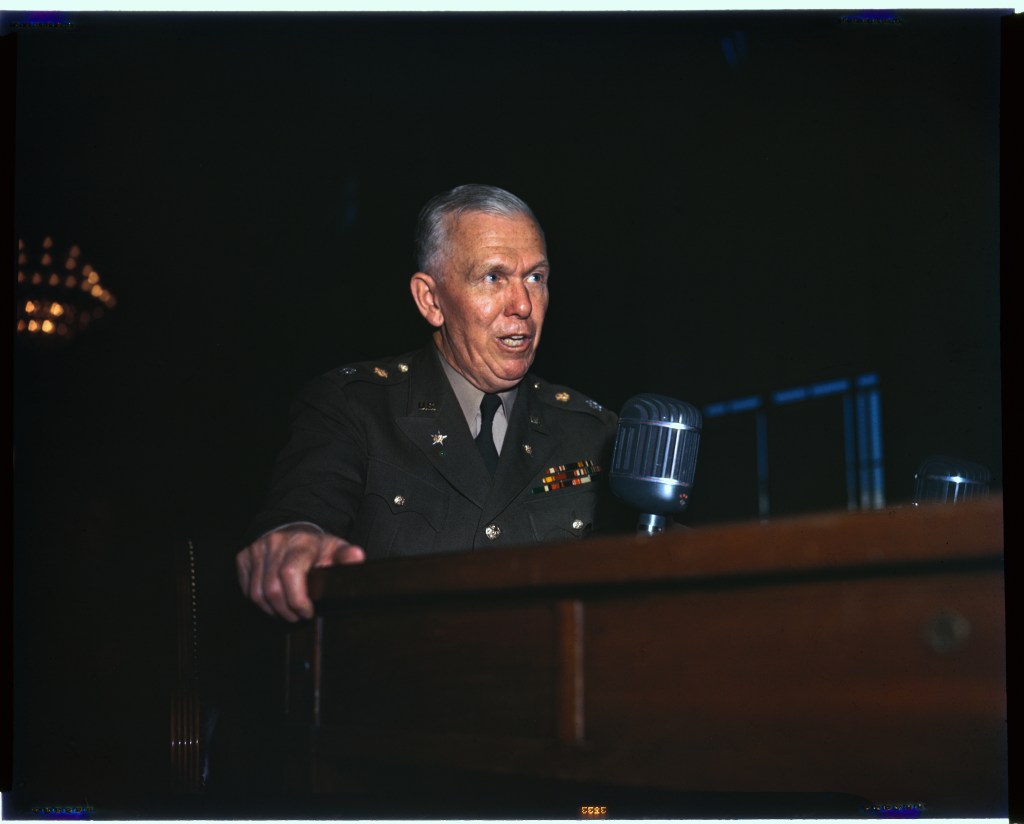
This June will mark the 79th anniversary of George Marshall’s commencement address at Harvard that launched the European Recovery Program (ERP), better known as the Marshall Plan. If the plan is thought of at all today, it is seen as a prime example of American largesse and altruism—the United States providing something on the order of $150 billion in today’s terms to ease Europe’s post-World War II liquidity crisis, enable the economic reconstruction of a war-devastated continent, and ultimately lead to the European miracle of the 1950s. As one student of the plan has noted, rather anomalously, “It passed into history with the warm regard of liberals and conservatives alike.” For many years after the successful conclusion of the ERP, whenever confronted with a particularly challenging politico-economic crisis—whether it was with regard to the decline of American cities, the collapse of the Soviet Union, or defeating the scourge of cancer—politicians have solemnly intoned about that need for “a Marshall Plan” to solve whatever happens to be the crisis de jour.
The Marshall Plan, however, was much more than simply the American people’s charitable goodwill on display—it was a sophisticated and complex effort to implement a strategic approach to the emerging Cold War with the Soviet Union. It undoubtedly accelerated the emerging division of Europe and prompted Stalin to bring down the Iron Curtain separating Western Europe from Eastern Europe, but it also set the conditions for the successful denouement of the Cold War only 40-odd years later.
The policymakers who were involved in both the conception and execution of the Marshall Plan—George Marshall himself, Dean Acheson, George Kennan, W. Averell Harriman, Charles Bonesteel, Paul Hoffman, Robert Lovett, John Hickerson, Charles “Chip” Bohlen and others—had all lived through the diplomacy and strategizing of World War II. That left them with a sense that the policy errors of the interwar years—American aloofness from the political divisions of Europe and unwillingness to make security commitments, the economic damage done by autarchic, beggar-thy-neighbor economic policies common among the European powers and, most important, the danger to U.S. interests that would result from allowing a hostile power to dominate the European continent—should not be repeated in the post-World War II era.
The U.S. emerged from that war as an economic colossus bestride the world with the productive powers of the American economy and populace galvanized by the demands of wartime production. As one historian has observed, it was “a full throttle … economic engine that produced half the world’s gross national product by 1945.”
President Franklin D. Roosevelt, who had shepherded the nation into and throughout the war, was a Wilsonian (he had been a sub-Cabinet official in Wilson’s Department of the Navy during World War I) and his party’s vice presidential nominee in the 1920 election. And one can see traces of the Wilsonian internationalism that promised to make the “world safe for democracy” in FDR’s commitment to a postwar international organization (the United Nations) and in the idealism of his Four Freedoms speech and the Atlantic Charter (which he imposed on a less than enthusiastic Winston Churchill).
But FDR’s Wilsonian internationalism was tempered by his experience of the interwar failures of the League of Nations and the experience of managing a coalition war with diverse partners like Britain and the Soviet Union who had spent much of the prewar period “at each other’s throats.” This injected a strong dose of realism that one can discern in his wartime enthusiasm for the idea that, after the conflict had ended, the “Three Policemen” (sometimes four when FDR hoped to include China) —the U.S., the U.K., and the USSR—would work together to enforce collective security rather than relying purely on the United Nations.
FDR was an immensely successful wartime president both as a coalition manager and as a domestic consensus builder. We, having grown up in the shadow of his amazing achievements, perhaps underestimate the accomplishment. He was particularly adept in capitalizing on those characteristics that provide an abiding comparative advantage for democracies competing with authoritarian systems, resilience, innovation, adaptability and efficiency. Alas, the nod to great power politics that his notion of “The Policemen” embodied proved to be too optimistic about the ability of the wartime coalition to survive the stresses and strains of peacemaking.
That peacemaking required solving the problem of reintegrating the two major defeated powers—Germany and Japan—into a new postwar economic and security order. The order that emerged was “both the most fragmented and most far-reaching of any postwar settlement in history,” and the Marshall Plan was, in many ways, the keystone of that herculean effort.
With FDR’s death and final victories over Germany and Japan, American policymakers and diplomats faced the difficult challenges of war termination. The failed effort at Versailles 25 years earlier offered a cautionary note about the challenges of the process. They were committed to moving Europe, the focus of the war effort, to reconstruction from the initial concentration on relief from the ravages of war. They hoped to rapidly conclude treaties with Germany and the other European powers who had sided with the Axis during the war (including Italy, which had switched sides in 1943). These efforts between 1945 and 1947, despite the U.S. nuclear monopoly that underpinned U.S. Secretary of State James F. Byrnes’ efforts to pursue “atomic diplomacy” that would intimidate the Soviets into agreement, were met with general Soviet obduracy.
By 1947 U.S. policymakers were confronting twin and interrelated crises of security and economic recovery. Early in the year British officials informed their U.S. counterparts that their country, bled white economically by the stringencies of the war effort, could no longer maintain responsibility for the security of the eastern Mediterranean where Greece was facing a communist insurgency and Turkey was facing unremitting pressure from the Soviets over control of access to the Black Sea. Truman and his colleagues, fearful that Soviet control over the Mediterranean would jeopardize European access to Middle East oil that was crucial for its industrial and economic recovery, decided to provide interim aid to these beleaguered governments. Internationalist-minded Republicans advised Truman that to garner public support from a largely uninformed and complacent public, he would need to “scare the hell” out of the American people about the danger of a communist takeover of a crucial international crossroads.
The March 1947 “Truman Doctrine” speech that resulted was a ringing call for ideological warfare. He noted that, “One of the primary objectives of the foreign policy of the United States is the creation of conditions in which we and other nations will be able to work out a way of life free from coercion,” which, after all, had been the main issue in the war against Germany and Japan. Truman went on to say that the current totalitarian threat from the Soviet Union meant “nearly every nation must choose between alternative ways of life” and that Americans needed to support “free peoples who are resisting attempted subjugation by armed minorities or by outside pressures.” And he ended with a ringing call for Americans to step up and provide direction in the face of the enormous challenges ahead. “If we falter in our leadership, we may endanger the peace of the world—and we shall surely endanger the welfare of our own nation.”
The president’s dramatic rhetoric succeeded in winning approval for $400 million in aid to Greece and Turkey, but U.S. policymakers still needed to address the burgeoning economic crisis that was gripping the rest of Europe. As one historian has noted, the proximate cause for what would become the Marshall Plan was a balance of payments crisis. “Fuel was scarce, workers were frustrated with calls for austerity, and strikes broke out with attendant political stresses.” Integrating Western Europe with the Soviet-occupied nations in Eastern Europe seemed impossible given the “breakdown” of U.S.-Soviet negotiations over the future of Germany. “The moment had come, for a concept of far more integrated Western European assistance, if only to persuade Congress that relief would not be poured perpetually down a rathole.” It was this challenge that laid the predicate for a series of speeches by administration officials culminating in Marshall’s Harvard commencement speech in June.
Marshall began by noting that the world situation was one of “enormous complexity” that made it hard for average Americans to understand what was at stake. The preparations for and conduct of the war had not just visited enormous physical destruction but had resulted in “the dislocation of the entire fabric of European economy.” Economic recovery had “been seriously retarded” by the inability to reach a peace agreement with Germany and Austria. As a result, “The rehabilitation of the economic structure of Europe quite evidently will require a much longer time and greater effort than had been foreseen” because Europe’s needs for food and other essential goods were “so much greater than her present ability to pay that she must have substantial additional help, or face economic, social and political deterioration of a very grave character.”
As Marshall made clear, providing economic assistance to break the “vicious circle” and rebuild Europe’s confidence was not just charity but in America’s own obvious economic self-interest. Returning Europe to economic health was the sine qua non without which there could be “no political stability and no assured peace.” In one of the most celebrated passages of the speech, Marshall assured the world that, “Our policy is directed not against any country or doctrine but against hunger, poverty, desperation and chaos. Its purpose should be the revival of a working economy in the world to permit the emergence of political and social conditions in which free institutions can exist.” He called upon Europeans to work together to generate a common set of requirements to facilitate U.S. efforts to assist in a common solution.
Marshall was maintaining a polite fiction when he said that the U.S. was not aiming its policy at any other country. He contended that U.S. assistance to European recovery efforts would be open to the USSR and the states of Eastern Europe that were occupied by Soviet forces and en route to becoming satellites of the Soviet Union. The reality was that American officials were deeply concerned that the Soviets would find a way to accept the U.S. offer of assistance and then work to subvert the program from within. They breathed a sigh of relief when Soviet officials made it clear that they would not play ball.
Although Marshall’s speech concentrated on the economic aspects of European recovery, it is important to recognize that the security and economic aspects of the continent’s reconstruction were intimately linked in American minds. As Truman would later note, the Truman Doctrine and Marshall Plan were “two halves of the same walnut,” and as presidential aide George Elsey noted, the Marshall Plan was “the Truman Doctrine in action.”
The complex linkage of problems that these policymakers were trying to solve may have begun with a simple balance of payments crisis, but it quickly assumed much broader geoeconomic and geopolitical dimensions. Providing U.S. financial assistance to manage the dollar gap was, relatively speaking, the easy part. Restoring the European economy, however, required reintegrating Germany into the broader continental economy for both economic and political reasons. Nobody wanted to see another round of German aggression, but, by the same token, no one wanted to see a Germany tempted by an alliance with Russia like the Rapallo Pact of the interwar years either.
Rehabilitating Germany and tying it to the West, however, raised security concerns for the French and British. Those security concerns could be assuaged only by an American security guarantee, which ultimately came in the form of U.S. adhesion to the North Atlantic Treaty in 1948. The interlocking challenges that faced U.S. policymakers in this period were neatly summed up by Lord Ismay’s pithy bon mot that the solution to the conundrums facing U.S. policymakers was an alliance that kept “the Russians out, the Americans in and the Germans down.” As Melvyn Leffler, the most distinguished living historian of the early Cold War, has written, “Although the core of the Marshall Plan consisted of an economic program, its geostrategic and military ramifications were great. The Marshall plan was designed to thwart Europe’s indigenous left, co-opt western Germany, and lure Soviet satellites away from the Kremlin. Its strategic aim was to prevent the Kremlin for gaining direct or indirect control over European resources, industrial infrastructure, skilled manpower and military bases.”
In the end, U.S. policymakers failed to immediately lure away any of the Soviet satellites. In fact, U.S. policy arguably provoked the Soviets to clamp down on their sphere of influence, prompting the division of Germany, the communist coup in Czechoslovakia in February 1948, and the descent of the Iron Curtain. In the longer run, however, it produced a balance of power in Europe that maintained a fragile stability enabling the strengths of Western liberty and democracy to show dramatic results while the Soviet system of command economy and totalitarian rule rotted from within, leading to the collapse of the entire Communist system in Europe in 1989 and the breakup of the Soviet Union in 1991. It is no wonder that looking back on his role some 20 years later that Dean Acheson would say that the Marshall Plan was “one of the greatest and most noble adventures in history.”
From today’s vantage point, the high-flown rhetoric and enlightened self-interest of the Marshall Plan seem almost quaint given the corruption and smash-mouth rhetoric of current national security officials. But the tale provides valuable moral instruction about what serious American national security professionals and seasoned and thoughtful American political leaders can accomplish when they marry the best of our nation’s ideals with its narrower geostrategic interests.