Theories.
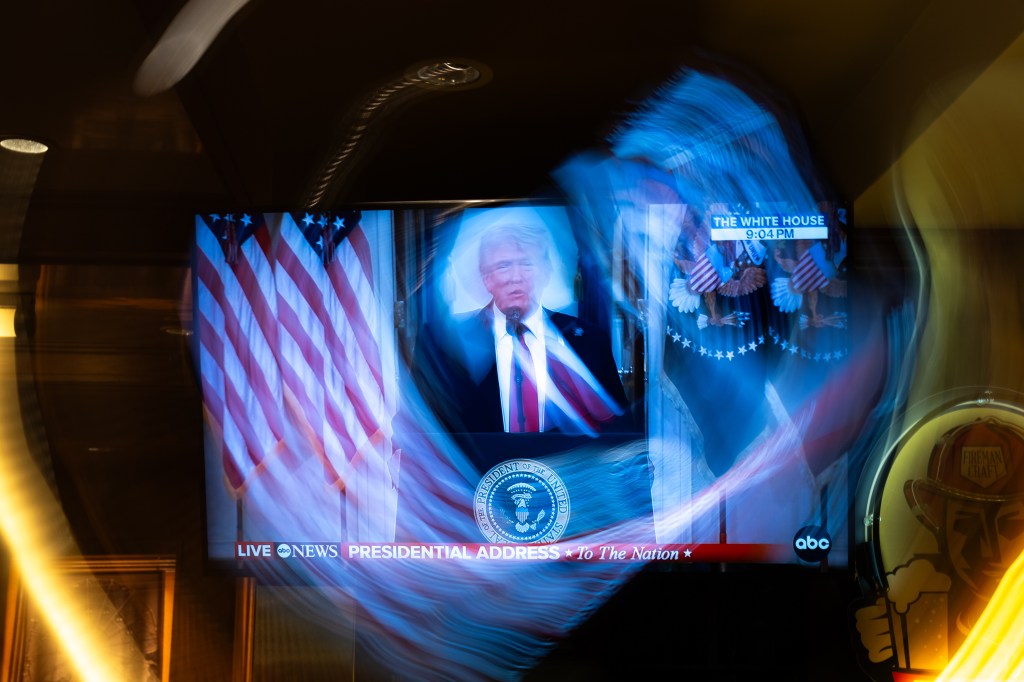
Maybe he was planning to declare the imminent end of operations. That’s how Politico made it sound in a piece published Tuesday before the address, reporting that Trump was prepared “to declare that the month-long war in Iran is winding down.”
And he did do that, sort of, in specifying a two- or three-week timeline to accomplish America’s remaining objectives. Whatever those might be.
But the intended audience didn’t seem reassured. Oil prices spiked following the speech while market futures fell, proof that investors came away thinking that a ceasefire is less probable than they’d hoped. And no wonder: Elsewhere in the speech, Trump threatened again to bomb Iran’s power plants if no deal is reached and mused that the country’s oil infrastructure would be “the easiest target of all.”
If the regime calls his bluff and he follows through, the likely result will be a humanitarian disaster and Iranian retaliation against oil output across the region. Militarily and economically, this clusterfark will become considerably more farked.
The president intended to avoid all that by using his speech to announce a proper TACO in the days to come, we might speculate, only to be talked out of it at the last minute by regional allies who worry how a wounded but not beaten Iran will behave once the U.S. leaves the region.
It could also be that he planned to do the opposite.
Rather than winding down, maybe he was preparing to ramp up by announcing that U.S. troops might soon be introduced into the fight. That would explain why he didn’t address Americans before the war but felt compelled to do so now. Once the battle moves from a turkey shoot in the air to a grind on the ground, the American people expect a gesture of accountability from their leader.
That theory has problems, though. The White House wouldn’t want to confirm its plan to use infantry to the enemy by revealing it publicly beforehand. And despite the buildup of U.S. troops in the region, I suspect all parties believe Trump will ultimately find an excuse not to put soldiers in harm’s way. Never mind the steep bipartisan opposition to doing so: By nature, the president is averse to any fight he’s not guaranteed to dominate. The risk of “looking bad” if U.S. casualties were higher than expected in an invasion is too great.
But you never know. There’s certainly a chance that a man “high on his own supply” of military power planned to excitedly announce that the Marines would soon be raising the American flag over Kharg Island. And that sober White House aides terrified of the political fallout descended on him before he spoke and begged him, successfully, to reconsider.
Either way, Tom Nichols is right. If Trump does end up using infantry after passing on his big opportunity to prepare Americans for the possibility, he’ll have deceived the country about his intentions in a momentous way. (Although not as much as when he ran in 2024 on “the pro-peace ticket.”) We’ll probably know by Sunday, as it would be characteristic of this administration to want to launch a ground attack on a Muslim country on Easter.
There’s a third possibility of what the president planned to announce, however, which I think is the likeliest of the bunch. To all appearances, he was preparing to say something about NATO and/or Europe that would have altered the alliance in an irreparable way.
There was reporting about that, too, in fact. Trump “intends to harshly scapegoat NATO allies for the biggest unresolved matter of the war, Iran’s ongoing restrictions of shipping traffic through the Strait of Hormuz,” Politico alleged in a piece yesterday. Thinly sourced speculation? Not at all: In a pre-address conversation with Reuters, the president himself “said one element of his speech would be to express his disgust with NATO for what he considers the alliance’s lack of support for U.S. objectives in Iran.”
He’s gone out of his way in interviews lately to spin Europe’s reluctance to join America’s war as the straw that broke the back of an alliance for which he’s never held any real regard. Last night seemed destined to be the moment when he made antipathy to NATO de facto U.S. policy, egging on an audience of millions to blame the Euroweenies for any economic pain they might suffer from the war going forward.
Surprisingly, he didn’t. The word “Europe” was uttered once in his speech, the word “NATO” not at all. The closest Trump got to “harshly” articulating his “disgust” was referencing unspecified countries that rely on the Strait of Hormuz for oil and exhorting them to “build up some delayed courage” by reopening the strait themselves. Handed a big stage, it seems he TACO’d out of pressing a case that he’d been pressing with reporters informally for the better part of a month. Why?
It can’t be that he was scared off by the federal law that bars him from withdrawing from NATO unilaterally. He doesn’t need to formally exit the treaty to destroy the alliance; all he needs to say is that, per his authority as commander in chief, he won’t issue any orders to U.S. troops to defend Europe under Article 5. No one can make him do so.
Plus, let’s be real. Trump never has been and never will be cowed by some statutory limit on his power.
There has to be another solution to the case of the missing NATO tirade.
A broken alliance.
One obvious guess: markets.
Markets are usually the explanation whenever the president pulls a TACO. It was a year ago today that he announced his “Liberation Day” tariffs, only to pull back a week later when trading in stocks and bonds began tilting toward a major financial crisis.
Markets also explain Trump’s bizarre vacillations over the past month between threatening Iran in apocalyptic terms and chirping about major progress in peace negotiations—an out-and-out lie, by the way, according to the New York Times. He’s simultaneously trying to scare Iran into submission and to talk markets up every time the Dow dips due to fears of a prolonged war.
Again, there’s nothing he fears more than “looking bad.” A market crash under The Greatest Economic President in History would look really bad.
Maybe someone in his orbit reminded him before the speech that, with markets already anxious, abruptly ending the transatlantic alliance and declaring Europe fair game for Russia would … not have a calming effect. So he backed off. The formal break with NATO is postponed for now, delayed until (if?) the global economy stabilizes enough for investors not to lose their minds about the official end of the Pax Americana.
It seems like a textbook TACO, in other words … except for one thing. NATO is already as good as dead, and markets have surely priced that in already.
An unnamed German official put it well to Politico. “With Trump in office, NATO is worthless,” he said. “We might have NATO, but we no longer have an alliance.” Last night’s silence didn’t undo the president’s longtime habit of “hollowing out” the organization by criticizing it repeatedly, casting so much doubt on his commitment to it that many Europeans now question whether U.S. membership still meaningfully deters enemies.
The organization will nominally exist, but there can’t be a single official from London to Vladivostok who’s still basing their security plans on America honoring Article 5 if Europe is attacked. “The United States now seems part of the problem of world disorder,” the Times said of opinion on the continent, citing a senior European official. “The country is no longer the solution and the guarantor of last resort.”
Weirdly, the indignant outrage at Europe among some Republicans for not joining America’s war seems completely deaf to that political reality.
I think it was foolish of some European governments not to let the U.S. at least use their airspace for staging attacks on Iran, but I also sympathize with their predicament. After the idiotic tariffs, the Putin-esque play for Greenland, the disparagement of European soldiers’ sacrifice in Afghanistan, and endless gratuitous insults in between, Trump is so poisonous to European electorates that even far-right parties feel obliged to run away from him. Voters are turning anti-American and understandably so. Joining an unpopular American war of choice under the circumstances would be immensely politically risky for any elected leader.
Yesterday the Financial Times reported that the president went as far as threatening to stop selling weapons to European nations for Ukraine’s use if those nations refused to help reopen the Strait of Hormuz, which nicely encapsulates his general attitude toward Europe. Having already weakened Ukraine’s defense by significantly reducing U.S. aid to the country, Trump is now promising to cripple it entirely to extort Ukraine’s allies if he doesn’t get some help—of questionable utility—with a problem of his own making. He regards U.S. support for European security as a pure favor, not something that’s in our own big-picture national interest.
And he treats it as a favor they can never fully repay, no matter how much blood they shed in the war on terror. They’re forever obliged to do anything we might ask of them and to do it with a smile, even as he derides them for their weakness. That’s why Trump can only understand it as ingratitude and disloyalty when the leaders of NATO states respond to elementary democratic political gravity, telling him no because their constituents would be incensed after the past 14 months if they did otherwise.
All of which makes it odd that he pulled his punches last night when given a chance to impugn those leaders on national television and blame them for his own failure in the strait.
Leverage.
I can think of only two explanations.
One is that some cooler head sat him down yesterday afternoon and explained that Europe’s best shot at reopening Hormuz is to approach Iran diplomatically, not militarily. “There’s no way to reopen the strait permanently without Iran’s acquiescence,” I wrote on Monday. The reopening of the strait “can only be done in coordination with Iran,” French President Emmanuel Macron observed on Thursday, as officials from 40 nations (but not the U.S.) gathered to discuss a diplomatic solution to the crisis.
If Macron and I are right, Europe joining a military operation to reopen the strait would antagonize Iran, killing the diplomatic effort, and might very well fail to accomplish its goal. (Even if it succeeded, how would it keep the strait open permanently?) The U.S. is better off letting NATO members play good cop to its bad cop in feeling out what’s left of Iran’s ruling regime for a settlement.
The other (admittedly unlikely) explanation is that Trump had a last-second “eureka” moment before his speech, somehow awakening to the fact that continuing to alienate Europe might eventually have consequences for our country and his presidency.
“By abdicating responsibility for the strait and saying it should be someone else’s problem, America is inviting into existence a rival economic and military alliance,” Jonathan Last argued today at The Bulwark. “Trump is giving China the green light to exert its influence in the Indo-Pacific. He is opening the door for Chinese cooperation with Europe. He is putting Taiwan—and hence the global supply of semiconductors—at China’s mercy. He is prompting the rest of the world to organize a new global order according to their interests.”
Just as Russia is the big winner of Trump’s war with Iran, China is the big winner of Trump’s cold war with Europe and Canada. It was just two days ago that Beijing rolled out the red carpet for lawmakers from the European Union, the first visit by any such delegation in eight years. We can only guess what, if anything, might have clued the president into the risk of a Sino-European alliance that leaves America out in the cold, but his vision of a new world order based on “spheres of influence” has always plainly imagined the U.S. able to go on working its will anywhere on the planet it desires.
As it dawns on him that our country might potentially be maneuvered into its own limited “sphere” by alliances among powerful adversaries, maybe he’s begun to think better of antagonizing Europe when he doesn’t absolutely need to.
The fact that European leaders acted in concert to defy his demand for help with Iran may itself have been a wake-up call. Because they were willing to risk alienating the U.S. by telling him no, he may have deduced that he has less leverage over them than he thought—and that what little is left will be squandered entirely if he formally pulls the plug on NATO. Perhaps last night’s silence was a rare case of him behaving prudently, opting not to forfeit that last bit of influence by scapegoating Europe for begging off a probably futile effort to avert a major strategic defeat. He’s lost enough influence with formerly friendly constituencies as it is.