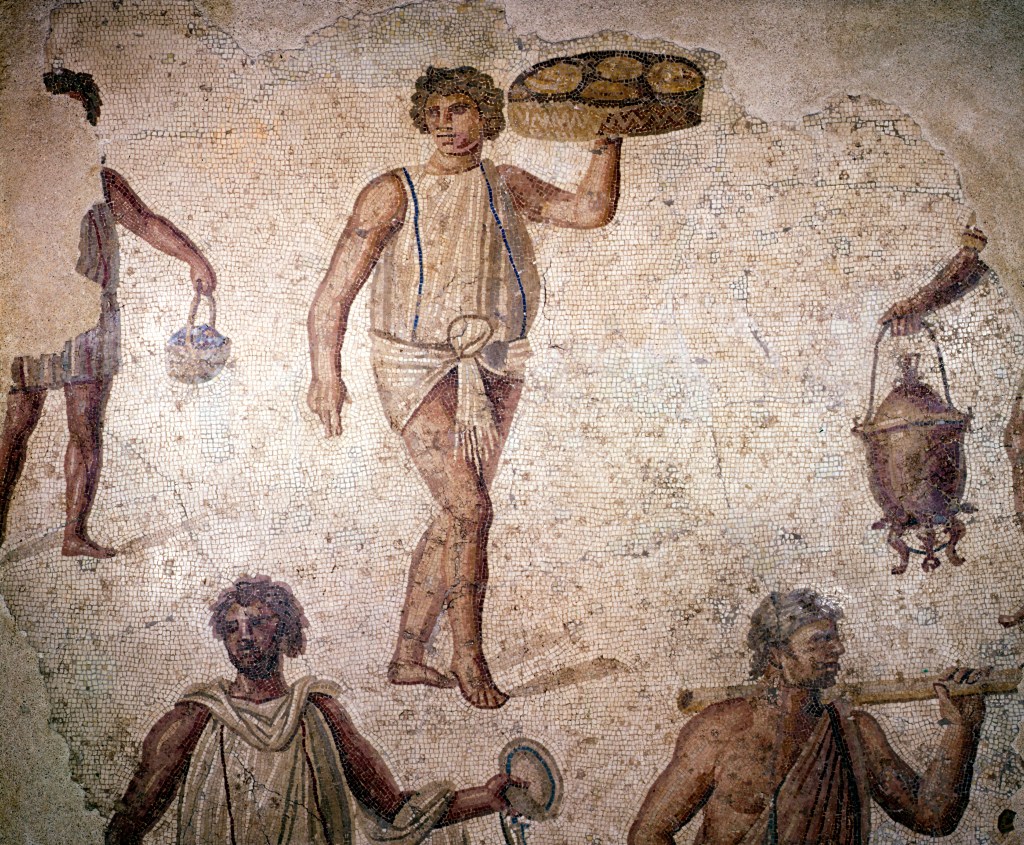
The oldest known records of slavery come from Mesopotamia, some 5,000 years ago. Then Egypt. Then China. Then Mesopotamia, of course, and Greece, and Rome. They continue for many centuries, presenting a ubiquitous social institution, entrenched across civilizations, celebrated by rulers, rationalized by philosophers, meticulously documented by diligent clerks.
The United States’ specific, horrific history with slavery evokes the subject as continuously relevant, and lately even as a political wedge, with populist voices like Elon Musk’s trumpeting (correct) claims that slavery was more widespread and long-lasting in non-Western civilizations. Just this week the United Nations passed a resolution formally recognizing the trans-Atlantic slave trade as the “gravest crime against humanity.”
Enslaving other humans has been, in fact, one of the most common and universal of human activities. Indeed most people in the ancient world would have struggled to imagine a human society without slaves, and hardly regarded slavery as an institution that could be separated from society or conceivably be abolished.
Even the citizens of the nation that founded its identity on its exodus from slavery—ancient Israel—held slaves, and did not object in principle to the institution of slavery. The Greeks as well, being the first to introduce democratic principles and institutions to political life, did not reject slavery, and actually found ample reasons to legitimize it.
Notably, a fundamental change began within the Christian world, with the decisive break coming not from economic change or political revolution, but from a theological claim: that every human being is created in the image of God. Following its transformation into a major, widespread religion, this idea gained acceptance across the Mediterranean Basin and into Europe. When Constantine began Christianizing the Roman Empire at the dawn of the fourth century, even imperial law was shaped by this principle. An edict of 316, for instance, made it illegal to brand a convict’s face. The reason was as simple as it was revolutionary, according to the edict’s language: “Because man is made in God’s image.”
The Christian church did not abolish slavery, and in fact there were many clergymen, as late as the 19th century, who supported slave ownership and used various theological arguments to justify their positions. Yet as early as the period of the church fathers in the third and fourth centuries, pioneering voices opposed slavery, their arguments predicated on the principle of the image of God.
Gregory of Nyssa was the loudest and most explicit. For Gregory the very attempt to buy or sell a human being was inherently absurd:
God said, let us make man in our image, after our likeness. If he is in the likeness of God, and rules the whole earth, and has been granted authority over everything on earth from God, who is his buyer, tell me? Who is his seller? To God alone belongs this power … But has the scrap of paper, and the written contract, and the counting out of obols deceived you into thinking yourself the master of the image of God? What folly! … Your origin is from the same ancestors, your life is of the same kind … Are not the two [slave and master] dust after death? Is there not one judgement for them? A common Kingdom, and a common Hell? (Homilies IV, Eccl. 2:7)
Humankind’s creation in God’s image, according to Gregory, not only gave people supreme value but also made them, in the fullest sense of the word, subjects. In this respect, no human could ever be deprived of their personhood and considered an object that could be bought or sold. No one could become the “master of the image of God.” Humans, as the image of God, were their own masters. Gregory’s words are the first principled articulation completely invalidating the institution of slavery.
Of all Hellenistic thinkers, the Stoics were the most positive in their attitude toward the enslaved, maintaining that slaves are to be treated humanely. They did not, however, reject slavery outright. For them the body-soul dichotomy, central to Greek thought, made it tolerable: Since the soul, according to the Stoics, was the locus of true personhood and was eternally free, there was no way to truly enslave anybody. It was not so terrible, therefore, to put humans in chains, as one could subjugate only their bodies.
When Gregory explains that all humans are judged equally by God, ascending after death to Heaven or descending to Hell, he draws on the same dualistic body-soul dichotomy. Unlike the Stoics, however, for Christians the soul is created by God and subsists in a personal relationship with Him. Human souls have supreme value in their own right. Every soul is a unique subject, an autonomous, distinct entity, its status compelling an appropriate standard of behavior from others toward it.
Gregory’s teachings demonstrate how profoundly conceptions of the individual changed with the rise of Christianity. Unlike the Stoics, for Christian thinkers the soul is not a hidden refuge where one could find a modicum of freedom, but a singular creation which stands in eternal relationship with the divine, its only true master, and to whom its whole existence must be dedicated. The body, being part of God’s creation, is not something that can simply be discounted. Accordingly, the person, in his or her entirety, must be free. The human person was the image of God, and thus a complete subject worthy of reverence. Where the Stoics preserved inner freedom by withdrawing personhood into the subjectivity, Gregory constitutes the entire person as subject, which, being made in the image of God, is beyond ownership. If the Stoics internalized freedom, Christianity ontologized dignity.
According to Aristotle, the slave is “a living tool,” and according to Varro, a Roman educator from the first century BCE, slaves were “articulate instruments.” Jews and Christians could not have accepted such definitions, because these definitions deprived slaves of their humanity. They found it inconceivable that slaves be analogized to instruments, because to do so denied their existence as creations in God’s image. Hence the ancient Hebrew laws (see Exodus 21, for example, or Deuteronomy 23) requiring the enslaved to be treated as human beings and mandating their participation in the worship of God. And hence, when Christianity transforms the idea of freedom and individualizes it, the voices calling for the complete rejection of slavery.
As I show in my book, this guiding logic would accompany Western civilization all the way to the total abolition of slavery. In the late 18th century, the famous British abolitionist William Wilberforce would still insist that because all humans were created in God’s image slavery was utterly illegitimate. In the mid 19th century, writing in dissent of the majority verdict in the infamous case of Dred Scott v. Sandford (1857), Justice John McLean insisted in defiance of his colleagues on the United States Supreme Court that “A slave is not a mere chattel. He bears the impress of his Maker.” In his promulgation of the Catechism of the Catholic Church in 1992, Pope John Paul II underscored that “Being in the image of God the human individual possesses the dignity of a person, who is not just something, but someone.”
Even where the theological vocabulary has faded, the moral architecture remains recognizable. The conviction that every human being possesses inherent dignity did not emerge ex nihilo. Nor was the consecration of specific dimensions of autonomy as self-evident and unalienable rights. Both were forged within a specific metaphysical vision of the human person, a vision which lies at the foundation of our modern liberal order.
It is hard, indeed terrifying, to contemplate the possibility that lacking the idea of the creation in the image of God the institution of slavery would have endured to this day. We must believe another moral or philosophical principle would have emerged to challenge it. Yet as much as we would like to think of our rights as self-evident and eternal, a close examination of the history of the West reveals just how much we owe to that one clear and distinct idea, that all human beings were created in God’s image.