When I was about 10, the pop punk band Bowling for Soup released “1985,” a song about, among other things, the unique pain of being left behind. Sung from the perspective of a middle-aged mom in 2003, the lyrics highlight the anguish of being nearly 20 years removed from one’s cultural zenith. “When did Mötley Crüe become classic rock?” the singer laments, realizing that her music has somehow become her kids’ parents’ music—in a word, uncool.
The song is still hugely popular today, a testament to the staying power of pop punk music and surely proof that the genre of music that I grew up listening to will never age into irrelevance.
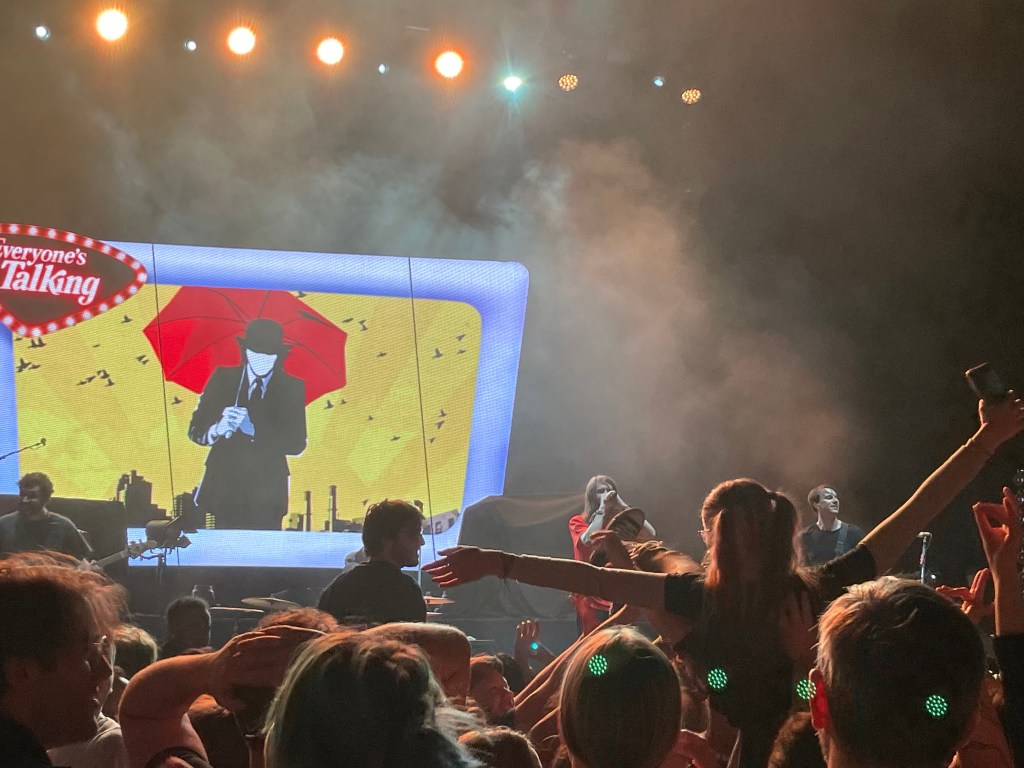
I naturally felt vindicated when I heard that mid-aughts pop punk mainstay All Time Low had added a show at Hammerstein Ballroom on Manhattan’s West Side due to popular demand. I logged onto StubHub and bought a very reasonably priced last-minute floor ticket for that night’s concert. That Monday night concert. That Monday-before-Thanksgiving concert.
I spent several songs of All Time Low’s set standing next to a kid who looked exactly like a skinny Ed Sheeran. He was pumped to be there, and dutifully sang along to the older hits. “We put our first album out 20 years ago!” Alex Gaskarth, the lead singer, shouted into the mic. “I was 3!” screamed the Ed Sheeran lookalike.
While it may be soul-crushing to think about that merciless march of time (really, what could be more emo than that?), it’s safe to say that pop punk has—so far—avoided the dreaded label of dad rock, in part because the genre continues to dominate the culture for those under 40. Alex Cooper, hostess of the hit podcast Call Her Daddy, has professed her love for Mayday Parade. Taylor Swift has cited Fall Out Boy’s Pete Wentz as one of her favorite lyricists. The Jonas Brothers’ most recent tour featured pop punk openers The All-American Rejects and Boys Like Girls, and featured local emo bands as live collaborations—including Red Jumpsuit Apparatus and Yellowcard.
What got me out to the show on a Monday night wasn’t the promise of screaming along to high school favorites like “Dear Maria, Count Me In” or “Remembering Sunday.” It was the opportunity to hear a few songs off All Time Low’s latest album, Everyone’s Talking!, released back in October. The album, simply put, is the band’s best effort in years—but All Time Low isn’t the only pop punk band to release a praiseworthy album two decades after their debut. Over the last several years we’ve seen a resurgence of interest in the pop punk scene, seemingly driven by nostalgia. But 2025 felt different, with nearly a dozen legacy pop punk and emo bands releasing some of the best music of their careers and reaching new heights. For the first time since its peak in the mid-2000s, pop punk is moving past “nostalgia chic”—and back to a cultural force that’s generating not just great live performances, but a steady stream of influential artistic work.
Pop punk, as you might have guessed, grew out of punk music. Tracing its roots back to the Ramones, the genre launched in earnest (probably) with Descendents’ 1982 record, Milo Goes To College. The mantle was picked up by Green Day and Blink-182, both of which lifted it to new heights at festival shows, including Warped Tour in the late 1990s and early 2000s. Then came Fall Out Boy and Paramore and features on MTV and MySpace pages.
Purists will argue that pop punk is absolutely f—ing not emo, an entirely different late-90s-early-aughts genre of music that originally grew out of the D.C. hardcore scene in the ’80s, was refined by Midwestern groups including American Football, and finally brought to the mainstream by Jimmy Eat World, Taking Back Sunday, and My Chemical Romance. I, however, am not a purist. And while there are plenty of differences between the subgenres, emo and pop punk bands have come up on parallel tracks and shared stages for the better part of two decades. For the purpose of this essay, we’ll eschew the purity test to analyze the resurgence of this very specific genre(s).
“We’re very happy that emo music as a whole, it came back with a vengeance in a way where it was sustainable and we could continue to make a living playing music, but then turned into something that … essentially now it’s mainstream,” Brooks Betts, guitarist for Mayday Parade, told me in an interview. “It’s a household genre. Before it was such a niche thing, and that was what was cool about it, and now it’s cool that it’s a household genre, you know?”
K Enagonio is a concert photographer and journalist who provides a running YouTube commentary on the evolving emo and hardcore scene. “I saw a huge influx of artists that I grew up loving and listening to coming out with new music or getting back together or coming out of their hiatus. I’ve seen 2025 really help bands get back on the road and get back to what they love doing most.” Enagonio is now a part of that, having joined Red Jumpsuit Apparatus this past summer as their full-time screamer. “I know how much this band means to people because I know how much this band means to me. You know, and they also got me through a bunch of stuff as a teenager and a young adult.”
But it’s not just the elder emos who are screaming along. “Collide with the Sky by Pierce the Veil to middle schoolers today is what Nevermind by Nirvana was for you and I in middle school,” said Devin McGuire, a middle school music teacher who also plays in numerous pop punk bands in New Jersey—and with whom I’ve jammed myself. “This is the record that their older cousins grew up on. So it’s not quite—you know, it’s in that perfect time period of being really cool and really relevant without feeling out of reach.”
Pop punk and emo initially saw explosive growth thanks to a breakneck pace of live events, elevated by early social media platforms. Basement shows, concerts at local strip malls, and VFW hall gigs all served as springboards to larger stages. But to achieve any of that success, it was critical to build a loyal fan base. “If I had to really boil it down, it’s Myspace and then us going out and selling CDs,” Betts told me, reflecting on Mayday Parade’s early days. “Our first [record], Tales Told By Dead Friends, we self-released it before we signed.” He credits their signing with Fearless Records in 2006 to this blending of online and real-life community. “There was a big buzz on Myspace and then we went out and we sold 11,000 copies out of backpacks at Warped Tour.”
But like any music fad, pop punk had a shelf life. The 2010s saw a large number of mainstay acts go on hiatus, break up, or retire. Festivals like Bamboozle and Warped Tour went dark. The barebones scene was held together by holdouts—including Mayday Parade and Red Jumpsuit Apparatus—as well as newcomers like The Wonder Years, Grayscale, and State Champs.
“I was at the last Warped Tour that happened in 2018,” Enagonio told me. “We were all like, ‘all right, this is it. It’s over.’”
A funny thing happened around 2020: The emo kids grew up, started making their own money, and were all trapped inside during the COVID pandemic. But that didn’t mean the desire to thrash evaporated. Emo kids simply went into hibernation.
A few key—and familiar, and controversial—ingredients stoked the emo flame before and after the pandemic. The first was emblematic of the all-important community aspect of the scene. Originally founded in 2016, Emo Nite is a traveling DJ party playing exclusively pop punk and emo hits, taking over local venues and inviting fans of all ages to dig out their studded belts and mosh the night away.
“We owe a lot of credit to those sort of events, you know, that kept so much music alive, especially while so many bands kind of stopped for a minute, or completely went away,” said Betts. “And then some of them even realized, like, ‘Oh, well, people still care. And they care more than they ever did. Maybe we should, like, revisit this, you know?’ Emo Nite … kept that alive for those bands that went away.”
McGuire also pointed to Emo Nite’s habit of inviting new acts into the spotlight. “While people have mixed opinions on them, Emo Nites have been good because sometimes they’ll feature local bands as well. And then that gets people that are coming to see their favorite legacy artists, and they can continue building the scene by seeing and supporting new artists.”
Pop punk music has also found a surprising explosion in popularity on TikTok, where “elder emos” and teens alike share songs from the early 2000s. I was even reminded of the power of TikTok at the show at Hammerstein. “Man,” Ed Sheeran yelled to me as All Time Low strummed the opening chords to their 2009 hit, “Damned If I Do Ya (Damned If I Don’t).” “I love their stuff on TikTok.”
Mayday Parade has been consistently active since 2005 (except for the year or so that COVID kept them from touring), but Betts points out that acquiring and maintaining an audience can still be a challenge. “Any band that’s been out for 20 years with eight albums starts to be tough to gain a new fan base,” he said. “Your band has to now evolve over a long span, retain those fans, hopefully make new fans, which I do believe we are doing. … But I do think that it’s interesting how you have to navigate the new world online, including social media, and how all that plays into your success.”
Social media played a major role in the promotion of an upstart new festival. In 2022, the When We Were Young Festival promoted what seemed to be an almost unbelievable lineup—promising the recently reunited My Chemical Romance and Paramore as headliners, and dozens of other too-good-to-be-true acts from the pop punk heyday. Online chatter got so loud that Live Nation, the festival’s organizing company, had to assure fans that the Las Vegas concert was, in fact, legitimate. Since then, When We Were Young has only grown, even adding a second date in 2024 to account for demand.
My college buddy Jarrod Anderson, a law partner and bar owner in his early 30s, traveled from Milwaukee to Vegas for the 2025 show. “It’s a special festival,” he told me when I asked what moved him to make the trek. “I’m not a festival guy, but it was absolutely worth it to see my favorite bands from when I was younger and too self-conscious—or too poor—to see them back then.”
What explains pop punk’s newfound success, according to the musicians in the scene?
“It never really got the attention that it deserved, because I don’t think that the younger generation was the target audience for advertisement,” Betts told me. “I think it was just underappreciated until that fan base became a marketable demographic. And it’s kind of messed up how it works, but I think that is a big part of it.”
A grown-up generation of pop-punkers and emo kids, he believes, is suddenly a massive commercial opportunity. “Now they’re buying, you know, they’re buying White Claws, you could advertise alcohol to them properly. … They have their own wallets now. So anybody who wants to, in a corporate way, get involved, can. And there’s a lot of dollars there to be pushed around. And that’s what helps put it up on the level that it deserved 20 years ago.”
Of course, the pop punk resurgence hasn’t avoided the fiasco of skyrocketing ticket prices—and the incredible demand from a fan base willing to spend may have only driven prices higher. “Ticket pricing really, like, screwed a lot of fans trying to go to shows,” Enagonio said. “That was the biggest difference I saw, was post-Covid ticket prices, because people were like, ready and eager to go back to shows.” A number of artists—including Red Jumpsuit Apparatus—are trying to wrestle more control of their ticket sales from major sellers, Enagonio added.
Despite the escalating costs—or perhaps in conjunction with increased revenue—the revival of festivals breathed new energy into a scene largely associated with nostalgia. “When We Were Young brought it back into the fold,” said Betts. “The stronger that any band is within our scene, the better it is for everybody. Including someone like MGK, where he gets a lot of hate for … whatever it is that people don’t like.”
MGK is Machine Gun Kelly, a former rapper who in 2020 released Tickets To My Downfall, the most popular piece of recent original work in the pop punk genre … which was promptly rejected by many original scenesters. Produced by Blink-182’s Travis Barker, Tickets was named Billboard’s top rock album of 2021. Enagonio also credited MGK for the modern resurgence. “I know this might be controversial or whatever—I think Machine Gun Kelly doing his Tickets to My Downfall album really showed people that, like, oh, my God, we should do emo music again. More like, he brought it into the mainstream.”
The collection of pop-punk music put out in 2025 is all over the map. But there’s a unifying thread tying it all together: It’s all, by and large, good.
Some bands, like The All-American Rejects, have largely left their old sound behind, opting for a more indie-core direction. Red Jumpsuit Apparatus revisited several unreleased demos from its first album, including them in 2025’s X’s for Eyes. Yellowcard enlisted the help of Blink 182’s Travis Barker for its slick comeback album Better Days. Motion City Soundtrack’s The Same Old Wasted Wonderful World—its first album in 10 years—is a classic return to form. The beats are driving and danceable, the synthesizer is soaring, and the lyrics are sardonic and self-reflective. It’s catchy from top to bottom, and includes some excellent reflections on aging gracefully in the scene you helped create. (“I’m so sick of living the nostalgia down / I just want to separate the past from now / Stay in present tense somehow” lead singer Justin Pierre croons on the title track.)
All Time Low’s Everyone’s Talking! is the most modern-sounding of the bunch, while maintaining familiar—if not more mature—guitar riffs and thunderous choruses. And while it might take some oldheads a minute to get over hearing Zoomer slang like “crash out” or “down bad” in an All Time Low song, sonically, lyrically, and thematically Everyone’s Talking! represents a pop punk band using modernity to reach its zenith. Just listen to “SUCKERPUNCH” or “The Weather”—which hit No. 1 on the Billboard Alternative Airplay chart last year.
In September, pop punk veterans The Starting Line opted for a stripped-down, heavier sound for its first album in 18 years, Eternal Youth. When I first texted my best friend Rex—“Emo Rex,” as we called him in high school—about the group’s latest album, he replied: “This kind of sound in 2025 wow … like stop for a sec and just remember how this sounded in 2000s.” He was right. I almost forgot how crunchy a guitar could sound.
The Starting Line’s lead singer, Kenny Vasoli, was reportedly hesitant to put out a new album. “I don’t think that people are interested in a full-length from us … Even the bands that I find really popular are kind of disappointing me with their new records that come out versus the things that I became attached to and became a fan of,” he told podcaster Robbie Fox in an interview earlier this year. But the band’s manager argued that this hesitation was just Vasoli’s own insecurities. “And that … just pushed a button in my head where I just wanted to prove him and myself wrong that I’m not insecure about the music that I make.”
The first song, “I See How It Is,”highlights this conflict. After a few rhythmic, open strokes on an electric guitar, Vasoli yells the opening to the album—ushering in waves of overdriven guitar, heavy drums, chunky bass, and a tastefully limited use of keyboard.
Didn’t have to think twice
Came down to not second-guessing those hunches
Came to know when it’s right
Though I admit I have had all my moments
Never giving it up
The remaining 10 songs on Eternal Youth feature minimalist production, letting each musician shine in a triumphant return. The album rushes headlong into the final track, “Benchmark,” which builds and crescendos into a visceral, near-manic crowing. Anchored by a thumping bass and pounding drums, the Philadelphia-based band takes a victory lap after a successful album—and career—as Vasoli swears with repeated, escalating intensity: “If I could do it all again, I would.”
Mayday Parade’s two releases—Sweet and Sad, the first two installments of a triple album set for completion later this year—blend the band’s classic emo sound while adding a layer of complexity. While unmistakably Mayday, the 2025 releases don’t just feel like listening to its 2007 monster hit “Jamie All Over” all over again. “I think that we’ve always been really eclectic in what we do, and we experimented with a lot of things,” Betts explains. “And good thing that we did right off the bat, we were writing, like, slower ballad stuff and then heavier rockier stuff and left that door open.”
I ask Betts if there’s still magic in creating new songs after 20 years—and he credits the revived festival scene for creating the excitement necessary for making something fresh.
McGuire, the music teacher in New Jersey, agrees and mentions the enthusiasm he saw for the new music not just in his younger students, but among his friends in the music industry. “You’ve got artists putting out the best albums of their career,” he says. “I feel like there’s a lot more excitement again. And I think this scene almost got a little oversaturated pre-pandemic.”
Can any of this last? Or is this latest renaissance just a delay of the inevitable 1985-ification of pop punk?
Betts and I talk a bit about the future of emo and pop punk music. “Like dad rock, right?” Betts says with a laugh when I ask him about the staying power of the genre. “It needs to kind of live in its own era. You can’t forever be sitting in this world of classic rock solos. People get tired of that.” He argues that the key to maintaining relevance lies in the next generation of artists—naming The Paradox, Hot Mulligan, and Yungblud—continuing to create fresh music and push boundaries, not simply trot out the hits. And then the bands have to get on the road. “The basement shows and the house shows and the VFWs and the hall shows, or a 300-cap club—if they can still be sold, with any artist or any genre, that’s what’s key.”
That live aspect, however, is getting harder and harder, especially for the younger bands trying to get their start. McGuire points to the difficulty DIY artists face when building a community—one that will stick with a band through a hiatus, or a pandemic, or a bad album. Or, worse, through simple lethargy. “I think building an audience is sometimes harder now because streams mean nothing,” he said. “You can have 10,000 monthly listeners, but will they physically come out to a show? And that’s where really the community aspect comes into play.”
Gaskarth, the All Time Low lead, seems to agree. He closed the Hammerstein show with a plea to the audience: Support local artists. “It’s getting harder and harder to tour,” he said. “We came out of a basement. If you know anyone who’s trying, go to those shows.”