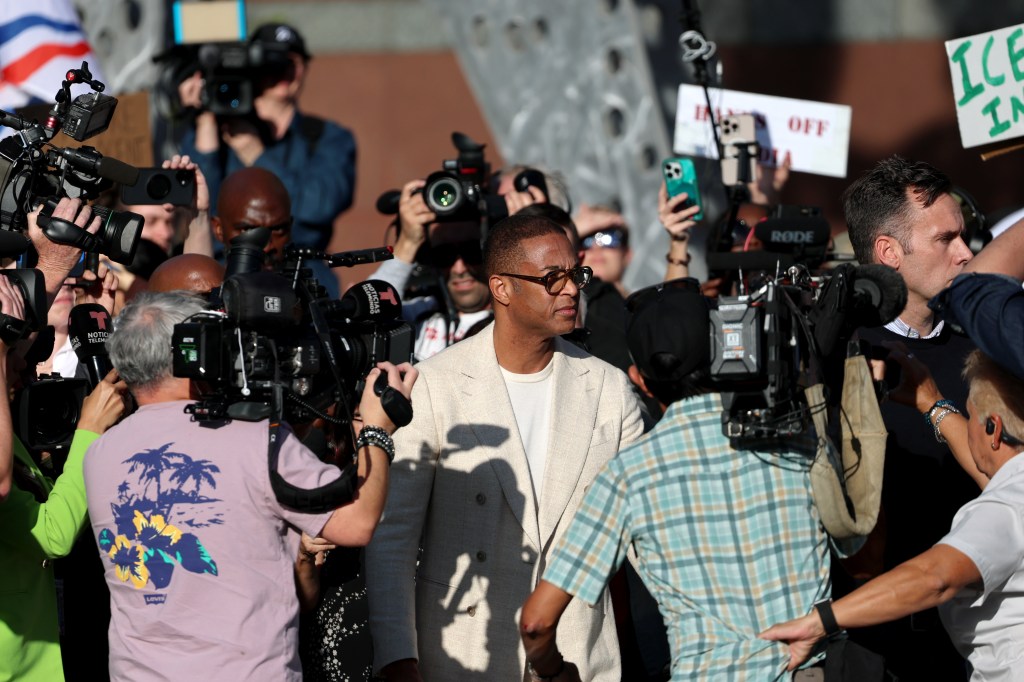
It is worth noting that many of the same nice liberals who are complaining about Don Lemon’s arrest were quite happy to see anti-abortion activists convicted of felonies for making secret recordings of Planned Parenthood officials that embarrassed the abortion industry. They, too, were engaged in First Amendment activity and considered themselves journalists making secret recordings in the tradition of 60 Minutes. I do not say that they were good journalists or good documentarians—claims to which I would take some exception—only that the First Amendment that protects their right to publish and to speak does not necessarily override laws against making surreptitious recordings.
In fact, one of the laws under which Lemon is being prosecuted was specifically enacted to make it easier to prosecute abortion protesters, creating a federal course of action against individuals and groups whose First Amendment activities go over the line and run up against what would otherwise be local trespassing cases at most. I do not think that this is a good law, for the same reason I do not think “shield laws” protecting journalists from being prosecuted for certain crimes are good laws: I believe in the American principle of equality before the law and therefore think it both wrong and unwise to create special protected classes of people and institutions. A country with a properly functioning criminal justice system would not need special laws that make murder or assault an extra-special, super-duper crime when the victim is a policeman—the laws that protect civilians must be good enough for the lawmen charged with protecting civilians, or else we are laying (as we have) the foundations for a caste system. Special protections for journalists—meaning, inevitably, government-recognized journalists—would be a step in the same direction.
The FACE Act—that is, the Freedom of Access to Clinic Entrances Act, another imbecilic congressional acronym—was celebrated by many of our progressive friends when it was being used by the Justice Department during the Biden administration to discourage abortion protests that were in the main a good deal less rambunctious than what we have seen in Minneapolis and elsewhere of late, just as many progressives cheered actions to censor anti-abortion speech in the form of graphic depictions of what the procedure actually does.
It is obvious that the FACE Act was meant to discourage anti-abortion protest per se, and not only trespassing or physical interference. Some linked the FACE Act to ordinary political speech, such as those embarrassing Planned Parenthood videos. Then-Sen. Dianne Feinstein, for example, expressly linked “aggressive tactics” such as “illegal filming” to the kind of thing the FACE Act was meant to prohibit and discourage. Feinstein also justified prosecuting the documentarians on the grounds that they had “longstanding ties to the anti-choice movement, including Operation Rescue, which is closely associated with clinic violence.” She argued that such speech, if unpoliced, would result in “the message being sent is that it is okay to commit crimes against Planned Parenthood, its employees, and its patients,” which is, of course, exactly what some of Donald Trump’s apologists say about anti-ICE protests: that the political speech should be suppressed because it could be understood as justifying violence or other criminal acts.
Lemon is also charged under a federal statute prohibiting “conspiracy against rights,” a post-Civil War measure that was targeted at the Ku Klux Klan and its terrorist campaign against the political and economic rights of African Americans. The statute is very broad, and prosecutors may be able to make a case that Lemon violated the letter of the law—but it is probably not a very good law. One of the sillier things I covered as a journalist was Lincoln University’s lawsuit against the neighbors of the Barnes Foundation in Lower Merion, Pennsylvania, under the “Klan Act,” the civil-recourse version of the statute here in question. The episode involved residents of an upscale, liberal, largely Jewish neighborhood who complained that the art institution (which Lincoln controlled) was creating parking and traffic problems for the residential community in which it was located. These anti-Klan laws may have made sense in the 19th century, but it is probably time to revise or repeal them.
And therein lies a lesson: Every time someone argues for creating some broad new power for the government—regulatory, criminal, defense-related, whatever—I want to tell them: Remember that the other side is going to win elections from time to time. The FACE Act seemed great when its advocates expected that Bill Clinton was going to represent the rightwardmost bound of presidential action. Democrats should always keep in mind that the American people are more than capable of putting such a man as Donald Trump in the White House, just as Republicans should keep in mind that the American people are more than capable of entrusting power to the likes of Barack Obama, Joe Biden, or Zohran Mamdani. Every time there is a change of administration, you are handing the other party a toolbox—you might want to think about whether you want to put a loaded gun in there.
Lemon will complain that the Trump administration is being vindictive because he is a critic, and, of course, he will be correct about that—after all, it was Trump himself who declared to his partisans: “I am your retribution.” Lemon will complain that the case against him is political (it is), extraordinary (it is), an example of selective prosecution (it is), a matter of bias (it is), etc.—but none of that means that he did not break the law. It is not a very good law. But, then, many of our drug laws are not very good laws, our immigration laws are not very good overall, our business regulations are, in many cases, positively terrible laws, etc.—and yet we expect, for good reason, that the laws will be enforced. Good citizenship demands that we forgo treating Lemon with the same gentle consideration that he and his comrades have extended to abortion protesters, that we give him the same First Amendment considerations that he would give to anti-abortion documentarians or right-wing provocateurs making secret videos or to a figure such as James O’Keefe or to a media entrepreneur more closely resembling Don Lemon, such as Tucker Carlson—it is always gratifying to beat an opponent with his own stick and hoist with his own petard, but the times we are in ask more of us.
If we want orderly government, the way to achieve it is not to forgo law enforcement when enforcing the law is inconvenient—the way there is to rid ourselves of agents of chaos, from minor irritants in the private sector, such as Don Lemon, to major malefactors in the public sector, such as the men and women prosecuting Don Lemon. We need better laws, and we also need better people to enforce them.
And Furthermore
History is very short, if you think about it: For example, it took only 127 days for the Trump administration to go from extrajudicial killings of non-U.S. citizens in the Caribbean to extrajudicial killings of U.S. citizens in Minneapolis. Some slopes really are very slippery.
Don’t you dare compare him to Hitler, the president’s apologists say. Trump’s wife (one of his wives) did claim that he kept a book of Adolf Hitler’s speeches at his bedside for inspirational reading, but—no, not Hitler. There are many ways to be awful short of being Adolf Hitler—and Hitler would have succeeded in taking Greenland. Don’t you dare call him a fascist, they say. Fair enough—fascism is infamously hard to define, but it is a school of political thought with some organization to it, whereas Trump’s political thought is not thought at all, nor is it organized—it is what Lionel Trilling once called conservatism: a series of “irritable mental gestures which seek to resemble ideas.” I have a similar thought when people accuse Trump of being a racist: He is a dumb bigot, to be sure, but racism implies a perverted sense of loyalty, in this case to a race, and loyalty to anything is entirely alien to Trump’s character. Unless you count his sense of humor, Trump is a man without virtues.
Fascism is a rotten way of looking at the world, but it implies some intellectual discipline. If, on the other hand, you have ever heard Billy Bob Thornton talk about his dyslexia, then you will have an idea of what it must be like to be Donald Trump listening to a policy briefing and wondering when it is his turn to talk. Thus spake Billy Bob:
I’m as dumb as a bag of hair, [and] I grew up with severe anxiety disorder, which I still have. And I have severe obsessive-compulsive disorder. And I also was severely dyslexic. But for some reason, I’ve always been able to memorize things instantly. It’s like I’m dumb as hell on every other aspect of life. But I can see things—it’s almost like a savant thing. I can look at a monologue … and I see two or three chunks. I don’t read left to right slowly like most people do. I look at something and I go, “Oh, okay. It says that.” It’s almost like some kind of weird science fiction movie where it goes into my head. … I’ll tell you where I do have a problem is if there’s a scene that’s nine pages long and there’s seven or eight people in it, and I’ve got one line every other page. I sit there and start thinking about other shit. God, you can’t help it with my mental issues. But it’s really harder for me when I don’t have as much dialogue.
Fascist? Not in the classical sense, though his economic ideas are fascism-adjacent and his love of thuggery is fascist-aligned.
But there are many interesting lines on Donald Trump’s résumé: pampered and self-aggrandizing real-estate heir, spectacular failure in the casino business, spectacular failure in the hotel business, sycophant of Arab princelings, sycophant of Russian oligarchs, enemy of the First Amendment, man accused of rape by his wife (by one of his wives, she later recanted the claim), man found legally liable in a court of law for sexual abuse, man who has a whole Wikipedia page dedicated to sexual abuse allegations about him, social-media addict, enemy of the Second Amendment, game-show host, deadbeat, Putin suck-up, Xi suck-up, convicted felon, tie-taper, make-up enthusiast, Broadway showtune enthusiast with an especial regard for the big show-stopper from Cats, enemy of the Fourth Amendment, bit player in pornographic films, golf cheat, heretic, grandson of a German whoremonger and Yukon horse-meat vendor, pal of Jeffrey Epstein, fraudster, swindler, Enemy of the Fourteenth Amendment, serial bankrupt, serial adulterer, serial divorcee, serial liar, desultory coup d’état leader, draft-dodging coward, precisely the kind of creep who probably shouldn’t own a beauty pageant business, Hillary Clinton donor, Kamala Harris donor.
It is a little weird to think about what a man on the edge of 80 might be when he grows up, but if Trump ever grows up, a fascist is what he will grow up to be. That said, I agree it is unfair to call him a fascist today for the same reason it would be unfair to ask my dachshund to write a commentary on Aristotle.
Economics for English Majors
I wrote last week about the folly of capping credit-card interest rates. Interest rates are a price, and when you artificially lower prices, what you get isn’t low prices—it is rationing.
Donald Trump, who once crowned himself the “king of debt,” wants credit card interest rates capped at 10 percent. He has urged the industry to adopt that cap voluntarily—which is not going to happen—but also has suggested to Congress that it should impose such a cap through law. The effect of doing this would not be to save Americans money on interest payments. The effect would be to deprive many Americans of access to ordinary consumer credit, beginning with those who have lower incomes and lower credit scores.
Trump, of all people, is well positioned to understand how this works in the real world. During his time as an incompetent real estate developer, Trump made almost as many appearances in bankruptcy proceedings as he did on Page Six. Trump is a known deadbeat and a bad credit risk. When you are a bad credit risk, you pay higher interest rates and get credit on generally worse terms. And then, at some point, you simply cannot get credit at all, at least through ordinary channels. Toward the end of his run in real estate, Trump found it practically impossible to get loans from any of the major lenders with which he had been associated—often to those banks’ regret—over the years. Trump is, at the moment, legally prohibited from taking out commercial loans from banks in the state of New York after having been found by a court to have engaged in financial fraud.
But most borrowers are not as outlandish in their behavior—or as wealthy—as Donald Trump. Ordinary borrowers see their credit ratings dinged from time to time over things like unpaid bills or late payments, too much debt relative to their incomes or savings—all the familiar stuff. Interest rates charged to consumers take into account credit risk—the banks’ chances of not getting paid back or of having to spend money and time recovering money owed—but also things such as opportunity cost (Why lend anybody money at 3 percent when you could just park those assets in an index fund and expect to make more money?) and, of course, the ultimate arbiter of interest rates: the market. People with poor credit scores or low incomes pay higher interest rates in part for reasons having to do with risk but also because there is a lot more competition to lend money to multimillionaires with 840 credit scores. The old bankers’ proverb holds true: You don’t want to lend money to people who need it—it is far better to lend to people who don’t need the money.
Not every problem is an economic problem with an economic solution. When we have division, convulsing debates over wars or abortion or education, “Let markets work!” is not usually the answer to the questions at hand, even though many of those concerns have economic concerns wrapped up in them. (If you think education is only about ensuring that businesses have workers and that young Americans can get good jobs, then you have a crude idea of what education is and is for.) But sometimes, “Let markets work!” is exactly the right answer. When Americans are unhappy about the price of something—gasoline, houses, college tuition—it is never the case that the problem is the price per se: The problem is always something else that the price is trying to tell us about.
Words About Words
Headline: “A Traitor’s Worst Enemy Is Themself.” That and grammar, apparently. Themselves would be ungrammatical, but what the heck is a themself? As often is the case, the homepage headline and the article headline are slightly different. It may be that the homepage copy is generated by a particularly illiterate AI. But, then, artificial intelligence is no match for organic stupidity.
A rhetorical tic exemplified in Slate: “It’s Time to Face the Big Question About Trump That No One Wants to Ask.” The question is whether Trump is “losing it”—i.e., the big question pretty much literally everyone wants to ask. Pretending that “no one wants to ask” a question or that “no one wants to talk about” an issue is a way for a writer, or his headline writer, to give him an unearned glow of courage or to add a synthetic flavor of originality to bland commentary. It is similar to the politician who boasts of his courage in “standing up to” this or that supposedly powerful group that everybody in his coalition detests and despises, making “standing up to” that group profitable and popular rather than an act of courage.
From Uncrate, a shopping site, a blown chance to use tetradecagon in writing about a new Zenith watch: “Its octagonal stainless steel case measures 37mm and is topped by a 14-sided bezel.” I mean, that opportunity doesn’t come up all that much. (If you read the entry, you’ll also see that they wrote “allied” when they meant “applied.”) Nifty-looking watch, with a tetradecagonal bezel, bezel from the French biseau and the Old French besel, meaning a sloped edge or chamfer, related to bevel. And do you know who knows the proper names for a great many of the polyhedra? Dungeons & Dragons dorks, that’s who.
From the New York Times: “On social media, Mr. Macron’s sunglasses were seen as a political statement, projecting a tough image in the face of Mr. Trump’s threats to impose tariffs on French wine and champagne and to annex Greenland.” Champagne is wine. Writing “wine and champagne” is like writing “cheese and cheddar.”
You all can, I think, imagine what my poor wife has to put up with. When the waiter, insipidly trying to cultivate a little cheap familiarity, asks: “Have we decided?” I have to stop myself (and don’t always succeed) from asking: “Are we f—ing plural?”
Speaking of “you all,” that Texan contraction is “y’all,” not “ya’ll.” And, of course, the super-plural form is “all y’all.”
Elsewhere
You can buy my most recent book, Big White Ghetto, here.
You can buy my other books here.
You can check out “How the World Works,” a series of interviews on work I’m doing for the Competitive Enterprise Institute, here.
You can watch me and the gang on The Dispatch Podcast here or listen on your podcast player of choice.
In Closing
Donald Trump wants you to believe that Alex Pretti was an “insurrectionist” and an “agitator,” agitator being the dumb man’s word for “protester of whom I do not approve.” Never mind the irony—though “irony” seems too mild a word—of Donald Trump complaining about insurrectionists after giving a blanket pardon to the most significant group of insurrectionists in recent American history.
Let’s pretend we’re stupid and take Trump at his word: Even if Pretti was an insurrectionist, do you know what we do with insurrectionists? We do not shoot them while they are unarmed and presenting no serious immediate danger to anybody. We arrest them, charge them under the relevant law, and put them on trial. I do not think that Donald Trump, of all Americans, should want to legitimize the precedent of just shooting insurrectionists.
Pretti seems to have been a big ol’ rage-monkey, which is no surprise: If you have ever been to protests of the kind we’re seeing in Minneapolis, then you may have noticed that they neither attract the happiest and most well-adjusted sort of people, nor do they bring out the best in the people they attract. (Do you know who else should know that? Donald Trump and every boot-licking sycophant in his orbit and employ.) I do not know whether Pretti was a bad man. It does not matter. Murdering a bad man is still murder, whatever the moral illiterates on your favorite social-media app have to say about it. Murdering a good man is not extra-special, super-duper murder—it is just murder. As a wise man once said, “Murders stay murder.”
Donald Trump once got nicked by a bullet—and he did not seem to enjoy the experience. We do not shoot people for being shmucks, a fact for which Donald Trump should be profoundly grateful.