One of Trump’s first executive orders after returning to the White House last year directs the federal government to deny U.S. citizenship to children born in the country if neither parent was a citizen or lawful permanent resident at the time of birth. The order applied to children of undocumented immigrants as well as those of parents on temporary visas—student visas, work visas, tourist visas—affecting more than 250,000 births per year. “We are the only Country in the World STUPID enough to allow ‘Birthright’ Citizenship!’” he wrote on Truth Social yesterday.
(According to the World Population Review, 33 countries have unrestricted birthright citizenship, including Mexico and Canada, with a further 32 having a limited version.)
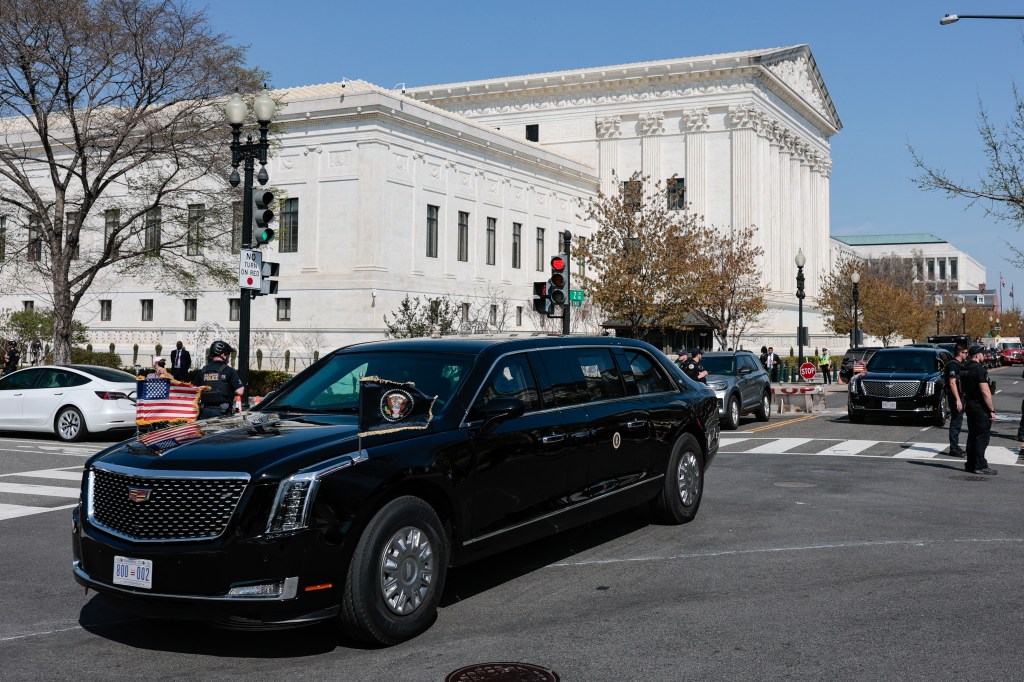
The order has not taken effect, having been blocked by numerous federal courts, but the White House has persisted in its legal efforts, bringing a case all the way to the high court. It’s one of the highest-profile, most widely discussed cases to reach the court this year, rivaling Learning Resources, Inc. v. Trump (the tariffs case in which the court ruled 6-3 against the president). On Wednesday, Trump listened as Solicitor General D. John Sauer represented his administration before the court. He left shortly after ACLU national legal director Cecillia Wang, who represented the challengers to Trump’s executive order, began answering questions from the justices.
Sauer argued that the Trump administration is not seeking to redefine or ignore the 14th Amendment, nor overturn the 1898 decision in United States v. Wong Kim Ark, which set legal precedent for birthright citizenship and that Sauer said the White House generally agreed with.
Rather, Sauer argued that the existing understanding of birthright citizenship reads too much into the Constitution and that the government was seeking to return to the text’s original intended meaning. In his argument, the 14th Amendment’s Citizenship Clause—particularly its language “subject to the jurisdiction thereof”—should apply only to people lawfully present in the country who intend to remain there, not children of illegal immigrants or temporary visitors to the U.S.
“The Citizenship Clause was adopted just after the Civil War to grant citizenship to the newly freed slaves and their children, whose allegiance to the United States had been established by generations of domicile here,” Sauer told the court in his opening argument.
Sauer’s argument was in some way a rejection of the traditional bases for citizenship—jus soli or citizenship by soil, and jus sanguinis or citizenship by parentage. He maintained that the common thread among the recognized exceptions to birthright citizenship as currently understood—ambassadors, members of Indian tribes, hostile invaders—was a lack of complete political allegiance to the United States. “Jurisdiction means allegiance,” Sauer told the justices, and argued that someone’s allegiance to a country is determined by whether they have established a permanent home there, rather than simply being physically present.
But some experts warn that such a framework makes distinctions that are far too broad. “There’s no logical basis for that distinction,” he said, “and it would leave open the possibility that a future president could broaden it out further.”
Justice Samuel Alito raised the “humanitarian problem” of people whose citizenship would be rendered invalid by such a view of the 14th Amendment. Sauer responded that Trump’s executive order would not revoke anyone’s citizenship, so long as they were born before February 2025 (30 days after the order was issued). “This executive order applies only prospectively,” Sauer said. “And we ask the court to rule only prospectively.”
César Cuauhtémoc García Hernández, a professor of immigration law at Ohio State University and SCOTUSblog columnist, said that isn’t how this works. “If we’re going to be honest about how to apply this interpretation to the 14th Amendment … we have to apply it going back to the very moment when the Citizenship Clause was added to the U.S. Constitution,” investigating the status of everyone who has obtained birthright citizenship since, he said.
Sauer also drew on an amicus brief filed by Ilan Wurman, a law professor at the University of Minnesota who specializes in the 14th Amendment, examining how English common law understood birthright citizenship. “In the English common law, the prevailing view was that temporary visitors were under the protection of the King” and that their “children were natural born subjects,” Wurman told TMD.
But “our states incorporated the common law as far as was convenient for our circumstances,” Wurman maintained, and birthright citizenship didn’t necessarily fit their needs. “One obvious difference in the American circumstance is that we had rebelled against the king, and so this idea of perpetual birthright allegiance to the sovereign was rejected, necessarily so.”
Wang made a simpler case before the court on Wednesday: Trump’s order is unlawful on both constitutional and statutory grounds. “Ask any American what our citizenship rule is, and they’ll tell you, everyone born here is a citizen alike,” Wang told the court. That rule, she argued, was enshrined in the 14th Amendment, affirmed in the Wong Kim Ark ruling, and codified through the Nationality Act of 1940.
“The statutory language [of that bill] just replicates what’s in the constitutional text,” Yale law professor and Dispatch Contributing Writer Keith Whittington told TMD. “And so, it’s at least the case that the intention of that Congress was to embody a broad birthright citizenship rule.”
Under questioning from Justice Brett Kavanaugh, Wang said her side had “two paths” to victory: either by winning the constitutional argument or the statutory one. The latter would allow the court to strike down the order without reaching the bigger constitutional question by simply noting that the executive order violated the Nationality Act.
And a majority of justices seemed to find Wang’s arguments persuasive.
Wang called Sauer’s stated agreement with Wong Kim Ark a “fatal concession,” because the ruling held that a child born in the country is a U.S. citizen. Sauer had argued the decision only protected children of permanently settled immigrants, pointing to the opinion’s repeated references to the parents’ domicile. But several justices suggested those references were contextual rather than a legal requirement—and Bethany Berger, a professor of law at the University of Iowa, told TMD that the decision’s actual rule makes parents’ residence or intentions irrelevant to the citizenship question.
Part of Sauer’s problem was that history doesn’t necessarily support his case, even though his argument rests on it.
“When the 14th Amendment was ratified in 1868, the concept of illegal immigration or temporary visitors—that really, it didn’t exist,” Ilya Shapiro, director of constitutional studies at the Manhattan Institute, told TMD.
Justice Neil Gorsuch made a similar point during oral arguments, noting that the U.S. didn’t have restrictive immigration laws until around 1880—so anyone who showed up and established a domicile in 1868 was “perfectly fine without respect to anything, any immigration laws.”
Berger told TMD that the history doesn’t provide a different definition of the core language, either. “We’ve looked at the dictionary definitions of jurisdiction from the 1860s, and they’re essentially the same as what you would expect them to be today,” she said. “If you are an originalist and focusing on the text,” then “jurisdiction means jurisdiction, and nobody is arguing that the children of immigrants here illegally are not subject to U.S. jurisdiction.”
The laws have changed to adapt to the evolving nature of migration and mobility over the past 158 years, but the justices didn’t seem to be persuaded by Sauer’s examples. Chief Justice John Roberts pressed him on “birth tourism,” asking how common it actually was. Sauer conceded that nobody knows for sure, and Roberts pushed further. As Amy Howe writes in SCOTUSblog:
Roberts then asked Sauer whether he agreed that, in any event, any problems that birth tourism might pose would have “no impact on the legal analysis before us.” Birth tourism, Roberts suggested, certainly wasn’t a problem when the 14th Amendment was ratified in the 19th century.
Sauer countered that we are living in a “new world.” But that prompted Roberts to respond that, although we may have a “new world,” we have “the same Constitution.”
“I think it went as expected and that you’re going to see an opinion invalidating the executive order. The only question really is, how broad will it be?” Gerard Magliocca, a 14th Amendment scholar at Indiana University, told TMD.
Even so, the case reaching the Supreme Court, argued by the White House, represents a victory for what was once a fringe legal argument. John Eastman—the legal architect of Trump’s dubious, unsuccessful effort to overturn the 2020 election results—told TMD that the Declaration of Independence “repudiated birthright citizenship at the very moment of our founding,” and that anything since has drifted from its purpose.
He said this “didn’t require the right case. It required the right person to press the issue.”
It’s up to the Supreme Court to decide whether that person’s arguments are legally sound.