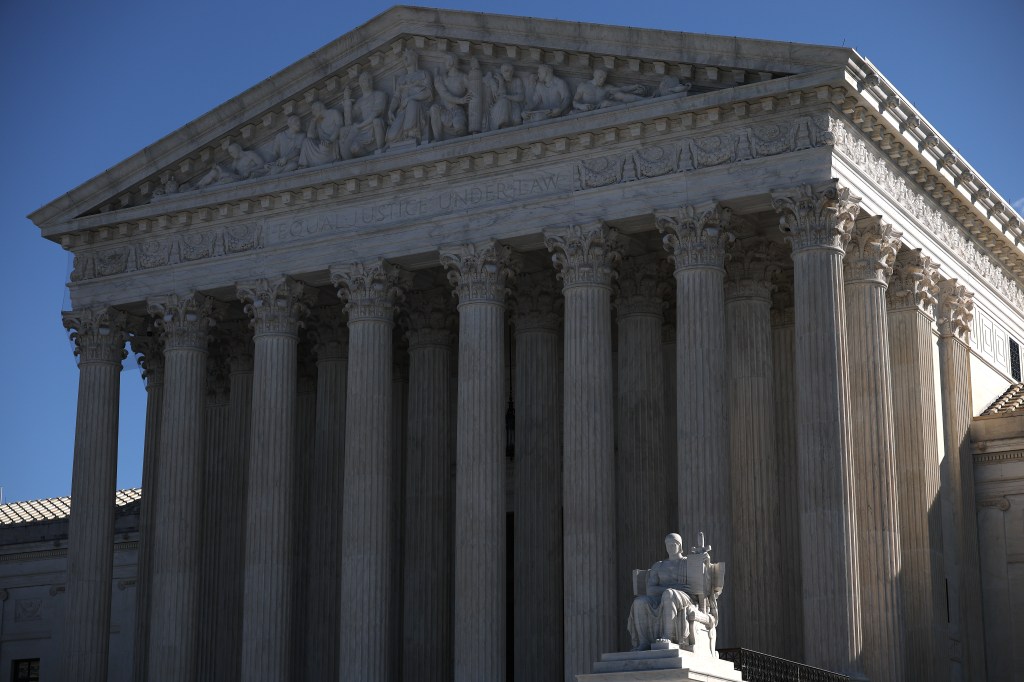
Start with the court.
First, there’s the court itself. From a purely legal perspective, the IEEPA litigation was about as open and shut as a Supreme Court case can get: Congress has sole authority over taxes, including tariffs; IEEPA’s text never mentions the word “tariff”; no U.S. statute uses the word “regulate,” which is in IEEPA, to include tariffs; and IEEPA had never been used to apply tariffs. The law isn’t in the part of the U.S. Code that contains all the actual tariff laws that remain available to the president—laws that cover a range of scenarios and would effectively be pointless if Trump had some sort of IEEPA tariff superpower that let him do all that stuff and more during peacetime and without those laws’ pesky substantive and procedural limitations. IEEPA’s legislative history is clear that the law was supposed to trim executive power, not expand it in the ways that Trump’s tariffs (and legal interpretation) would. And it’s perfectly reasonable that this “emergency” law permits a total ban on trade or import/export licenses (and related administrative fees) but doesn’t permit taxes, which are less draconian, more hidden, paid mainly by Americans, constitutionally prohibited for exports, and—again—the sole purview of Congress
The statutory basics are so simple and clear that one can avoid thornier issues about the “major questions” or “nondelegation” doctrines—which is what the court’s six-vote majority did. (Things got more complicated in the concurrences, but we can leave that for another time.) They also explain why betting markets and expert opinion expected a victory for plaintiffs—especially after oral arguments showed the justices harping on various statutory weaknesses in the government’s arguments.
Yet the case wasn’t a slam dunk, and politics was arguably the biggest reason why (the president’s foreign policy powers being the other). Supreme Court litigation isn’t conducted in a magical legal vacuum, and many outside observers—me included—predicted that the plaintiffs would prevail but routinely hedged by noting that partisanship and politics might trump the clear statutory basics. If so, we might see a messy “split-the-baby” ruling that preserved some type of IEEPA tariff power or, even worse, let the whole thing stand as-is. This latter outcome wasn’t my base case, but—given the court’s partisan makeup, the president’s love of these tariffs, and his vocal pressure campaign to save them—it couldn’t be ruled out. Others, it should be noted, took a much dimmer view, believing that politics would triumph outright, and that the ruling would cement the court’s official position as Trump’s rubber stamp.
Fortunately, that didn’t happen. Instead, the Supreme Court, including three Republican appointees (and two Trump appointees), ruled decisively against the president on a pillar of his economic and foreign policy agenda and one that he personally loved. The opinion and concurrences were solid and thoughtful and issued despite the obvious political and economic risks that an adverse ruling raised (potential Trump/MAGA wrath, extracting $170 billion from federal coffers, etc.). And the ruling could portend future court skepticism of other “emergency” presidential actions—including ones that the left wants and the right doesn’t.
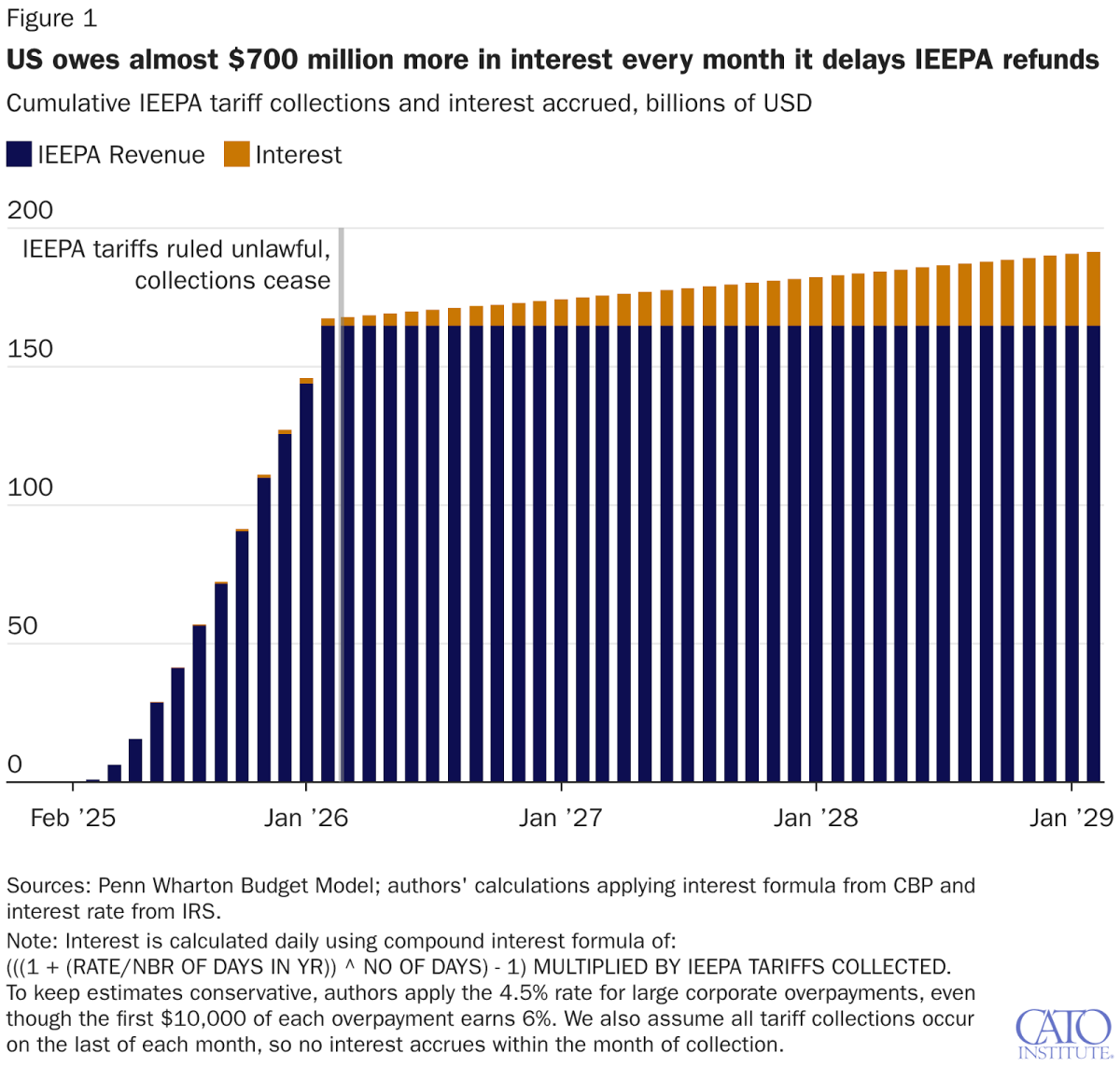
To be sure, the outcome here wasn’t perfect. Three “conservative” justices still dissented, and those dissents were weak and disturbing. The liberal justices, meanwhile, are still hesitant to embrace more forceful court skepticism of executive overreach and the delegation of congressional powers (likely because they prefer an empowered, activist bureaucracy). We also still have to deal with tariff refunds, which the court didn’t touch (see the charts/links below for more). And the court could have moved more quickly, including by simply declining to take the case and thus cementing the lower court rulings against the tariffs.
Overall, however, the court’s clean, simple, and decisive ruling is very good news for U.S. law and policy—and for future cases that might raise similar issues. Folks on the left and right who were openly convinced that the Supreme Court would bow to politics owe the justices an apology. I’m sure it’ll be coming any day now.
David beats Goliath.
The ruling is also a victory for our legal system more broadly—one in which a handful of tiny companies can take on the most powerful government in the world (and its center-of-the-universe leader) and win. One of the biggest surprises of the last year was the lack of an immediate challenge to the IEEPA tariffs from the largest U.S. companies—Amazon, Apple, Ford, etc.—or the trade associations that represent them. The tariffs were, as noted already, legally vulnerable and imposed high costs on big firms that could easily afford to challenge them in court. Indeed, rumors had swirled for months that several major law firms had already drafted challenges to hypothetical IEEPA tariffs months before Trump actually pulled the trigger. When he did, however, no major U.S. companies filed a case, choosing instead to keep their heads down, lobby for exemptions, rejigger inventories and supply chains to lower tariff costs, and use their market power to pass on the rest to their customers.
In retrospect, Big Business’ silence and inaction shouldn’t have been surprising, and the strategy may have made good business sense. Yet it raised the troubling prospect of blanket presidential tariffs (and a historically large tax hike) never being challenged in court—an outcome, we now know, that would have been wildly unjust. Fortunately, a handful of small businesses—firms that, unlike the big boys, were facing financial ruin from these new taxes—saved the day. And the roster of plaintiffs reads like a Hollywood script:
- The plaintiffs in the Learning Resources case are family-owned educational toy companies that manufactured their products in China and other Asian countries. The main company, Learning Resources, has around 460 employees, and its sister company, hand2mind, has roughly 100. Both firms make hands-on learning tools for kids that can’t be made here at a price their customers (mainly schools) can afford. And, because of IEEPA, they saw their tariff bill skyrocket from around $2.3 million in 2024 to $14 million last year. If the highest China/IEEPA tariffs had remained in place at more than 130 percent, these firms would have faced more than $100 million in tariff exposure—a sum their CEO called an extinction-level event (and that motivated their lawsuit).
The five plaintiffs in the VOS. Selections case were a delightful cross-section of American small business:
- VOS Selections is a New York City-based wine and spirits importer with a staff of 20. When the company filed its lawsuit, it had already absorbed $20,000 in tariff costs that it couldn’t immediately pass on because New York State Liquor Authority rules require prices to be posted a month in advance (bah!).
- Genova Pipe/Plastic Services and Products is a Salt Lake City manufacturer of ABS and CPVC pipes and fittings with seven U.S. factories and hundreds of employees. According to various court filings, Trump’s IEEPA tariffs added $274,000 in raw material costs for May and June orders alone—with no domestic alternatives for the specialized resin it needs.
- MicroKits is a Charlottesville, Virginia, maker of educational electronic instruments with just two people on staff—the company’s founder and a part-time employee. When China tariffs exceeded 100 percent, the owner slowed his business to a crawl and estimated he’d have about seven weeks of inventory before being forced to cease production altogether.
- FishUSA is a Pennsylvania fishing tackle retailer and manufacturer with 37 employees. Tariff costs caused the company to delay shipments, pause production, and cease expansion indefinitely.
- Terry Precision Cycling is a Burlington, Vermont, women’s cycling apparel brand with 16 employees. The firm sources materials from France, Guatemala, Italy, and China, and then manufactures the clothing in the United States. IEEPA levies pushed its projected 2025 tariff bill from $25,000 to more than $200,000, placing the company’s survival in doubt.
So much for foreigners paying the tariffs, eh?
The companies’ legal representation is also notable. The Learning Resources team had private counsel, shelling out big bucks to stave off government-induced bankruptcy. But the other companies were represented by the nonprofit public interest litigation firm Liberty Justice Center, which took on the case pro bono and is funded entirely by public donations (none from the government). The companies also got intellectual support—blog posts, articles, videos, and dozens of amicus briefs—from a wide range of companies, lawyers, academics, and practitioners. And they withstood a barrage of ridiculous public attacks by the president himself, who even once called them “enemies of the country.” Sigh.
That these American businesses could challenge Trump’s tariffs in court—taking all the risks that such action necessarily entails—and ultimately win is a classic David-vs.-Goliath tale and a real testament to our legal system. They had a good case and a good team of lawyers, and—with their livelihoods on the line—little to lose. They risked it all and won, and no amount of government power, taxpayer dollars, or presidential name-calling could change that. It’s an outcome to feel good about, and one that should encourage more “little guys” to challenge government overreach in the future, whether by this administration or any other.
Summing it all up.
The Supreme Court decision invalidating the IEEPA tariffs is surely good for U.S. trade policy, the U.S. economy, and the rule of law. But best of all might just be what it says about our legal system and government. The system isn’t perfect, and reforms are surely still needed. But when a handful of tiny businesses can trounce the president of the United States on his home court, resulting in one of the most important curtailments of executive power presidential in decades, things are still pretty, pretty good.
That the government has thus far accepted the court’s ruling—albeit reluctantly and not without at least one presidential tantrum—is another bit of good news. We couldn’t fully rule out that Trump might simply ignore the decision, setting off a full-blown constitutional crisis along the way. Instead, Customs and Border Protection officially and quietly terminated the IEEPA tariffs last Monday—the first business day after the court issued its ruling. Yes, Trump complained a lot, immediately imposed other costly tariffs, and seems to be slow-walking refunds. But IEEPA tariffs are no more, and we can appreciate the administration’s cooperation in making that happen.
There are, of course, still reasons for concern—on U.S. trade policy, emergency powers, and this administration’s repeated abuse of the law. But the IEEPA tariff case can—at least momentarily—dispel the popular view of America irreversibly becoming an authoritarian banana republic. A pessimist would say that these are victories we should have never needed. But they’re victories nonetheless. And for today, at least, we should celebrate.








!["And May All Your Christmases Be [Woke]": Liberal Pundits Come For Santa And Other Holiday Traditions](https://www.rightnewsdigest.com/wp-content/uploads/2025/12/1766668243_And-May-All-Your-Christmases-Be-Woke-Liberal-Pundits-Come-350x250.jpg)